Last updated: July 2026
Reading research papers isn’t difficult because the science is complicated.
It’s difficult because most researchers read every paper the same way.
When I first started working in a research lab, I made the same mistake. I started at the introduction, read every section in order, and spent nearly an hour on papers that turned out to be irrelevant.
Experienced researchers rarely work that way.
Instead of asking, “How can I read faster?”, they ask a much more useful question:
Is this paper worth reading at all?
That single question can save hours every week while helping you understand the literature more effectively.
In this guide, you’ll learn a practical workflow used by many experienced researchers to decide what deserves a deep read—and what doesn’t.
Before You Read: Decide Why You’re Reading the Paper
The fastest way to waste time is to read every paper with the same level of attention.
Before opening a paper, decide why you’re reading it.
Your purpose determines how deeply you should read and which sections deserve your attention.
| Your goal | How deeply should you read? |
|---|---|
| Decide whether the paper is relevant | Title + Abstract |
| Understand the main finding | Abstract + Figures |
| Evaluate the experimental evidence | Figures + Results + Methods |
| Learn a new technique | Methods |
| Prepare for a journal club or presentation | Full paper |
Notice that none of these goals require exactly the same reading strategy.
If you’re screening dozens of papers for a literature review, spending 30 minutes on every paper is inefficient.
If you’re planning to reproduce an experiment, however, carefully reading the Methods section becomes essential.
The mistake many beginners make is assuming there is a single “correct” way to read a scientific paper.
Experienced researchers know that the right reading strategy depends on the question they’re trying to answer.
A Faster Workflow for Reading Research Papers
Most productivity advice focuses on reading faster.
Researchers benefit more from reading in a better order.
The workflow below prioritizes the information that helps you decide whether a paper deserves deeper attention.
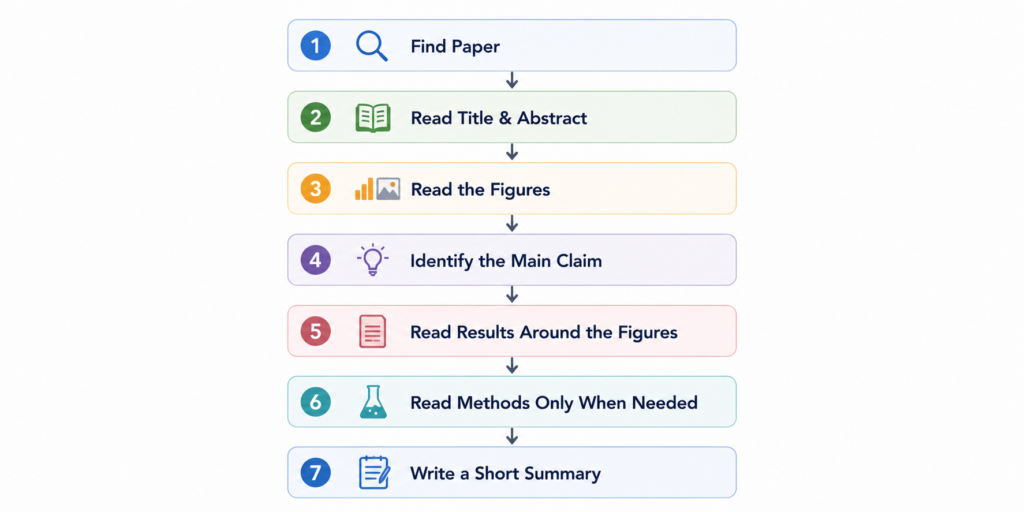
Instead of reading every section in order, this workflow prioritizes the information that helps you decide whether the paper deserves a deeper read.
Instead, it follows the same questions experienced researchers naturally ask:
- Is this paper relevant?
- What is the main claim?
- Which figures support that claim?
- Do the data actually support the authors’ conclusion?
- Is this paper worth reading in greater depth?
By answering these questions first, you avoid spending valuable time on papers that are ultimately irrelevant to your research.
The following sections explain each step of this workflow in more detail and show how to decide where your attention is most valuable.
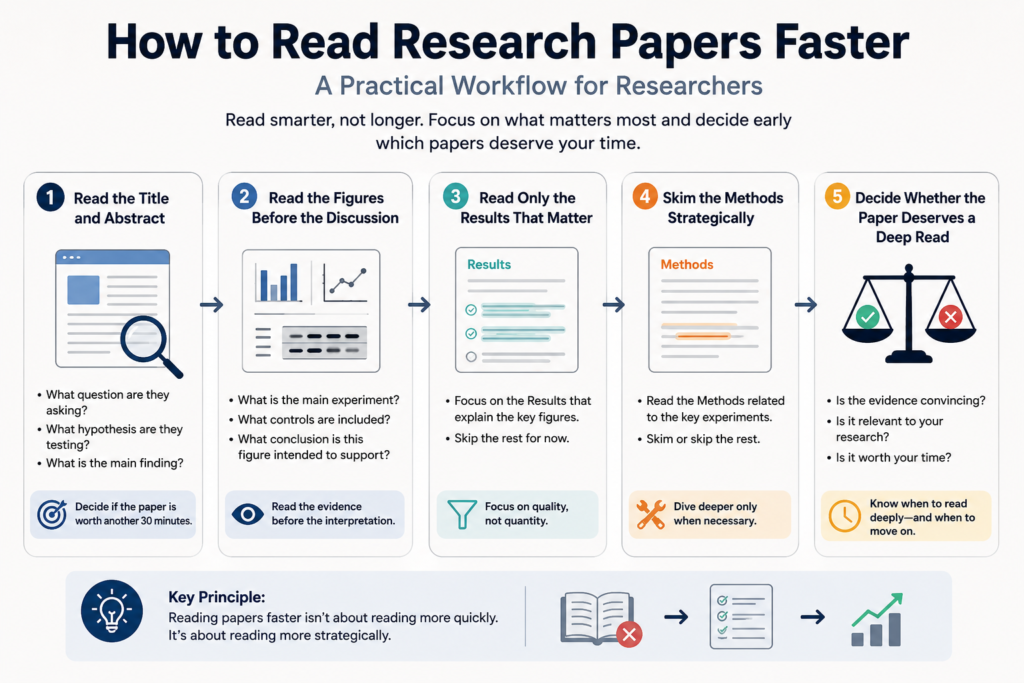
Step 1 — Read the Title and Abstract
Before reading anything else, decide whether the paper deserves your attention.
The title and abstract should answer three basic questions:
- What research question are the authors asking?
- What hypothesis are they testing?
- What is the main finding?
At this stage, you’re not evaluating the quality of the paper. You’re deciding whether it is relevant enough to continue reading.
Ask yourself one simple question:
Is this paper worth another 30 minutes?
If the answer is no, move on.
One of the most valuable productivity habits researchers develop is recognizing when not to keep reading.
Step 2 — Read the Figures Before the Discussion
Many readers jump directly from the abstract to the discussion.
Experienced researchers often do the opposite.
They read the figures first.
The reason is simple:
Read the evidence before you read the interpretation.
Understanding the data before reading the discussion makes it much easier to judge whether the conclusions are actually supported.
A practical checklist
For each important figure, ask:
- Which figure provides the strongest evidence for the paper’s main claim?
- What experiment was performed?
- What controls are included?
- What conclusion is this figure intended to support?
If you can answer these questions, you’ve already understood much of the paper.
Don’t try to understand every panel immediately. Start by reading the figure title and legend, identify the main experiment, and then ask whether the data actually support the authors’ claim. If a figure doesn’t help answer the paper’s main question, it’s probably not where you should spend most of your time.
If you’re unfamiliar with certain experimental techniques, don’t worry about understanding every detail on your first pass. Focus on the overall message of the figure before diving into the methodology.
How to Read Western Blot Figures?
→ How to Interpret Scientific Figures
Step 3 — Read Only the Results That Matter
Once you’ve identified the key figures, read only the Results sections that explain them.
Many papers include experiments that are interesting but not essential to the paper’s central conclusion.
Rather than reading every paragraph in order, move directly between the figures and the corresponding Results section.
Step 4 — Read the Methods Selectively
Not every paper requires a detailed reading of every method.
Instead, match the depth of your reading to your purpose.
Read the Methods carefully if you are:
- Learning a new experimental technique
- Planning to reproduce the experiment
- Evaluating the quality of the experimental design
Otherwise, focus only on the methods directly related to the figures or experiments that are most relevant to your work.
Reading every procedural detail rarely improves understanding when your goal is simply to evaluate the paper’s main finding.
If you’re reading primarily to understand the paper’s conclusion, detailed protocol optimization can usually wait.
Want to use AI for difficult methods?
→ How to Read Research Papers with AI
Step 5 — Decide Whether the Paper Deserves a Deep Read
At this point, you should have enough information to make an informed decision.
Not every paper deserves a full, line-by-line reading.
A simple decision framework can save a significant amount of time.
If the paper answers your research question but uses methods you’re unfamiliar with, save it and come back later rather than forcing yourself to understand every detail in one sitting.
Here are three common situations you’ll encounter:
| If… | Then… |
|---|---|
| The topic is relevant and the evidence is convincing | Read the full paper. |
| The topic is interesting but the evidence is limited | Read selectively and focus on the key experiments. |
| The paper is not relevant to your research | Move on to the next paper. |
One of the biggest differences between beginners and experienced researchers is knowing when to stop reading.
Step 6 — Write a One-Minute Summary
Before closing the paper, spend one minute writing your own summary.
A short note is often far more valuable than dozens of highlighted sentences because it forces you to identify what actually mattered.
A simple template works well:
- Research question
- Main finding
- Strongest figure
- Biggest limitation
- Why I saved this paper
If your summary fits on one screen, you’ve probably captured the most important information without unnecessary detail.
A one-minute summary today can save you from rereading the entire paper six months later.
Need a better system for organizing papers?
→ How to Organize Research Papers
Common Mistakes When Reading Research Papers
Reading research papers efficiently is not about avoiding mistakes altogether—it’s about avoiding the mistakes that waste the most time.
Here are some of the most common ones.
Reading Every Paper from Beginning to End
Not every paper deserves a full read.
Screen the paper first. Only invest significant time if it is relevant and supported by convincing evidence.
Spending Too Much Time on the Introduction
Introductions provide useful context, but they rarely contain the paper’s most important information.
If your goal is to evaluate the study, prioritize the figures and results before returning to the introduction for additional background.
Reading the Discussion Before the Figures
The discussion explains what the authors think the results mean.
The figures show the evidence.
Read the evidence first, then decide whether you agree with the interpretation.
Ignoring the Experimental Controls
A strong conclusion is only as convincing as its controls.
Whenever you examine a figure, ask yourself:
What is the control, and does it support the authors’ conclusion?
Highlighting Everything
Highlighting can create the illusion of learning without improving understanding.
Instead of highlighting entire paragraphs, summarize the paper in your own words immediately after reading.
📋 Before You Spend 30 Minutes on This Paper
Before committing to a deep read, work through this checklist.
| ✓ | Check |
|---|---|
| □ | Is this paper relevant to my research question? |
| □ | Did I understand the title and abstract? |
| □ | Did I examine the key figures? |
| □ | Do the figures support the authors’ main conclusion? |
| □ | Is this paper worth reading in depth? |
Many papers can be screened in just a few minutes using this checklist.
Frequently Asked Questions
How can I read research papers faster?
Focus on reading strategically rather than reading every word. Start with the title, abstract, and figures before deciding whether the paper deserves a deeper read.
Should I read the whole paper?
Not always.
Many papers can be screened using the title, abstract, figures, and key results. Reserve full reading for papers that are directly relevant to your research.
How many research papers should I read in a day?
There’s no ideal number of papers to read each day. One paper that you understand well is often more valuable than skimming ten papers without retaining the key findings. Focus on reading papers that are relevant to your research, and adjust the number based on your goal—whether you’re screening the literature or studying a paper in depth.
Should I read the figures before the discussion?
Yes.
Figures contain the experimental evidence, while the discussion presents the authors’ interpretation of that evidence. Understanding the data first helps you evaluate the conclusions more critically.
Can I skip the Methods section?
Sometimes.
If you’re only deciding whether a paper is relevant, you may only need to skim the methods. If you’re evaluating the quality of the experiments or planning to reproduce them, the Methods section deserves careful attention.
How should I take notes?
Keep your notes short and structured.
Include:
- Research question
- Main finding
- Strongest figure
- Biggest limitation
- Why the paper is relevant to your work
When should I stop reading a paper?
As soon as you determine that the paper is not relevant to your research or that the evidence does not answer your question. Choosing not to finish a paper is often an efficient research decision—not a failure.
Key Takeaways
If you want to read research papers faster, remember these principles:
- Read papers according to your purpose, not a fixed order.
- Read the figures before the discussion whenever possible.
- Don’t spend 30 minutes on papers that aren’t relevant.
- Read the Methods section only as deeply as your goal requires.
- Write a short summary immediately after reading while the paper is still fresh.
Above all, remember this:
Experienced researchers don’t read faster because they read more quickly. They read faster because they know what deserves their attention.
Continue Learning
Reading papers efficiently is a skill that improves with practice. Once you develop a consistent workflow, you’ll spend less time reading irrelevant papers and more time thinking critically about the studies that matter. If you’d like to build a complete research workflow, explore the guides below.