Last updated: July 2026
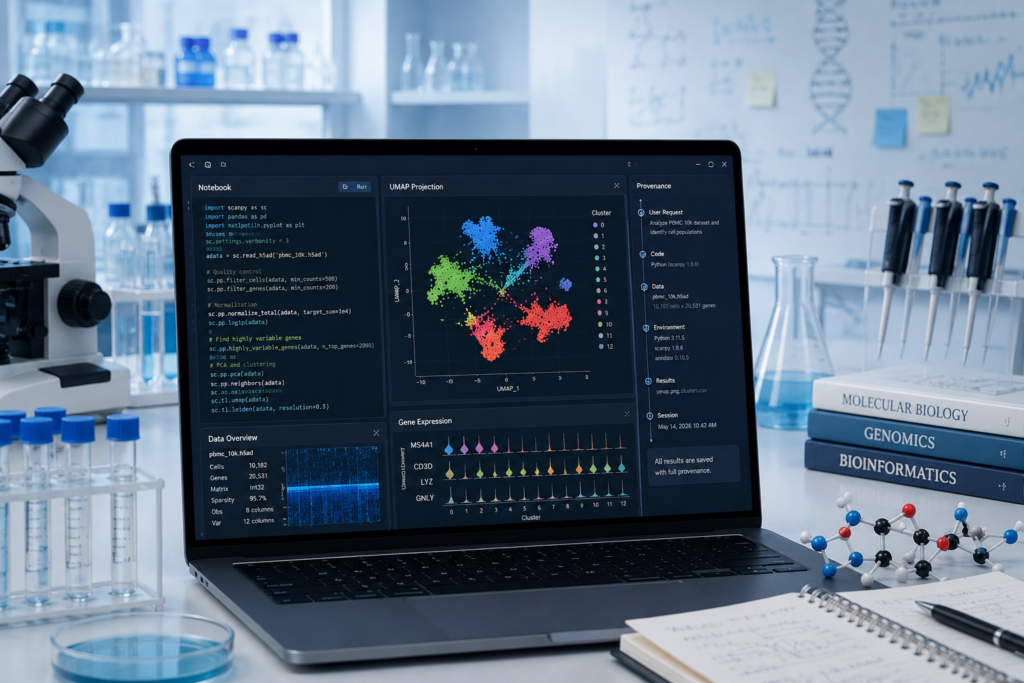
For the past few years, AI has helped scientists mostly through conversation.
It could summarize papers, explain unfamiliar methods, suggest statistical tests, or help polish an abstract.
Useful, but limited.
In practice, much of scientific research happens outside the chat window: in Python notebooks, R scripts, sequencing pipelines, HPC clusters, scientific databases, figures, and folders full of half-finished analyses.
That is why Claude Science, Anthropic’s new science-focused workspace for Claude, is interesting.
It tries to move AI out of the chat box and into the environment where scientific work actually happens.
Rather than introducing a new AI model, Anthropic is building a workspace around Claude that connects the model to scientific tools, databases, and computational workflows.
The broader shift is that AI for science is moving beyond conversation and becoming part of the research workflow.
This article looks at Claude Science not only as a product release, but as a sign of where AI research tools may be heading: toward reproducible, traceable, domain-specific research environments.
What Is Claude Science?
Claude Science is best understood as a scientific workbench built around Claude.
Rather than being a separate AI model, it adds a research environment around Claude with code execution, database access, compute integration, provenance tracking, and scientific artifacts that can be traced back to the work that produced them.
Anthropic currently describes Claude Science as available in beta on macOS and Linux for Pro, Max, Team, and Enterprise plans. Team and Enterprise users may need an administrator to enable access.
Because Claude Science is still in beta, availability, pricing, supported plans, and platform access should be checked on Anthropic’s official page before making decisions based on this information.
| Feature | What it means |
|---|---|
| Not a new model | Uses Claude models already included in supported plans |
| Scientific workbench | Adds tools, compute, databases, and research artifacts around Claude |
| Local or controlled execution | Analyses can run where the researcher’s data and compute environment live |
| Provenance | Results are linked to the code, environment, and conversation that produced them |
| Background reviewer | Adds a checking layer for claims, numbers, citations, or outputs before they are treated as final |
A simple way to think about it is:
Claude is the AI model.
Claude Science is the research workspace built around that model.
The Big Shift — From Chatbot to Research Environment
A general AI assistant can already help with many research-adjacent tasks.
It can summarize a paper, explain a method, draft code, or rewrite a paragraph.
Those tasks are useful. But they are not the full workflow of science.
Scientific research usually requires:
- access to data
- executable code
- reproducible analysis
- traceable figures
- database queries
- persistent workflow history
- collaboration across people and tools
That is where a chatbot starts to feel too small.
A scientist does not only need an answer. They need to know where the answer came from, which data were used, which code generated the figure, and whether the same result can be reproduced later.
Claude Science is less about making Claude “smarter” and more about placing Claude inside the parts of research where work actually happens.
A chatbot can explain an RNA-seq workflow.
A research workspace should help run the analysis, generate the figure, preserve the code, and make the result easier to check later.
If Claude Science succeeds, its impact will come from making scientific workflows easier to execute, document, and reproduce. That is a more meaningful shift than simply introducing another AI assistant.
Why Provenance Matters More Than Another AI Summary
Many AI tools can already summarize scientific information.
What makes Claude Science different is its emphasis on provenance—the ability to trace where a result came from.
In research, provenance means knowing the path behind an output. For a figure, table, or notebook, that includes:
- which data were used
- which code generated the result
- which environment ran the code
- which instruction or conversation led to the output
Anthropic says Claude Science saves results as versioned artifacts with a full provenance record. Its product page also emphasizes that figures, tables, and notebooks include the code, environment, and conversation that produced them.
That matters because a scientific result is judged not only by whether it looks correct today, but also by whether it can be checked, reproduced, modified, and defended later.
Anyone who has worked with old figures knows the problem. You find a plot from six months ago, but the script is in a different folder, the dataset has been renamed, the package versions have changed, and no one remembers exactly which filtering step was used.
At that point, the figure may still look polished, but its scientific value becomes fragile.
This is why provenance has long been important in scientific workflow research. The idea that data lineage can support reproducible science is not new; what Claude Science attempts to do is package that principle into an AI-native research environment.
What stands out is its attempt to preserve the path behind each result, rather than generating answers alone.
AI That Actually Runs the Workflow
A regular chatbot can explain an analysis.
Claude Science is designed to help run one.
According to Anthropic’s documentation, researchers can describe a task in plain language, and Claude can write and run Python, R, or shell code in a sandbox, read approved folders, pull data through connectors, and save results as reproducible artifacts.
Instead of stopping at an explanation, Claude Science is designed to execute the analysis and preserve the workflow.
For example, a wet-lab researcher working with RNA-seq data may not only need a definition of differential expression.
They may need to:
- load the count matrix
- run quality control
- generate exploratory plots
- revise the figure
- preserve the code
- explain what changed
Those steps illustrate why a research workspace is fundamentally different from a chatbot.
Persistent analysis environments also matter. If Python or R kernels remain available during an analysis, objects such as dataframes, models, and intermediate results do not need to be rebuilt from scratch every few minutes. That can make iterative analysis much less painful, especially when working with large biological datasets.
The real advantage is the continuity of the workflow. Researchers can ask a question, run the analysis, inspect the results, revise the code, and keep a complete record of each step.
Why Claude Science Matters for Biology
Modern biology involves far more than reading papers. A typical project combines experiments with complex computational workflows.
A single project may involve literature search, sequencing data, quality control, statistical analysis, database lookup, figure generation, and interpretation of biological context.
That is why Claude Science is especially relevant to life science research.
Anthropic says Claude Science is pre-configured for domains such as genomics, single-cell analysis, proteomics, structural biology, and cheminformatics. Its product page also says it can query more than 60 scientific databases.
Because Claude Science is still in beta, database coverage, domain integrations, and supported scientific tools should be checked on Anthropic’s official page before relying on this information.
The researchers who may benefit most may not be expert bioinformaticians, but experimental biologists who understand the biological question and struggle to turn it into a reproducible computational workflow.
For example, a wet-lab researcher may understand the biology behind a single-cell experiment but still feel blocked by the analysis steps: clustering cells, annotating populations, checking marker genes, generating plots, and keeping track of how each figure was made.
If Claude Science works reliably, it could reduce that friction.
That does not eliminate the need for computational expertise.
Biological interpretation, statistical judgment, experimental design, and validation still belong to the researcher. Claude Science may help connect the pieces, but it does not remove the need to understand what those pieces mean.
A more realistic vision is not fully automated science, but a workspace that helps researchers move more efficiently from biological questions to reproducible analyses.
Claude Science vs General AI Chatbots
Rather than asking whether Claude Science gives better answers than a chatbot, a more useful question is whether it supports a more complete research workflow.
| Task | General AI chatbot | Claude Science |
|---|---|---|
| Explain a method | Good | Good |
| Summarize a paper | Good | Good |
| Run analysis code | Limited or tool-dependent | Built for executable research workflows |
| Track provenance | Usually weak | Core feature |
| Query scientific databases | Limited or tool-dependent | Built around connectors |
| Work with lab infrastructure | Usually limited | Designed for local or HPC-style workflows |
| Support reproducibility | Depends heavily on the user | Built into artifact history |
A general chatbot is still enough for many tasks.
If you want to understand a method, brainstorm a paper structure, or clarify a concept, you may not need Claude Science.
But if your work involves data analysis, figures, code, and reproducibility, Claude Science is designed for a different level of workflow support.
The difference is less about generating better answers and more about supporting the entire research process.
Limitations and Open Questions
Claude Science is promising, but it should not be treated as a finished replacement for existing scientific workflows.
Several questions still matter.
It Is Still Beta
Claude Science is currently described by Anthropic as a beta app.
As with any beta software, availability, supported platforms, pricing, and performance may change over time. For research teams, that uncertainty matters because scientific workflows depend on stable and reliable tools.
A tool that works well in a demo still needs to prove that it can handle ordinary lab work: messy data, unclear metadata, incomplete documentation, old scripts, and repeated revisions.
Because Claude Science is still in beta, access, pricing, operating system support, and plan requirements may change. Check Anthropic’s official page before making adoption decisions.
Product Claims Need Real-World Validation
Anthropic provides strong testimonials from researchers and organizations, including examples from UCSF, MIT/Whitehead, and industry groups.
These examples suggest that the platform has attracted serious research users. However, they are still case studies selected by Anthropic rather than independent evaluations.
That does not make them false, but it does mean they should not be treated like controlled evaluations.
A more important question is whether Claude Science can support reproducible work across ordinary research labs with different datasets, workflows, and levels of computational expertise.
AI Cannot Replace Scientific Judgment
Even if Claude Science tracks provenance, runs code, and checks outputs, it cannot remove the need for scientific judgment.
Researchers still need to verify:
- biological interpretation
- statistical assumptions
- experimental design
- figure validity
- citations
- clinical or biomedical claims
This is especially important in biology, where a technically correct analysis can still lead to a weak biological conclusion.
For example, an AI system may help generate a differential expression plot. But the researcher still needs to ask whether the samples were properly matched, whether the batch effects were handled, whether the cell annotation makes biological sense, and whether the result supports the claim being made.
Claude Science may help organize and automate parts of the workflow, but responsibility for interpreting and validating the science still rests with the researcher.
Access and Pricing May Limit Adoption
Access may also be a practical limitation.
Anthropic currently describes Claude Science as available in beta for macOS and Linux on Pro, Max, Team, and Enterprise plans. Some Team and Enterprise workspaces may require administrator enablement.
Academic or nonprofit research discounts may also be available depending on eligibility.
Pricing, plan access, administrator requirements, academic discounts, and supported platforms may change while Claude Science remains in beta.
For individual students, this may be too much for casual use.
For labs and research teams, the decision will depend on cost, privacy requirements, integration with existing infrastructure, and whether the tool actually saves time in real projects.
Who Should Use Claude Science?
Claude Science is not designed for every researcher. Its value depends largely on the type of work you do.
| User type | Should they try it? | Why |
|---|---|---|
| Undergraduate student | Maybe | Useful for learning research workflows, but may be more than they need |
| Wet-lab graduate student | Yes, if available | Can help bridge biological questions and computational analysis |
| Computational biologist | Maybe | Useful if it integrates with existing pipelines rather than replacing them |
| PI / lab manager | Worth watching | Provenance and reproducibility may be valuable for team workflows |
| Industry R&D team | Depends | Access, privacy, compliance, and integration matter most |
| Casual paper reader | Probably not | General AI tools may be enough |
Researchers who work with data, code, figures, and reproducible analyses are likely to benefit the most. For users who mainly want paper summaries or quick explanations, general-purpose AI chatbots are often sufficient.
My Take — Why This Matters Beyond Claude
Every major AI assistant can already summarize papers. What makes Claude Science more interesting is that it treats research as a workflow rather than a conversation.
This reflects a broader shift in AI tools.
The first wave of AI assistants helped users ask questions. The next wave may be domain-specific workspaces where AI works inside the tools, files, data, and processes of a profession.
Science is a natural place for this shift because scientific work needs auditability more than most fields.
A polished answer is not enough.
A researcher needs to know:
- Where did this number come from?
- Which data were used?
- Which script made this figure?
- Can someone else reproduce it?
- Can I defend this result in a meeting, manuscript, or review?
If Claude Science works well, its strongest selling point may not be raw model intelligence.
It may be trust.
Not trust in the sense of blindly believing the AI, but trust in the sense that the workflow leaves a record that can be checked.
That is a much more useful idea for science.
The promise is real, but the proof will come from whether ordinary labs can use it reliably—not from launch demos or selected testimonials.
Frequently Asked Questions
Is Claude Science a new model?
No. Anthropic describes Claude Science as a beta app, not a new model. It uses Claude models included in supported plans while adding scientific tools, database connections, compute integrations, and provenance tracking around them.
What makes Claude Science different from regular Claude?
Regular Claude can explain and discuss research. Claude Science is designed to run analyses, connect to scientific tools, trace outputs to code and environment, and work inside a more complete research workflow.
Why is provenance important?
Provenance makes it easier to reproduce, edit, audit, and defend scientific outputs. Instead of treating a figure or table as a final image, provenance connects the output to the data, code, environment, and instructions that produced it.
Is Claude Science useful for wet-lab researchers?
Potentially. Claude Science may be especially useful for wet-lab researchers who understand the biology but need help connecting literature, code, databases, and reproducible analyses.
Is Claude Science available now?
Anthropic currently describes Claude Science as available in beta for macOS and Linux on Pro, Max, Team, and Enterprise plans.
Can Claude Science replace bioinformaticians?
No.
Claude Science may reduce computational friction, but expert judgment is still needed for experimental design, statistical interpretation, workflow validation, biological interpretation, and troubleshooting. For many labs, the best use case may be collaboration: helping experimental researchers move closer to computational workflows, while still relying on expert review when decisions matter.
Key Takeaways
Claude Science is best understood as an AI research workspace, not a new AI model.
Its most important idea is provenance: connecting outputs to the code, environment, and conversation that produced them.
The product reflects a broader shift from general chatbots to domain-specific AI work environments.
For biology, the most interesting use case may be helping researchers connect literature, data, analysis, and figures in one workflow.
Claude Science is still a beta product, so features, access, pricing, and reliability should be verified.
The real test is not whether Claude Science can produce impressive demos, but whether it can support reproducible research in everyday lab workflows.
Claude Science matters because it asks a better question: not “Can AI answer a scientist?” but “Can AI work inside the scientific workflow?”
Continue Learning
AI for Researchers
- How to Read Research Papers with AI
- AI Literature Review Workflow
- Elicit Review
- NotebookLM Review
- Scite Review
Research Productivity
- How to Read Research Papers Faster
- How to Find Research Papers Faster
- How to Organize Research Papers