Last updated: July 2026
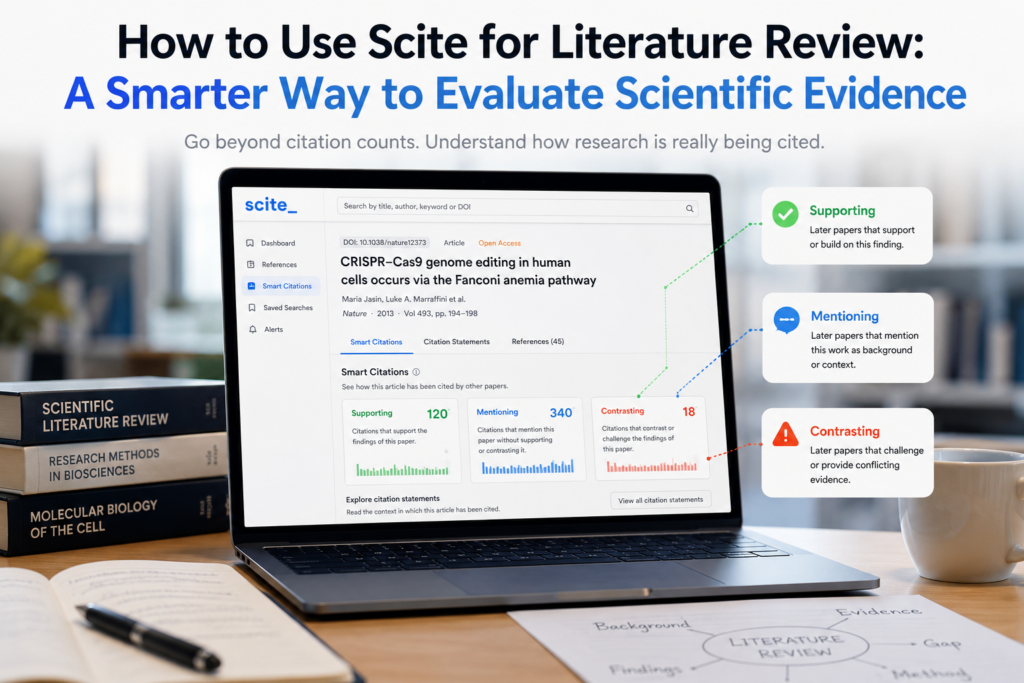
Most researchers judge a paper by one number:
How many times has it been cited?
It seems like a reasonable shortcut.
A paper with hundreds or thousands of citations must be influential.
But citation count tells only part of the story.
A paper can be highly cited because later studies support its findings, challenge its conclusions, or simply mention it as background. Treating every citation as equal can make a literature review slower—and sometimes misleading.
This is the problem Scite was designed to solve.
Instead of asking,
“How many citations does this paper have?”
Scite asks a more useful question:
“How are researchers actually citing this paper?”
That shift changes the role of citations.
Rather than treating them as a popularity metric, Scite treats them as evidence that can be interpreted.
For researchers, that makes Scite much more than another paper search engine.
It becomes a tool for evaluating scientific evidence.
What Is Scite?
Scite is often described as a literature search tool, but that description is incomplete.
It is better understood as a citation-context platform.
Traditional databases tell you how often a paper has been cited.
Scite focuses on how it has been cited.
Instead of treating every citation equally, it analyzes the surrounding citation statement and classifies how later studies refer to the original work.
| Traditional citation search | Scite |
|---|---|
| Counts citations | Classifies citations |
| Citation number | Citation context |
| Manual inspection | Prioritized reading |
| Paper discovery | Evidence evaluation |
Citation count alone cannot show whether later studies support, question, or simply mention an earlier finding. That is where Scite adds value.
Scite is designed to help researchers understand citations—not just count them.
What Are Smart Citations?
The foundation of Scite is Smart Citations.
Rather than showing only a list of papers that cite an article, Scite attempts to classify the relationship between the citing paper and the original study.
The three most common categories are:
Supporting
A later study reports results that are generally consistent with the original finding.
Supporting citations may increase confidence that a result has been reproduced or is consistent with subsequent evidence.
Contrasting
A later study reports evidence that challenges or conflicts with the original finding.
This does not necessarily mean the original paper is wrong. Scientific disagreement is common, and conflicting results often arise from differences in experimental design, sample type, or methodology.
Mentioning
The original paper is cited as background or context without directly evaluating its conclusions.
Many citations fall into this category.
They acknowledge the earlier work without providing evidence for or against it.
| Citation type | What it usually means |
|---|---|
| Supporting | Later evidence is generally consistent with the original finding |
| Contrasting | Later studies report conflicting evidence |
| Mentioning | The paper is cited without evaluating the claim directly |
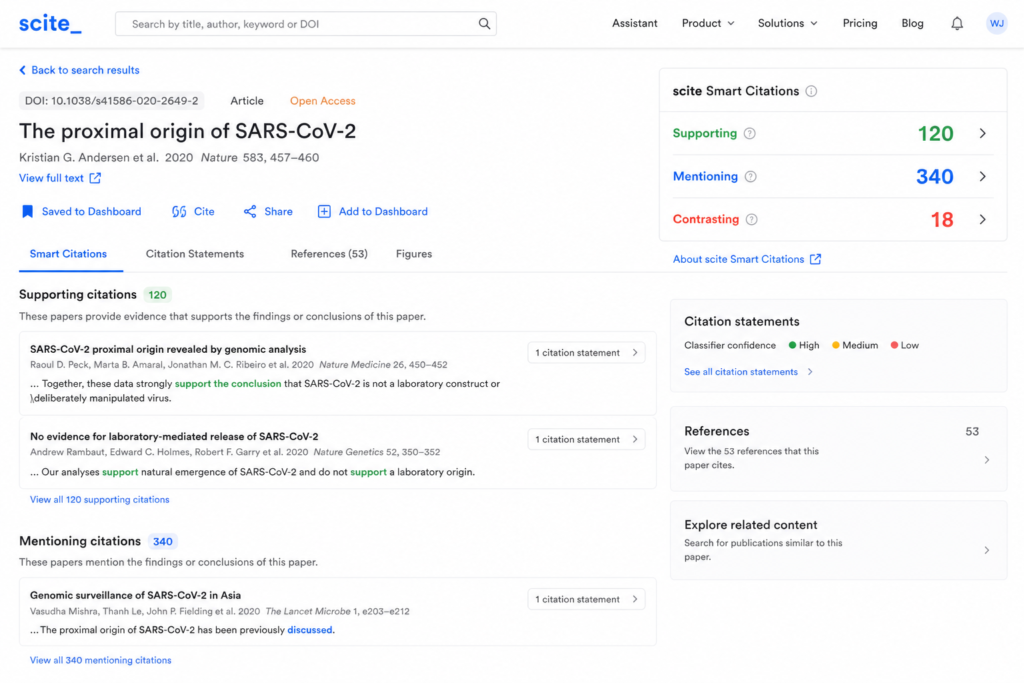
One limitation is worth keeping in mind:
Smart Citations provide context—not scientific truth.
They help researchers decide where to look next, not what to believe.
Important findings should always be verified by reading the original papers and the relevant citation contexts.
Why Citation Count Is Not Enough
Citation count has long been used as a quick way to judge the influence of a paper.
The problem is that influence and scientific support are not the same thing.
Imagine a paper with 1,200 citations.
A traditional citation database tells you only one thing:
This paper has been cited 1,200 times.
Scite asks a different question.
How are those citations distributed?
For example:
- 700 mentioning citations
- 430 supporting citations
- 70 contrasting citations
This paints a much richer picture.
The paper is clearly influential, but researchers can also see that later studies have responded to it in different ways.
Citation count alone cannot distinguish between:
- support
- criticism
- neutral discussion
That distinction becomes especially valuable when evaluating controversial findings or preparing a literature review.
Instead of reading dozens of citations in random order, researchers can prioritize the papers that contribute the strongest supporting or contrasting evidence.
This does not replace critical reading.
It simply makes it easier to focus on the papers that are most likely to influence your scientific judgment.
A Practical Scite Workflow for Literature Review
Scite works best as part of a literature review workflow—not as the starting point.
Instead of searching Scite first, begin by finding a relevant paper through your usual literature search process.
Once you have an important paper, use Scite to understand how later research has responded to it.
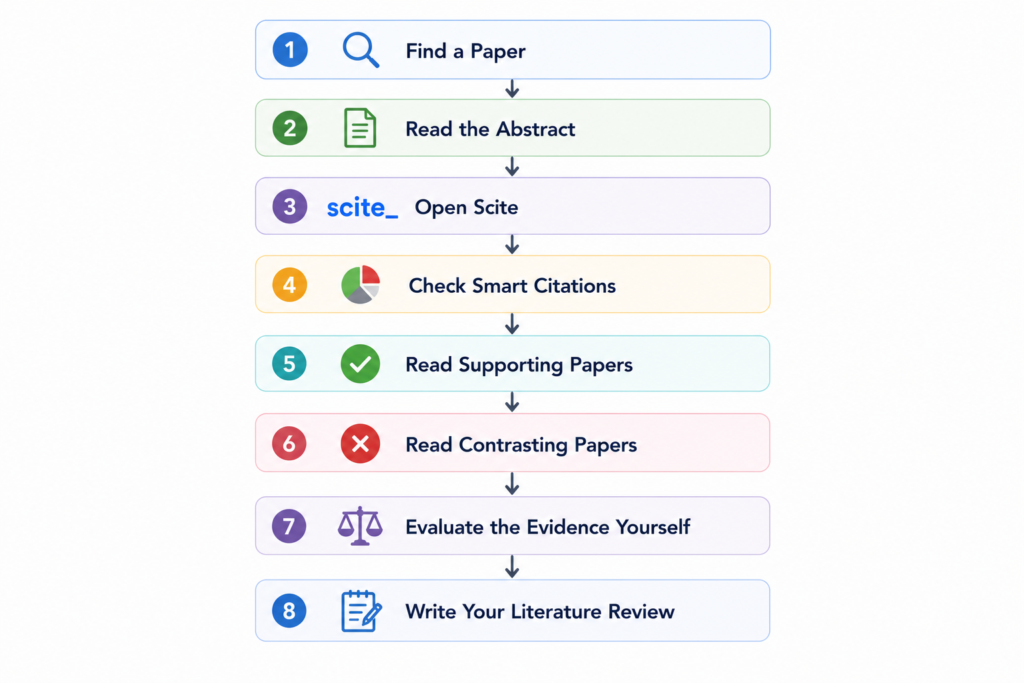
The key point is where Scite fits into the workflow.
It helps you evaluate the literature after you’ve identified an important paper.
It does not replace reading the paper itself.
A useful way to think about Scite is this:
Scite supports scientific judgment. It does not replace it.
When Should You Use Scite?
Scite is not necessary for every paper you read.
Its value increases when understanding the surrounding evidence is just as important as understanding the original paper.
Scenario 1 — Evaluating an Important Paper
When a paper is central to your project, don’t stop after reading it. Check how later studies have responded to its findings.
Scenario 2 — Investigating Controversial Results
Conflicting findings are common in science. Scite can quickly highlight studies that report evidence supporting or challenging the original conclusion.
Scenario 3 — Writing a Literature Review
Instead of relying only on citation counts, use Smart Citations to identify the papers that contribute the strongest supporting and contrasting evidence.
Scenario 4 — Preparing for Journal Club
Before presenting a paper at journal club, check how later studies responded to its conclusions. Doing so often leads to a more balanced discussion and helps anticipate questions from the audience.
Scenario 5 — Looking for Replication Studies
Supporting citations are often a useful starting point when searching for studies that attempted to reproduce or extend an important finding.
They are not proof of replication, but they can help prioritize your reading.
| Goal | How Scite helps |
|---|---|
| Prioritize papers | Citation context |
| Find potential replication studies | Supporting citations |
| Identify disagreements | Contrasting citations |
| Understand scientific influence | Citation statements |
Scite is most useful when you already have an important paper and want to understand how it fits into the broader scientific literature.
Common Mistakes When Using Scite
Like any research tool, Scite is most effective when used with the right expectations.
Believing Supporting Citations Prove a Claim
Supporting citations increase confidence that later studies are consistent with the original finding, but they do not prove that the conclusion is correct. Scientific evidence is built from the quality of experiments—not simply the number of supporting papers.
Assuming Contrasting Citations Invalidate a Paper
Conflicting studies are a normal part of scientific progress. A contrasting citation tells you that later work reported different findings. It does not automatically mean the original paper was wrong. The next step is to understand why the studies disagree.
Reading Smart Citations Without Reading the Original Paper
Citation context is helpful, but it should never replace reading the original study. Scite helps you decide where to look. It cannot replace your own evaluation of the evidence.
Treating Scite as a Replacement for Critical Thinking
Scite helps organize scientific evidence. It does not tell you which conclusion to believe. Researchers must still evaluate study design, experimental methods, controls, and biological interpretation.
Ignoring the Citation Context
A citation category is only the starting point. Whenever a paper is important to your work, read the actual citation statement and the original paper before drawing conclusions.
Scite vs Google Scholar
Scite and Google Scholar are often compared, but they solve different problems.
Google Scholar helps you discover papers, while Scite helps you evaluate how those papers have been discussed in the scientific literature. For most researchers, the two tools complement each other rather than compete.
| Feature | Google Scholar | Scite |
|---|---|---|
| Citation count | ✅ | ✅ |
| Citation context | ❌ | ✅ |
| Supporting and contrasting citations | ❌ | ✅ |
| Paper discovery | Excellent | Good |
| Evidence evaluation | Limited | Better |
In short:
Google Scholar helps you find papers. Scite helps you understand how those papers have been cited.
Limitations of Scite
Scite is a valuable research tool, but it also has limitations.
Understanding those limitations is just as important as understanding its strengths.
Smart Citations Are AI-Generated
Smart Citations are generated using machine learning models.
Although they are often helpful, they are still automated classifications and should not be treated as definitive judgments.
Citation Classification Is Not Perfect
Scientific writing is nuanced.
A citation may support one part of a paper while questioning another, making automatic classification difficult.
Whenever a citation is important for your work, read the original citation context yourself.
Coverage Depends on Available Literature
Scite’s coverage depends on the availability of full-text articles and publisher access.
Some papers, journals, or older publications may have limited citation context available.
Citation Context Is Not Scientific Evidence
Knowing how a paper is cited is useful.
It is not the same as evaluating the experiments themselves.
Supporting citations do not prove a conclusion, and contrasting citations do not automatically invalidate one.
Researchers still need to assess study design, methodology, and biological evidence.
Important Papers Still Need to Be Read
Scite is best viewed as a guide for prioritizing evidence, not as a substitute for reading the original literature.
The strongest literature reviews still depend on careful evaluation of the primary evidence.
Features May Change
Because Scite is actively evolving, available features, pricing, and indexed content may change over time.
Who Should Use Scite?
Scite is not equally useful for every researcher.
Its value depends on how often you evaluate scientific evidence rather than simply search for papers.
| User | Recommendation | Why |
|---|---|---|
| Undergraduate student | Yes | Learn how scientific findings are discussed after publication |
| Graduate student | Highly recommended | Improve literature review quality and evidence evaluation |
| PI | Useful | Quickly assess influential papers and citation patterns |
| Systematic reviewer | Useful with caution | Prioritize evidence without replacing manual screening |
| Casual reader | Optional | General literature databases may be sufficient |
Scite is most valuable for researchers who regularly need to judge the strength of scientific evidence rather than simply locate papers.
My Take — Why Scite Changes the Way We Read Papers
Most researchers ask a simple question when they find an interesting paper:
“How many times has this paper been cited?”
Scite encourages a better question:
“How are researchers actually citing this paper?”
That shift is more important than any individual feature.
Scientific evidence is not built from citation counts alone. It is built from understanding how later studies respond to earlier findings.
Some papers become influential because they are consistently supported.
Others become influential because they are controversial.
Citation count cannot distinguish between those situations.
Citation context often can.
That, more than any individual feature, is what makes Scite valuable.
Frequently Asked Questions
What is Scite?
Scite is a literature review platform that analyzes citation context rather than simply counting citations. Its Smart Citations classify how later papers refer to earlier studies.
Is Scite free?
Scite offers both free and paid features. The available functionality depends on your subscription plan.
What are Smart Citations?
Smart Citations classify citation statements into categories such as Supporting, Contrasting, and Mentioning to provide context about how a study has been cited.
Is Scite better than Google Scholar?
They serve different purposes. Google Scholar is better for discovering papers. Scite is better for understanding how those papers have been discussed by later research.
How accurate are Smart Citations?
They are generally useful, but they are AI-generated classifications rather than definitive scientific judgments. Important citation contexts should always be verified manually.
Can Scite find contradictory studies?
Yes.
Contrasting citations can help identify later studies that report evidence different from the original paper. Researchers should still read those papers to understand why the results differ.
Is Scite worth paying for?
That depends on your workflow.
Researchers who regularly perform literature reviews or evaluate large numbers of papers are likely to benefit more than occasional readers. Because Scite’s pricing and subscription plans may change, check the official Scite website before making a decision based on cost.
Can Scite replace a literature review?
No.
Scite helps prioritize evidence and identify important citation contexts, but researchers still need to read and critically evaluate the original literature.
Does Scite detect retracted papers?
Scite includes information related to retractions and editorial notices where available.
How should graduate students use Scite?
A practical workflow is:
- Find an important paper.
- Read the abstract.
- Check Smart Citations.
- Read supporting and contrasting studies.
- Evaluate the evidence yourself.
- Write your literature review.
Key Takeaways
If you plan to use Scite for literature review, remember these principles:
- Scite analyzes citation context, not just citation counts.
- Smart Citations help identify supporting, contrasting, and mentioning studies.
- Citation context can help prioritize what to read next.
- Scite supports evidence evaluation, but it does not replace critical reading.
- Important citation contexts should always be verified in the original papers.
Above all, remember this:
Scite doesn’t tell you what to believe. It helps you ask better questions about the scientific evidence.
Continue Learning
AI for Researchers
- How to Read Research Papers with AI
- AI Literature Review Workflow
- NotebookLM Review
- Elicit Review
- Claude Science Explained