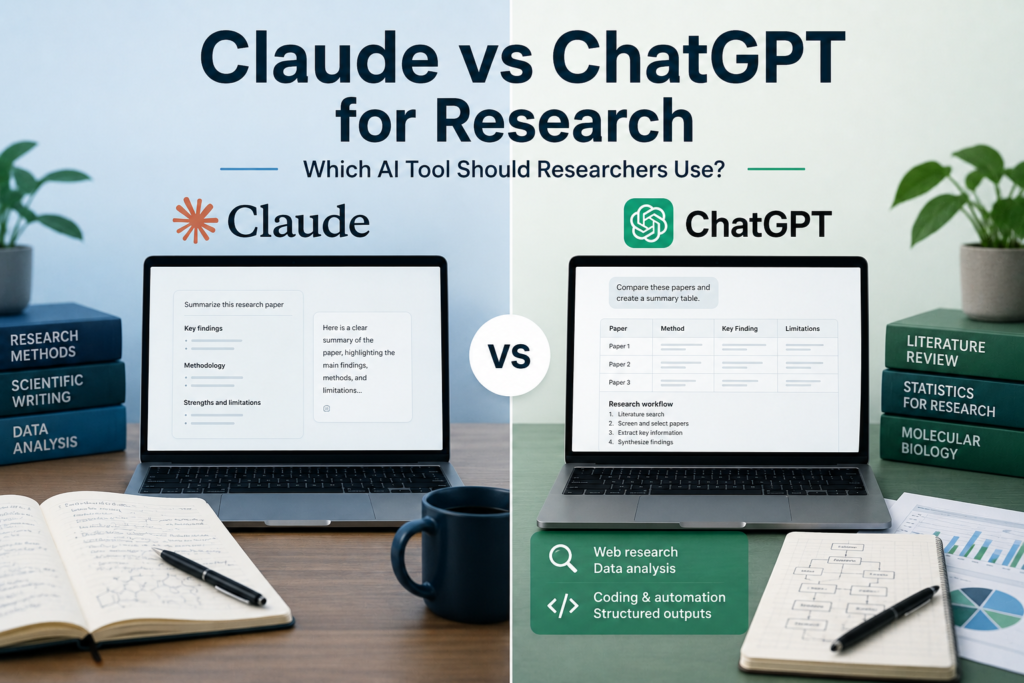
Researchers often ask a simple question:
Which is better for research: Claude or ChatGPT?
It is a reasonable question, but it is too broad to answer well.
Research is not a single task.
Reading papers, reviewing the literature, interpreting figures, writing manuscripts, and analyzing data all require different kinds of support.
So the better question is:
Which tool fits which part of your research workflow?
Claude and ChatGPT can both be useful for researchers. Both can summarize papers, explain methods, draft text, generate outlines, write code, and help organize ideas.
But neither tool should be treated as a source of scientific truth.
The best use of AI in research is not to outsource judgment. It is to make your own judgment faster, clearer, and better organized.
This article compares Claude and ChatGPT from a practical research perspective: when each tool may be useful, where they differ, and when you should stop using AI and return to the original evidence.
The Short Answer
Claude and ChatGPT are both useful for research, but they are not useful in exactly the same way.
| Common research task | Better starting point | Why |
|---|---|---|
| Brainstorming research questions | Claude or ChatGPT | Both can generate ideas, but ideas must be checked |
| Reading long papers | Claude or ChatGPT | Depends on file handling, context length, and output style |
| Literature review synthesis | Both + databases | AI helps organize, but evidence must be verified |
| Source-based web research | ChatGPT Deep Research or Claude Research | Use tools with live search and citations |
| Scientific writing polish | Claude or ChatGPT | Choose based on the style of revision you need |
| Structured outlines and tables | ChatGPT or Claude | Both can help organize information |
| Coding and data analysis | ChatGPT, Claude Code, or Claude Science | Depends on available execution tools |
| Biology workflow analysis | Claude Science, if available | Potentially useful for life science workflows, but still requires verification |
| Quick concept explanation | Claude or ChatGPT | Good for learning, but technical claims should be checked |
The safest answer is this:
Use Claude or ChatGPT to accelerate research work, not to replace scientific judgment.
If the task is about clarity, synthesis, or long-form revision, Claude can be a strong starting point.
If the task is about structure, tool use, source-based research, or workflow organization, ChatGPT can be a strong starting point.
If the task is about whether a scientific claim is actually supported, return to the paper.
Claude vs ChatGPT: The Wrong Way to Compare Them
A common mistake is to ask which model is “smarter.”
That can be misleading.
Model performance changes over time. Features change. Plan access changes. Context windows, file limits, web search, connectors, and coding tools may all differ depending on the version and subscription tier.
Since these features change over time, check the official OpenAI and Anthropic websites for the most up-to-date information before choosing a tool.
For researchers, the more useful comparison is not:
Which AI is better?
It is:
Which part of my research workflow do I want AI to support?
That shift matters.
A tool that is excellent for rewriting a paragraph may not be the best tool for source-based literature review. A tool that is strong for coding may not be the best tool for interpreting biological evidence. A tool that summarizes papers clearly may still miss a key control in a figure.
Research usefulness is task-specific.
When Claude May Be Useful for Research
Claude is often useful when the task involves reading, rewriting, synthesizing, or working through long-form material.
For many researchers, Claude can be helpful for:
- explaining difficult concepts
- summarizing long documents
- improving the flow of scientific writing
- comparing arguments across papers
- drafting structured notes
- turning rough ideas into clearer prose
Claude often produces responses that read more like an edited document than a conversational reply, which many researchers find useful when revising scientific writing.
For example, if you paste a rough paragraph from a manuscript and ask for a clearer version without changing the scientific meaning, Claude may be a good starting point.
But this is still a writing task, not an evidence task.
A polished paragraph can still contain a weak claim.
Claude is best used here as a tool for clarity, not as the final judge of whether the science is correct.
When ChatGPT May Be Useful for Research
ChatGPT can be useful when the task requires structure, workflow planning, file analysis, coding support, or source-based research.
For many researchers, one of ChatGPT’s strengths is turning unstructured information into a clearer format.
Depending on the available tools and plan, ChatGPT may help with:
- generating outlines and tables
- comparing methods
- analyzing uploaded files
- writing or debugging code
- summarizing source-based information
- creating research workflows
- preparing presentations
- organizing notes into a structured format
Some ChatGPT plans may include features such as Search, Deep Research, Canvas, file analysis, or code execution. OpenAI describes Deep Research as a tool for multi-step research across the web, while Canvas is designed for writing and coding projects that require editing and revision.
Because these features vary by plan, region, and product updates, check the official OpenAI documentation before building a workflow around them.
For example, if you are comparing several AI literature review tools, ChatGPT can help turn messy notes into a table, identify evaluation criteria, and suggest a workflow.
That kind of structure is useful.
But structure is not evidence.
A well-organized output should still be treated as a starting point, not a final conclusion.
Claude vs ChatGPT for Literature Review
For literature review, neither Claude nor ChatGPT should be your only tool.
A strong literature review still starts with reliable search and evidence evaluation.
Use databases and research tools such as PubMed, Google Scholar, Semantic Scholar, Scite, Web of Science, or Scopus if available through your institution.
Then use Claude or ChatGPT to organize what you found.
Claude may be useful when you want a careful summary or smoother synthesis across papers.
ChatGPT may be useful when you want structured comparison tables, step-by-step workflows, or source-based research features.
But the final evaluation should come from you.
Claude vs ChatGPT for Reading Scientific Papers
Both Claude and ChatGPT can help explain scientific papers.
A useful paper-reading workflow is:
- Read the title and abstract yourself.
- Identify the main claim.
- Ask AI to explain unfamiliar methods.
- Read the figures yourself.
- Ask AI to summarize the results section.
- Compare the AI summary with the figures.
- Write your own notes.
This workflow matters because AI can make a paper feel easier than it really is.
A model may summarize the conclusion clearly while missing a weak control, a small sample size, or a limitation hidden in the methods.
Use Claude or ChatGPT for:
- explaining unfamiliar methods
- simplifying dense paragraphs
- summarizing background information
- comparing two papers
- creating study notes
Do not rely on either tool for:
- deciding whether a figure proves the claim
- judging whether controls are sufficient
- verifying statistical validity
- replacing your own reading of key results
The closer you are to the original evidence—figures, methods, and raw results—the less you should rely on AI summaries.
Claude vs ChatGPT for Scientific Writing
For scientific writing, both tools can be useful.
The best choice depends on what kind of revision you need.
Use AI for:
- improving clarity
- reducing repetition
- restructuring paragraphs
- making transitions smoother
- turning rough notes into a draft
- checking whether a paragraph is too vague
- creating outlines for introductions or discussions
Be careful with:
- adding citations
- making claims stronger
- changing technical meaning
- rewriting results in a way that overstates the data
- making speculative conclusions sound established
Claude tends to work well when you want a paragraph to sound more natural and less mechanical.
ChatGPT may be useful when you want structure: outlines, headings, tables, alternative versions, or reviewer-response drafts.
But neither tool knows what your data truly support.
If a sentence becomes more polished but less accurate, it is worse scientific writing.
Good scientific writing is not just smooth.
It is precise.
Claude vs ChatGPT for Coding and Data Analysis
This is one area where tool access matters more than brand preference.
Both Claude and ChatGPT can help write code, explain errors, and suggest analysis steps.
But actual usefulness depends on whether the tool can:
- read your files
- run code
- inspect outputs
- debug iteratively
- work with your preferred language
- preserve the analysis context
- connect to your workflow safely
ChatGPT may be useful when file analysis and code execution tools are available.
Claude may be useful when Claude Code or Claude Science fits the workflow.
Since coding and data analysis features change over time, always check the latest product documentation before building your workflow around them.
For research coding, do not only ask:
“Can this AI write code?”
Ask:
“Can I verify what the code did?”
For data analysis, the important questions are:
- What data were used?
- What preprocessing steps were applied?
- What assumptions were made?
- Were results saved reproducibly?
- Can someone else rerun the analysis?
- Did the code produce the figure shown?
AI-generated code can be helpful, but it can also be subtly wrong.
The safest use is to let AI draft, explain, and debug code while you verify the logic and outputs.
A Practical Decision Framework
Instead of choosing one tool forever, choose based on the research task.
Use Claude when you need careful text work
Claude may be a good starting point when you need to:
- improve manuscript clarity
- summarize long documents
- refine tone
- synthesize arguments
- turn rough notes into readable prose
Best use case:
“Help me make this paragraph clearer without changing the scientific meaning.”
Avoid using it for:
“Tell me whether this claim is true without checking the original evidence.”
Use ChatGPT when you need structure, tools, or workflow support
ChatGPT may be a good starting point when you need to:
- build comparison tables
- create research workflows
- analyze files
- work through coding problems
- perform source-based research, if browsing or Deep Research is available
- generate structured outlines
Best use case:
“Compare these papers in a table and identify which claims need verification.”
Avoid using it for:
“Give me citations I can trust without checking them.”
Use neither as the final authority
Use original sources when the task requires:
- verifying a citation
- interpreting experimental evidence
- deciding whether a claim is supported
- evaluating clinical or biomedical significance
- checking statistical assumptions
- drawing final conclusions for a thesis or manuscript
AI can support the work.
It should not become the source of truth.
Real Research Scenario: Literature Review for a Biology Project
Imagine you are writing a literature review on a signaling pathway involved in inflammation.
You find a highly cited paper claiming that Protein X increases inflammatory cytokine production.
A weak AI workflow would look like this:
Ask Claude or ChatGPT to summarize the paper
        ↓
Copy the summary into your notes
        ↓
Assume the claim is reliable
That is fast, but risky.
A stronger workflow would look like this:
Read the abstract and main figures
        ↓
Ask Claude or ChatGPT to explain difficult methods
        ↓
Use Scite to check supporting and contrasting citations
        ↓
Read key follow-up papers
        ↓
Ask AI to compare the evidence across studies
        ↓
Check the original figures and methods yourself
        ↓
Write your own synthesis
This workflow uses AI, but it keeps the researcher in control.
That is the difference between using AI as a shortcut and using AI as a research assistant.
The goal is not to make the literature review effortless.
The goal is to make your attention more focused.
My Recommendation
If you can use both Claude and ChatGPT, use both.
Not because one is always better, but because research involves different kinds of work.
Use Claude when you need careful reading, synthesis, or writing refinement.
Use ChatGPT when you need structure, workflow planning, coding help, or source-based research.
But the most important decision is not which model you choose.
It is knowing when to stop asking AI and return to the original paper.
Common Misconceptions
“One tool is always better.”
Sometimes Claude may feel better for reading or writing. Sometimes ChatGPT may be more useful for structure, coding, or source-based workflows. But “better” depends on the task, the model version, and the tools available. There is no permanent winner.
“More features automatically mean better research.”
Tools matter only when they match your workflow. Browsing, file analysis, coding support, or long-context tools can be useful for some tasks and unnecessary for others. More features do not automatically lead to better scientific judgment.
“AI citations can be trusted if they look real.”
No. AI-generated citations can be wrong, incomplete, outdated, or fabricated. Always verify references using original databases, publisher pages, PubMed, Google Scholar, DOI lookup, or institutional access.
“AI can replace literature review.”
AI can help with parts of a literature review. It can summarize, compare, organize, and explain. But it cannot replace critical reading of key papers. A real literature review requires judgment.
“A polished answer is a reliable answer.”
A clear answer can still be wrong. This is especially dangerous in research because AI can make weak evidence sound confident. Always separate writing quality from scientific reliability.
Limitations of Using Claude or ChatGPT for Research
Both tools have limitations.
Researchers should keep these in mind:
- Features change frequently.
- Plan access differs.
- AI may hallucinate references.
- Summaries may miss methodological details.
- AI may overstate weak findings.
- Source-based answers depend on retrieved sources.
- Uploaded papers may raise copyright or institutional policy issues.
- Sensitive unpublished data should not be uploaded without checking policies.
- AI cannot replace domain expertise.
- Benchmarks do not fully predict real research usefulness.
The most important limitation is simple:
AI can help process information, but it cannot take responsibility for your scientific conclusions.
FAQ
Is Claude better than ChatGPT for research?
No single tool is better for every research task. Claude is often preferred for long-form reading and writing, while ChatGPT may be stronger for structured workflows, coding, and source-based research.
Is ChatGPT better than Claude for literature review?
Not necessarily. For literature review, both tools should be used alongside databases such as PubMed, Google Scholar, Semantic Scholar, or Scite. AI can help summarize and compare papers, but it should not replace source verification.
Which is better for reading scientific papers?
Either can help explain papers. The most important rule is to read the figures, methods, and key results yourself. Use AI to explain difficult sections, not to replace your own evaluation.
Which is better for scientific writing?
Both can help. Claude may be useful for natural-sounding prose and clarity. ChatGPT may be useful for structure, outlines, and tables. Always check that the scientific meaning has not changed.
Which is better for coding and data analysis?
It depends on tool access. ChatGPT may be useful when code execution and file analysis are available. Claude may be useful through Claude Code or Claude Science if those tools fit your workflow. Available coding and data analysis features depend on the current product version and plan.
Can Claude or ChatGPT cite papers accurately?
They may provide useful leads, but citations should always be verified. Never rely on AI-generated references without checking the original source.
Can I use Claude or ChatGPT for a thesis?
Yes, but carefully. They can help with outlining, summarizing, clarifying writing, and organizing notes. They should not be used to fabricate citations, replace reading, or make unsupported claims. Check your institution’s AI policy before using AI in thesis work.
Can AI replace literature review?
No. AI can support literature review, but it cannot replace reading key papers, evaluating methods, and writing your own synthesis.
Should graduate students use both Claude and ChatGPT?
If available, yes. Using both can be helpful because each may perform better for different tasks. But graduate students should focus less on tool loyalty and more on verification habits.
Which tool is better for biology research?
It depends on the task. For explaining concepts or papers, either may help. For computational workflows, available coding and analysis tools matter more. Claude Science may become relevant for biology workflows if available, but it should be treated as a tool that still requires scientific oversight.
What should I never use AI for in research?
Do not use AI to:
- invent citations
- replace reading key papers
- judge evidence without verification
- analyze sensitive unpublished data without permission
- make clinical or biomedical claims without expert review
- write conclusions that your data do not support
Key Takeaways
Claude and ChatGPT can both support research, but neither is the best tool for every task.
The better question is not which AI is better, but which part of your research workflow needs support.
For literature review, use AI alongside trusted databases and citation tools—not instead of them.
For scientific writing, use AI to improve clarity, but protect the meaning of your claims.
For data analysis, verify the code, assumptions, and outputs yourself.
For evidence evaluation, return to the original paper, figures, methods, and data whenever possible.
Most importantly:
Do not ask which AI is better for research.
Ask which part of your research workflow you want AI to support.
Continue Learning
AI for Researchers
- How to Read Research Papers with AI
- AI Literature Review Workflow
- How to Use Scite for Literature Review
- NotebookLM Review
- Elicit Review
- Claude Science Explained