Last updated: August 2026
Quick Verdict
| Category | Rating |
|---|---|
| Literature Discovery | ⭐⭐⭐⭐⭐ |
| Citation Exploration | ⭐⭐⭐⭐⭐ |
| Ease of Use | ⭐⭐⭐⭐☆ |
| Collaboration | ⭐⭐⭐⭐☆ |
| Literature Review Support | ⭐⭐⭐⭐☆ |
| Scientific Writing | ⭐⭐☆☆☆ |
| Overall | ⭐⭐⭐⭐☆ (4.6/5) |
Best For
- Graduate students and PhD candidates
- Researchers starting a literature review
- Scientists exploring unfamiliar research fields
- Discovering related papers beyond keyword search
- Building structured literature collections
Less Suitable For
- Writing scientific manuscripts
- Summarizing research papers
- Statistical analysis
- Reference management
- Evaluating study quality
Bottom Line
ResearchRabbit is one of the most effective tools available for discovering scientific literature. It should not replace Google Scholar or PubMed, but it significantly improves the process of finding related papers, influential authors, and hidden connections across the scientific literature.
In my own test, starting from a single 2025 Z-RNA paper led me to a structural biochemistry study on ADAR1 that I probably would not have prioritized through a conventional ZBP1-focused keyword search.
Should You Read This Review?
This review is designed for researchers who regularly work with scientific literature and want to discover relevant papers more efficiently.
You’ll find it particularly useful if you are:
- A graduate or PhD student starting a literature review
- An academic researcher entering a new field
- A scientist trying to identify influential papers and authors
- Someone who feels that keyword searches alone often miss important publications
- Looking for a smarter alternative—or complement—to Google Scholar
This review may be less relevant if your primary goal is writing manuscripts, summarizing papers, or managing references. In those cases, tools such as Claude, NotebookLM, or Zotero are likely to provide greater value.
Rather than asking whether ResearchRabbit is “better” than other AI tools, this review focuses on a more practical question:
At what stage of the research process does ResearchRabbit provide the greatest advantage?
Introduction
Most researchers begin a literature search the same way: they type a few keywords into Google Scholar or PubMed and start scrolling.
It works—but only to a point.
Keyword search is excellent for finding papers you already know how to describe. It is much less effective at revealing unexpected connections, influential authors, or important studies that use different terminology.
This is exactly the problem ResearchRabbit was built to solve.
Instead of treating scientific papers as isolated search results, ResearchRabbit visualizes the relationships between publications. Starting from just one relevant paper, researchers can discover related studies, trace citation networks, follow leading authors, and gradually build a more complete understanding of a research field.
The result is a fundamentally different way of exploring scientific literature.
Rather than asking, “Which papers contain these keywords?”, researchers begin asking, “Which papers are connected to the evidence I already trust?”
That shift changes how literature discovery works.
In this review, I’ll look at where ResearchRabbit fits into a modern research workflow, where it performs well, and where its limitations remain.
But I also wanted to test its central promise in a real research scenario. I started with a single 2025 Nature paper on Z-RNA and followed ResearchRabbit’s recommendations to see whether it could lead me to relevant literature I would not have found—or prioritized—through keyword searching alone.
The result turned out to be the most useful part of this review.
What Is ResearchRabbit?
ResearchRabbit is an AI-assisted literature discovery platform designed to help researchers explore scientific publications through citation relationships rather than traditional keyword searches.
Official website: https://www.researchrabbit.ai/
Instead of repeatedly searching with different keywords, researchers begin with one or several relevant papers. ResearchRabbit then recommends related publications, visualizes citation networks, identifies influential authors, and continuously expands the surrounding literature.
This approach shifts literature discovery from searching to exploring.
Traditional search engines answer questions like: “Which papers mention this keyword?”
ResearchRabbit answers a different question: “Given this paper, what else should I read?”
For researchers entering a new field, this distinction can make a significant difference. Important papers are not always discovered through keywords alone. They are often found because they are closely connected to influential studies, highly cited authors, or emerging research communities.
ResearchRabbit also allows users to organize papers into collections, making recommendations increasingly relevant as the collection grows. Rather than functioning as a one-time search engine, it gradually becomes a personalized literature discovery assistant.
It is important, however, to understand what ResearchRabbit is not.
It is not a paper summarizer. It is not a writing assistant. It is not a reference manager.
Its purpose is much more specific—and much more valuable for many researchers.
ResearchRabbit helps researchers answer one of the most important questions in science:
“What should I read next?”
ResearchRabbit doesn’t help you search faster. It helps you discover more intelligently.
Real Literature Discovery Workflow
The biggest mistake researchers make when using literature discovery tools is expecting them to replace scientific thinking.
ResearchRabbit is most valuable when it becomes part of a structured research workflow—not when it is treated as another search engine.
Imagine you are beginning a literature review on single-cell RNA sequencing.
Typing “single-cell RNA-seq” into Google Scholar will return thousands of papers. While this is useful, it rarely answers the more important question:
“Which papers should I read first?”
A more effective workflow looks like this.
Step 1: Start with one trusted paper
Every literature review needs a starting point.
Rather than collecting dozens of papers immediately, begin with one or two high-quality review articles or landmark studies recommended by your supervisor, colleagues, or recent review papers.
ResearchRabbit performs best when it has a strong starting point.
Step 2: Build a literature collection
Add those papers to a collection.
Instead of searching repeatedly with different keywords, allow ResearchRabbit to expand outward from your existing knowledge.
This approach often reveals papers that traditional keyword searches fail to surface.
Step 3: Explore citation networks
Once recommendations begin to appear, avoid downloading everything.
Instead, look for patterns.
Ask questions such as:
- Which authors appear repeatedly?
- Which studies are consistently cited?
- Which papers connect different research areas?
- Which recent papers are building upon these discoveries?
The objective is not to collect more papers.
It is to understand the structure of the field.
Step 4: Read strategically
Once the most relevant papers have been identified, move to a reading tool such as NotebookLM.
ResearchRabbit helps answer:
“What should I read next?”
NotebookLM helps answer:
“What does this literature actually say?”
The two tools solve different problems and complement each other remarkably well.
Step 5: Organize your knowledge
Finally, store important papers and notes inside a long-term knowledge management system such as Zotero or Obsidian.
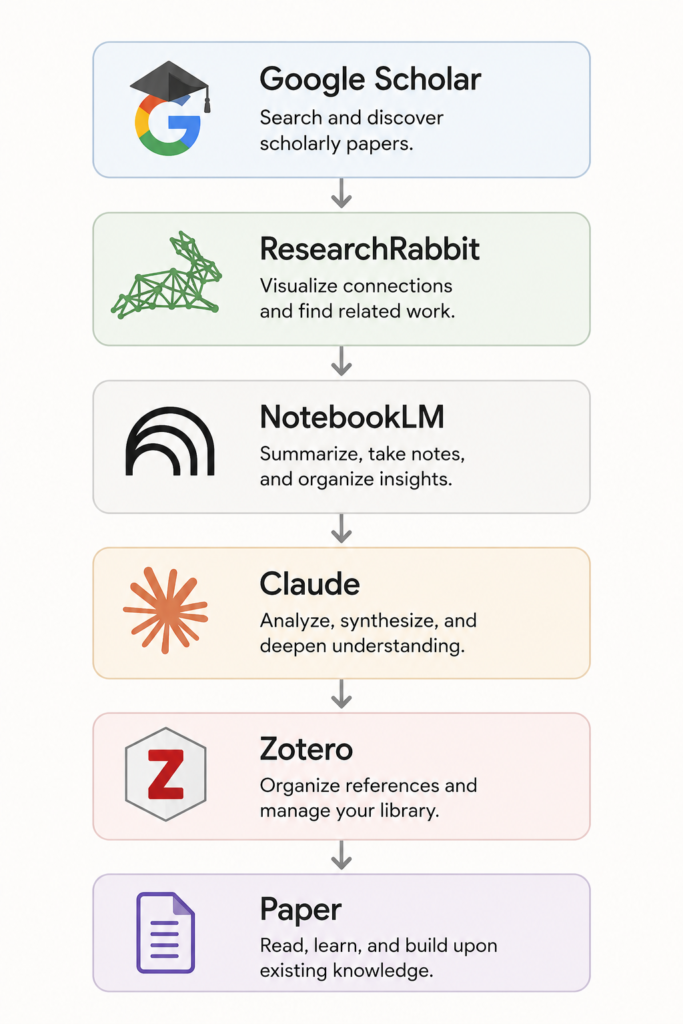
A complete AI-assisted workflow might look like this:
Research Question → Google Scholar / PubMed → ResearchRabbit → NotebookLM → Zotero → Obsidian → Manuscript
No single AI tool completes every stage of research.
The researchers who benefit most from AI are usually those who combine multiple specialized tools rather than relying on one application alone.
My Real Test: Building a Literature Map From One Paper
Most ResearchRabbit reviews explain what the platform can do.
I wanted to test something more practical:
Can ResearchRabbit actually lead me to a paper I would have missed with a normal keyword search?
To find out, I built a small literature map around a topic I was already interested in: Z-DNA and Z-RNA biology.
This was not meant to be a systematic literature review. The goal was much simpler.
I wanted to follow one paper through ResearchRabbit and see where the citation network would take me.
Choosing a Seed Paper
I started with a single paper related to Z-RNA biology:
Seed paper:
Yin, C. et al. (2025). Host cell Z-RNAs activate ZBP1 during virus infections. Nature, 648, 707–716.
I deliberately started with only one paper rather than importing a large collection.
This paper was a useful starting point because it focuses on the biological role of Z-RNA during viral infection. The authors showed that host cell-derived Z-RNAs, rather than only viral RNAs, can act as ZBP1-activating ligands during HSV-1 and influenza A virus infection.
This gave me a relatively focused starting question:
What other research could help me understand how Z-form nucleic acids are recognized at the molecular level?
Looking at the Recommended Papers
Once the seed paper was added, ResearchRabbit generated a set of related papers.
Some were relatively predictable because they dealt directly with Z-DNA, Z-RNA, or closely related molecular mechanisms.
Others were less obvious.
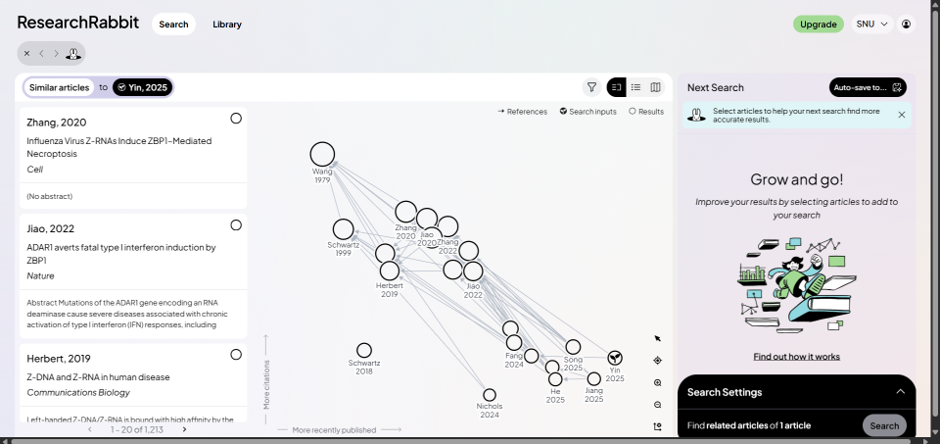
Caption: Recommendations expanded beyond papers that would necessarily appear in a narrow keyword search.
This is where I think ResearchRabbit starts becoming genuinely useful.
A traditional database is very good at finding papers when you already know what terminology to search for.
But research fields do not always use consistent terminology.
A biologically relevant paper may focus on a protein, signaling pathway, disease mechanism, or experimental model without using the exact keyword you originally searched.
Citation-based discovery can expose those connections.
Instead of deciding whether a paper was relevant based only on its title, I started looking at why it appeared near my seed paper.
That changed the way I evaluated the recommendations.
Following the Citation Network
Next, I opened the visualization around the seed paper.
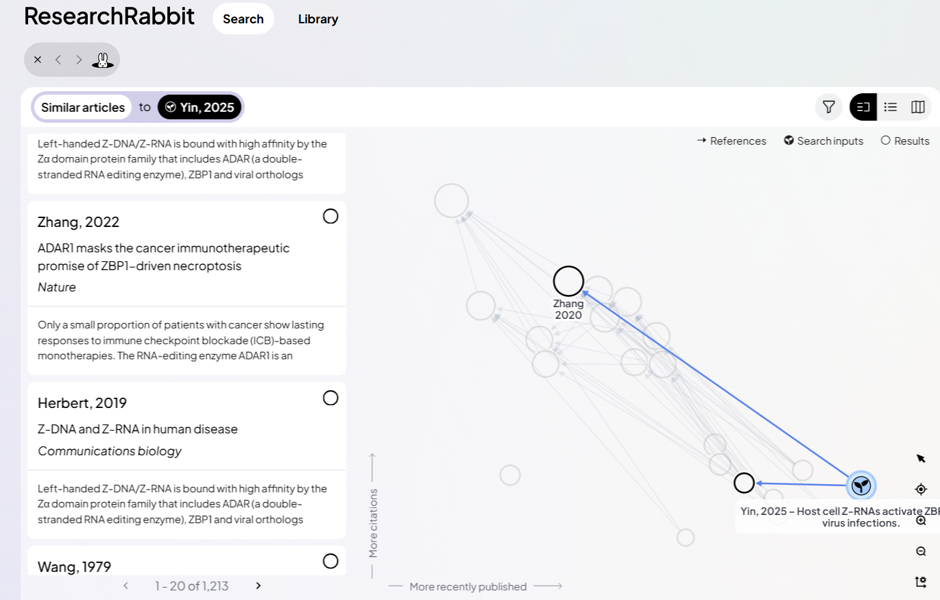
Caption: The visualization made it easier to see older foundational studies and newer papers building on related ideas.
This was probably the most useful part of the experiment.
Rather than seeing literature as a flat list of search results, I could see clusters of papers connected through citations and related work.
Several questions became easier to investigate:
Which older papers appear repeatedly around this topic?
Which authors or research groups occur across multiple papers?
Which newer studies seem to extend earlier discoveries?
Are there papers connecting Z-RNA biology to fields I was not originally searching?
The visualization itself does not tell you whether a study is good.
A highly connected paper can still have methodological limitations.
But the network provides something keyword search does not provide as naturally:
context.
It helps explain where a paper sits inside a research field.
The Unexpected Paper
The real test was whether ResearchRabbit could show me something I probably would not have searched for myself.
Eventually, one recommendation caught my attention:
Unexpected paper:
Nichols, P. J., Welty, R., Krall, J. B., Henen, M. A., Vicens, Q. & Vögeli, B. (2024). Zα Domain of ADAR1 Binds to an A-Form-like Nucleic Acid Duplex with Low Micromolar Affinity. Biochemistry, 63(6), 777–787.
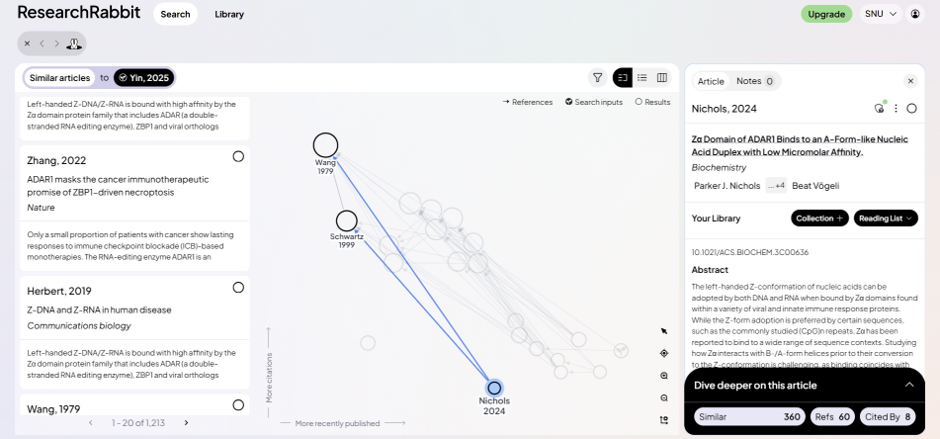
Caption: This was the paper that made the experiment useful—it approached Z-nucleic-acid recognition from a very different angle than my original seed paper.
What made this paper interesting was that it was not primarily about viral infection or ZBP1.
Instead, it examined the Zα domain of another Z-nucleic-acid-binding protein, ADAR1, and asked a more fundamental molecular question: does a Zα domain bind only after a nucleic acid adopts the Z-conformation?
The authors used a locked A-form-like nucleic acid duplex that could not adopt the characteristic Z-form conformation. Surprisingly, the ADAR1 Zα domain still bound this non-Z-form construct with low micromolar affinity.
That immediately changed how I thought about the literature surrounding my seed paper.
If I had searched only for terms such as “host Z-RNA,” “ZBP1 viral infection,” or “ZBP1 Z-RNA,” I probably would not have prioritized a structural biochemistry paper focused on ADAR1.
ResearchRabbit surfaced it because both papers sit within the broader scientific network of Z-nucleic-acid recognition.
Step 5: Was the Paper Actually Worth Reading?
Finding an unexpected paper is not enough.
Recommendation systems can easily generate papers that look related but add very little to the actual research question.
So I opened the paper and evaluated whether it was genuinely useful.
1. Did it contribute information relevant to my research topic?
Yes.
The paper added an important molecular perspective that was missing from my seed paper. My starting paper focused on the biological consequences of Z-RNA recognition by ZBP1 during viral infection, whereas Nichols et al. examined what Zα-domain binding actually means at the structural level.
Most importantly, the study showed that the Zα domain of ADAR1 can bind an A-form-like nucleic acid duplex even when that duplex is prevented from adopting the Z-conformation.
That means Zα-domain binding alone may not always be sufficient evidence that a nucleic acid was already in the Z-form.
2. Did it lead me to another useful mechanism, author, method, or paper?
Yes.
It introduced me to a more mechanistic literature on how Zα domains interact with nucleic acids before and during Z-form adoption.
The paper also made me pay more attention to experimental approaches such as NMR, locked nucleic acid constructs, and biophysical binding measurements—methods I would not necessarily have encountered by staying within the infection and innate-immunity literature.
It also pointed toward a broader question that I had not initially considered:
How confidently can experiments using Zα-domain binding distinguish genuine Z-form nucleic acids from other conformations?
That question is directly relevant when interpreting studies that use Zα-containing proteins or antibodies to identify potential Z-RNA or Z-DNA targets.
3. Would I have included it in my literature collection after reading it?
Yes.
I would not classify it as a central paper for understanding ZBP1-mediated antiviral cell death, but I would definitely keep it in a broader Z-RNA literature collection.
It provides useful mechanistic context for interpreting how Z-nucleic-acid-binding domains recognize their targets and, importantly, highlights a potential limitation in assuming that Zα binding is completely specific to the Z-conformation.
My conclusion was: Worth reading.
The paper was valuable precisely because it was not an obvious extension of my seed paper.
My starting point was a biological study of host-derived Z-RNA activating ZBP1 during viral infection. ResearchRabbit led me instead to a structural biochemistry study of ADAR1 showing that a Zα domain can bind a nucleic acid that is prevented from adopting the Z-conformation.
That connection broadened the question from “Which Z-RNAs activate ZBP1?” to “What does Zα-domain binding actually tell us about nucleic acid conformation?”
I probably would not have prioritized this paper through a narrow keyword search focused on ZBP1 and viral infection.
For me, this was the strongest evidence that ResearchRabbit was doing something meaningfully different from a traditional search engine.
Practical Strengths
ResearchRabbit is particularly strong because it changes how researchers discover scientific literature.
Discovering papers beyond keyword search
Traditional databases depend heavily on search terms.
ResearchRabbit encourages exploration through citation relationships, often revealing relevant papers that would otherwise remain hidden.
Understanding research landscapes
Instead of viewing papers individually, researchers can see how publications connect to one another through citation networks.
This makes it easier to identify influential papers, major research groups, and emerging topics.
Finding influential authors
Scientific progress is often driven by research groups rather than isolated publications.
ResearchRabbit makes it easier to discover leading authors and follow their future work.
Supporting literature reviews
While it cannot perform a literature review automatically, ResearchRabbit dramatically reduces the time required to identify relevant literature before reading begins.
Easy to learn
The interface is intuitive enough that most researchers can begin exploring literature within minutes without extensive training.
Practical Weaknesses
Despite its strengths, ResearchRabbit should not be viewed as a replacement for traditional literature searching.
It cannot judge scientific quality
Highly connected papers are not necessarily high-quality papers.
Researchers must still evaluate methodology, sample size, statistical analysis, and experimental design themselves.
It does not replace Google Scholar or PubMed
ResearchRabbit complements traditional search engines.
It is most effective after researchers have already identified one or several relevant papers.
It does not summarize papers
Unlike NotebookLM, ResearchRabbit does not explain or summarize scientific literature.
Its role ends once the researcher has identified which papers deserve closer attention.
Recommendations require critical thinking
Recommended papers are suggestions—not evidence.
Every recommendation should be evaluated using scientific judgment before being included in a literature review.
Database coverage may change
The breadth of indexed publications and recommendation quality may evolve over time.
ResearchRabbit vs Other Research Tools
| Tool | Best For | Not Designed For |
|---|---|---|
| ResearchRabbit | Literature discovery | Paper summarization |
| Google Scholar | Keyword searching | Citation exploration |
| NotebookLM | Reading uploaded papers | Finding new papers |
| Elicit | Evidence synthesis | Citation visualization |
| Claude | Scientific writing | Literature discovery |
| Zotero | Reference management | AI-assisted analysis |
Rather than competing directly, these tools perform best when each is used for the task it was designed to solve.
Choosing the right workflow is often more important than choosing the “best” AI tool.
Frequently Asked Questions
Is ResearchRabbit free?
ResearchRabbit offers a free version that is sufficient for most researchers, especially for exploring related papers, visualizing citation networks, and organizing literature collections. A premium plan (ResearchRabbit+) is also available for users who need advanced search and larger-scale literature review features.
Is ResearchRabbit better than Google Scholar?
Not necessarily.
Google Scholar is better for keyword searching, while ResearchRabbit excels at discovering related papers through citation relationships.
Most researchers benefit from using both.
Can ResearchRabbit replace a literature review?
No. ResearchRabbit helps researchers discover relevant literature, but evaluating evidence, interpreting results, and synthesizing findings remain human responsibilities.
Does ResearchRabbit summarize papers?
No. For paper summarization and document-based question answering, tools such as NotebookLM are generally more appropriate.
Who should use ResearchRabbit?
ResearchRabbit is especially valuable for graduate students, PhD candidates, postdoctoral researchers, and scientists beginning a new research project or literature review.
Can ResearchRabbit replace PubMed?
No. ResearchRabbit is not designed to replace PubMed. PubMed remains one of the most important databases for biomedical literature and is often the best starting point for keyword-based searches.
ResearchRabbit works best after you have identified one or two relevant papers. It helps you discover related publications, influential authors, and citation networks that traditional database searches may overlook.
For biomedical research, the most effective workflow is often: PubMed → ResearchRabbit → NotebookLM → Zotero
Can I use ResearchRabbit without Google Scholar?
Yes, but it is generally not recommended.
ResearchRabbit is designed for literature exploration rather than initial keyword searching. While you can begin directly within ResearchRabbit, most researchers first identify a high-quality paper using Google Scholar or PubMed and then use that paper as the starting point for exploration.
In practice, the two tools complement each other rather than compete.
Google Scholar helps you find the first paper. ResearchRabbit helps you discover everything that follows.
Final Verdict
ResearchRabbit is one of the most effective literature discovery tools available today.
Its greatest strength is not helping researchers search faster—it helps them discover more intelligently.
My Z-RNA test made that distinction much clearer.
I started with a paper on host-derived Z-RNAs activating ZBP1 during viral infection. ResearchRabbit eventually led me to a structural biochemistry paper examining how the Zα domain of ADAR1 interacts with an A-form-like nucleic acid duplex.
I would not have considered those two papers obvious neighbors from their titles alone. But scientifically, the connection mattered: both raised questions about how Z-nucleic acids are recognized and how confidently Zα-domain binding can be interpreted.
That is the type of discovery where ResearchRabbit provides the most value.
Instead of treating scientific papers as isolated search results, ResearchRabbit encourages researchers to think in terms of citation networks, research communities, and connected ideas.
For researchers who regularly work with scientific literature, it is a tool well worth learning.
Overall Rating: ⭐⭐⭐⭐☆ (4.6/5)
ResearchRabbit is not designed to replace scientific judgment.
It is designed to help researchers discover the evidence that scientific judgment depends on.
Further Reading
If you’d like to learn more about ResearchRabbit, the following official resources are a good place to start:
- ResearchRabbit Official Website – Product overview and latest features
- ResearchRabbit Help Center – User guides and documentation
- ResearchRabbit Blog – Product updates and research workflow tips
Related Articles
• NotebookLM Review (2026) →
After finding relevant papers with ResearchRabbit, many researchers use NotebookLM to summarize, organize, and ask questions about their literature.