Last updated: July 2026 • 13 min read
Quick Verdict
| Category | Rating |
|---|---|
| Literature Review | ⭐⭐⭐⭐⭐ |
| Evidence Synthesis | ⭐⭐⭐⭐⭐ |
| Research Question Exploration | ⭐⭐⭐⭐☆ |
| Ease of Use | ⭐⭐⭐⭐☆ |
| Scientific Writing | ⭐⭐⭐☆☆ |
| Reference Management | ⭐⭐☆☆☆ |
| Overall | ⭐⭐⭐⭐☆ (4.7/5) |
Best For
- Graduate students and PhD candidates
- Researchers conducting literature reviews
- Comparing evidence across multiple studies
- Identifying research gaps
- Building evidence tables
Less Suitable For
- Writing complete manuscripts
- Managing citations
- Statistical analysis
- Replacing careful reading of original papers
Bottom Line
Elicit is one of the more useful AI tools for researchers who need to organize and compare evidence during literature reviews. Rather than replacing researchers, it reduces the manual work of comparing studies, leaving more time for interpretation.
Should You Read This Review?
This review is designed for researchers who regularly work with scientific literature and want to spend less time organizing evidence—and more time interpreting it.
You’ll find this review particularly useful if you are:
- Conducting a literature review for a thesis or dissertation
- Comparing findings across multiple scientific papers
- Looking for a faster way to identify research gaps
- Searching for an AI tool that supports evidence-based research
- Interested in improving your literature review workflow
This review may be less relevant if your primary goal is:
- Writing scientific manuscripts
- Managing references
- Brainstorming research ideas
- General-purpose AI conversations
Rather than asking whether Elicit is “better” than other AI tools, this review focuses on a more practical question:
Can Elicit genuinely improve literature reviews—or does it simply help researchers work faster?
Introduction
Every literature review starts with a simple question:
What does the evidence actually tell us?
Answering that question, however, is rarely simple.
Most researchers can find relevant papers within minutes using Google Scholar or PubMed. The difficult part comes afterward—reading dozens of studies, comparing their findings, identifying recurring patterns, and deciding which conclusions are actually supported by the evidence.
That process often takes far longer than the search itself.
Elicit was built to make this stage of research easier.
Unlike traditional academic search engines, Elicit focuses less on finding papers and more on helping researchers organize and compare evidence across multiple studies.
In other words, it shifts the focus from searching for literature to understanding what the literature collectively suggests.
In this review, I’ll look at where Elicit genuinely saves time, where it still falls short, and how it fits into a modern research workflow alongside tools like ResearchRabbit, NotebookLM, and Claude.
What Is Elicit?
Elicit is an AI-powered research assistant designed to help researchers search scientific literature, compare findings across multiple studies, and organize evidence more efficiently.
Unlike traditional academic search engines, Elicit is not primarily focused on finding papers through keywords.
Instead, it is designed around a different workflow: Research Question → Evidence → Interpretation
Rather than simply asking, “Which papers mention this topic?”
Researchers can ask broader questions, such as:
- Which studies support this hypothesis?
- What evidence currently exists?
- What conclusions appear consistently across multiple papers?
Finding papers has never been the hardest part of research.
Making sense of them is.
That’s exactly where Elicit becomes useful.
Its most useful feature is not the search itself, but the table that follows. By placing study characteristics, methods, and findings side by side, Elicit gives researchers a faster way to compare papers before deciding what to read in depth.
It’s important to understand what Elicit isn’t.
It won’t replace careful reading, it won’t perform a systematic review for you, and it certainly won’t write a publishable paper on its own.
What it does remarkably well is help researchers organize evidence before the real scientific thinking begins.
Real Literature Review Workflow
One misconception appears in almost every discussion about AI for research.
People often assume AI should replace literature reviews.
It shouldn’t. It should help researchers think better—not think for them.
What AI can do exceptionally well is reduce the amount of repetitive work involved in collecting and organizing evidence.
Imagine you are beginning a literature review on ferroptosis in colorectal cancer.
Without AI, the workflow often looks like this:
Research Question → Google Scholar → Read dozens of abstracts → Create manual comparison tables → Identify patterns → Begin writing
This process can take many hours before meaningful analysis even begins.
A more efficient workflow using Elicit looks like this:
Research Question → Elicit → Relevant Papers → Evidence Table → NotebookLM → Claude → Manuscript
Here’s how each stage contributes to the research process.
Step 1: Start with a research question
Instead of beginning with keywords, begin with the scientific question you are trying to answer.
For example: Does ferroptosis contribute to colorectal cancer progression?
This immediately focuses the search on evidence rather than terminology.
Step 2: Compare evidence instead of collecting papers
Rather than downloading dozens of papers immediately, use Elicit to identify relevant studies and organize their findings into structured tables.
Instead of asking,
“How many papers can I find?”
The better question becomes:
“What patterns emerge across these studies?”
Step 3: Read strategically
Once Elicit has identified the most relevant evidence, move to NotebookLM to understand the papers in greater depth.
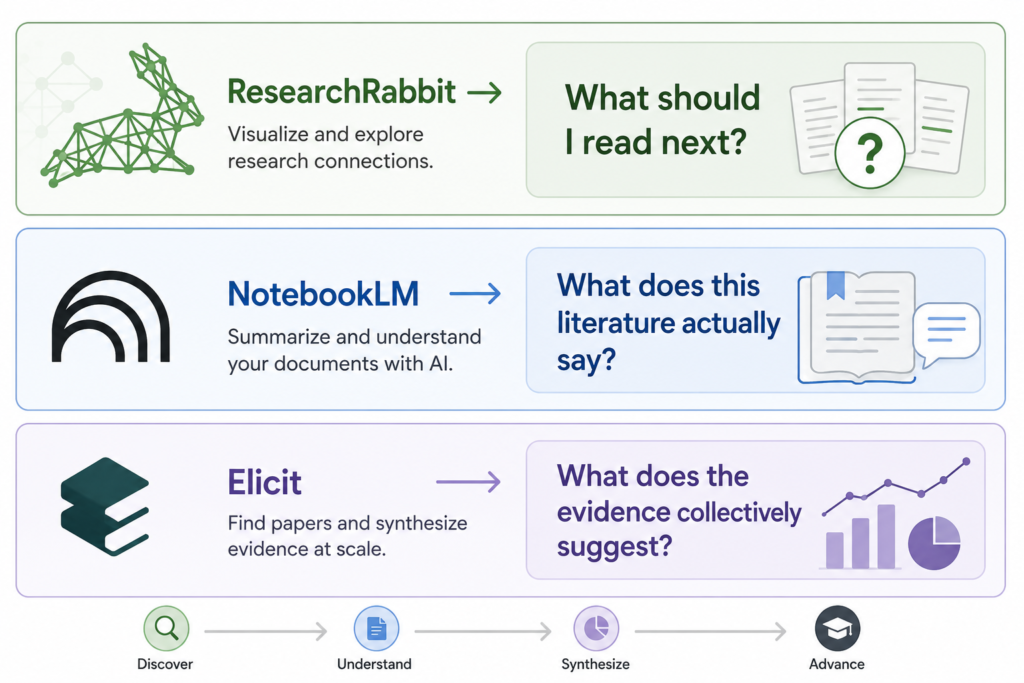
Elicit answers:
“What does the evidence collectively suggest?”
NotebookLM answers:
“What do these individual papers actually say?”
Together, they create a much more efficient literature review process than either tool alone.
Step 4: Write with confidence
After understanding the evidence, move to a writing assistant such as Claude to organize ideas into a clear scientific narrative.
Each tool contributes to a different stage of research.
No single tool does everything well.
The most effective researchers are not looking for one perfect AI tool. They know when to switch tools.
Practical Strengths
Elicit is most useful when a literature review starts becoming hard to manage.
At the beginning, reading a few papers is straightforward. But once the number grows to twenty, thirty, or more, the real difficulty is no longer finding papers. It is keeping track of what each study examined, what it found, and how those findings compare with one another.
At that point, the value of Elicit becomes less about speed and more about structure.
It does not remove the need for careful reading, but it can make the early stages of evidence organization much less tedious.
Saves time during literature reviews
Elicit reduces the repetitive screening work that often slows down early literature reviews.
Instead of opening every paper individually just to understand whether it is relevant, researchers can quickly scan study details, summaries, and extracted information in one place.
This is especially useful when a topic has a large number of related papers. Elicit helps narrow the field before deeper reading begins.
It does not decide which papers are important for you. But it helps you reach that decision faster.
Makes patterns easier to notice
When papers are read one by one, patterns are easy to miss.
One study may report a particular mechanism. Another may use a different model system. A third may reach a similar conclusion but with a very different method.
Elicit helps bring those details closer together.
Instead of asking only:
“What does this paper conclude?”
the better question becomes:
“What patterns appear across these studies?”
That shift is important. Literature reviews are not just collections of summaries. They are attempts to understand how evidence fits together.
Helps organize evidence into tables
Manually building evidence tables is one of the least glamorous parts of research.
It is also one of the most useful.
Elicit can help organize information from multiple studies into structured tables, making it easier to compare study characteristics, methods, outcomes, and findings.
These tables should not be treated as final answers. They are better understood as a starting point: a way to decide which papers deserve closer attention and which claims need to be checked in the original text.
For early-stage literature review, that is already valuable.
Useful for finding research gaps
Research gaps often become visible only after multiple studies are compared side by side.
Elicit can make this process easier by helping researchers notice where findings are consistent, where evidence is thin, and where studies disagree.
That does not mean Elicit can tell you what your next research project should be.
It cannot.
But it can make the landscape easier to inspect, which is often the first step toward asking better research questions.
Practical Weaknesses
Elicit is useful, but it has clear limits.
Those limits matter because Elicit is most helpful when its role is clearly defined.
It cannot tell whether evidence is convincing
This is the biggest limitation.
Elicit can organize evidence, but it cannot reliably judge whether that evidence is strong.
Two papers may report similar conclusions while differing sharply in sample size, experimental design, statistical quality, or risk of bias. A table can place those findings next to each other, but it cannot replace the judgment required to interpret them.
That part still belongs to the researcher.
It does not replace careful reading
Evidence tables are helpful, but they are not the same as understanding a paper.
Important details often live in the methods, figures, supplementary materials, or discussion section. These details can completely change how a study should be interpreted.
Before citing a paper or using it to support a scientific claim, researchers still need to return to the original publication.
Elicit can help decide what to read first. It cannot do the reading for you.
It cannot perform a systematic review by itself
Elicit can support literature review, but it should not be confused with a complete systematic review workflow.
A proper systematic review requires a predefined protocol, clear inclusion and exclusion criteria, database search strategy, screening process, quality assessment, and transparent reporting.
Elicit may help with parts of that process, especially evidence organization, but it does not replace the methodological rigor required for formal review work.
Database coverage may change
As with most AI research tools, the sources Elicit searches and the features it provides may change over time.
Where Elicit Fits Into My Workflow
One thing that became clear while exploring Elicit is that it approaches literature reviews very differently from traditional academic search engines.
Rather than encouraging researchers to collect as many papers as possible, it encourages them to organize evidence first.
That subtle shift changes the workflow.
Instead of opening dozens of abstracts one by one, I found myself comparing study characteristics, reported findings, and publication details in a single view. The goal was no longer simply to build a reading list. It was to understand how the existing evidence fits together.
For research areas with hundreds of publications, this approach can significantly reduce the amount of manual organization required before deeper reading begins.
Of course, Elicit does not replace careful evaluation of the original papers.
Study quality, methodology, experimental design, and interpretation still require human judgment.
In my view, Elicit works best as an evidence organization tool rather than a literature review replacement.
I would use it after defining a research question, then move to NotebookLM for detailed reading and Claude for drafting and refining scientific writing.
Elicit vs Other AI Tools
| Tool | Best For | Not Designed For |
|---|---|---|
| ResearchRabbit | Discovering relevant papers | Summarizing papers |
| Elicit | Comparing evidence across studies | Judging evidence quality |
| NotebookLM | Understanding individual papers | Finding new papers |
| Claude | Scientific writing and editing | Literature discovery |
| ChatGPT | Brainstorming and general reasoning | Source-grounded review |
| Zotero | Reference management | Evidence synthesis |
I would not choose just one of these tools.
The better question is not which tool is best, but where each tool belongs in the research workflow.
ResearchRabbit helps me find papers. Elicit helps me compare evidence. NotebookLM helps me understand individual papers. Claude helps me turn rough ideas into clearer writing. Zotero keeps the references organized.
The mistake is expecting one tool to do everything.
A better approach is to know when to switch tools.
Frequently Asked Questions
Is Elicit free?
Elicit offers a free version with limited usage. Pricing, available features, and subscription plans may change, so it is worth checking the official website before relying on it for a large project.
Can Elicit replace Google Scholar?
No.
Google Scholar is still useful for broad keyword-based searching. Elicit is better suited for organizing and comparing evidence once you have a research question or a topic area. In practice, the two tools work better together than separately.
Can Elicit replace systematic reviews?
No.
A systematic review requires a protocol, search strategy, screening criteria, quality assessment, and transparent reporting. Elicit can help organize evidence, but it cannot replace that process.
Can Elicit summarize scientific papers?
Yes, but summaries should be treated as starting points. Before citing a finding or using it to support an argument, researchers should verify it in the original paper.
Is Elicit better than ResearchRabbit?
Not exactly.
ResearchRabbit is better for discovering papers through citation relationships. Elicit is better for comparing evidence across studies. I would use ResearchRabbit to expand the literature and Elicit to examine what that literature suggests.
Is Elicit better than NotebookLM?
They serve different purposes. NotebookLM is stronger when you want to work closely with specific papers you have uploaded. Elicit is more useful when you want to compare evidence across multiple studies. For literature review, they complement each other well.
Can beginners use Elicit?
Yes.
Graduate students and early-stage researchers may find Elicit especially helpful because it makes the structure of evidence easier to see. Still, beginners should be careful not to treat AI-generated tables as final conclusions.
What is Elicit’s biggest limitation?
Its biggest limitation is that it cannot judge whether evidence is scientifically convincing. It can organize information. It can highlight patterns. But the interpretation still has to come from the researcher.
When should I use Elicit in a literature review?
Use Elicit after you have a clear research question or topic area, but before reading every paper in depth. It is most useful for organizing and comparing evidence during the early synthesis stage.
Final Verdict
Elicit is not a tool that replaces researchers.
It is a tool that makes the evidence easier to work with.
For literature reviews, that matters. Researchers often lose hours not because they cannot find papers, but because comparing those papers is slow and repetitive. Elicit helps reduce that burden.
Used carefully, it can make literature review more organized, more efficient, and less overwhelming.
But the final interpretation still belongs to the researcher.
Overall Rating: ⭐⭐⭐⭐☆ (4.7/5)
Further Reading
If you’d like to learn more about Elicit, the following official resources are a good place to start:
- Elicit Official Website – Product overview and latest features
- Elicit Help Center – User guides and documentation
- Elicit Blog – Product updates and research workflow tips
Related Articles
• NotebookLM Review (2026) →
After comparing evidence with Elicit, many researchers use NotebookLM to read and question individual papers in greater depth.
• ResearchRabbit Review (2026) →
Looking for a tool to discover related papers before comparing evidence? Read our ResearchRabbit Review.