Last updated: July 2026 • 12 min read
Scite Review (2026): Can Smart Citations Help Researchers Evaluate Evidence?
Quick Verdict
| Category | Rating |
|---|---|
| Citation Context | ⭐⭐⭐⭐⭐ |
| Literature Review Support | ⭐⭐⭐⭐☆ |
| Evidence Evaluation | ⭐⭐⭐⭐☆ |
| Paper Discovery | ⭐⭐⭐☆☆ |
| Ease of Use | ⭐⭐⭐⭐☆ |
| Scientific Writing | ⭐⭐☆☆☆ |
| Overall | ⭐⭐⭐⭐☆ (4.7/5) |
Best For
- Researchers evaluating influential papers
- Literature reviews
- Understanding citation context
- Checking whether important findings have been supported or challenged
- Researchers working in rapidly evolving fields
Less Suitable For
- Finding papers from scratch
- Scientific writing
- Reference management
- Determining whether a paper is scientifically correct
- Replacing careful reading of original studies
Bottom Line
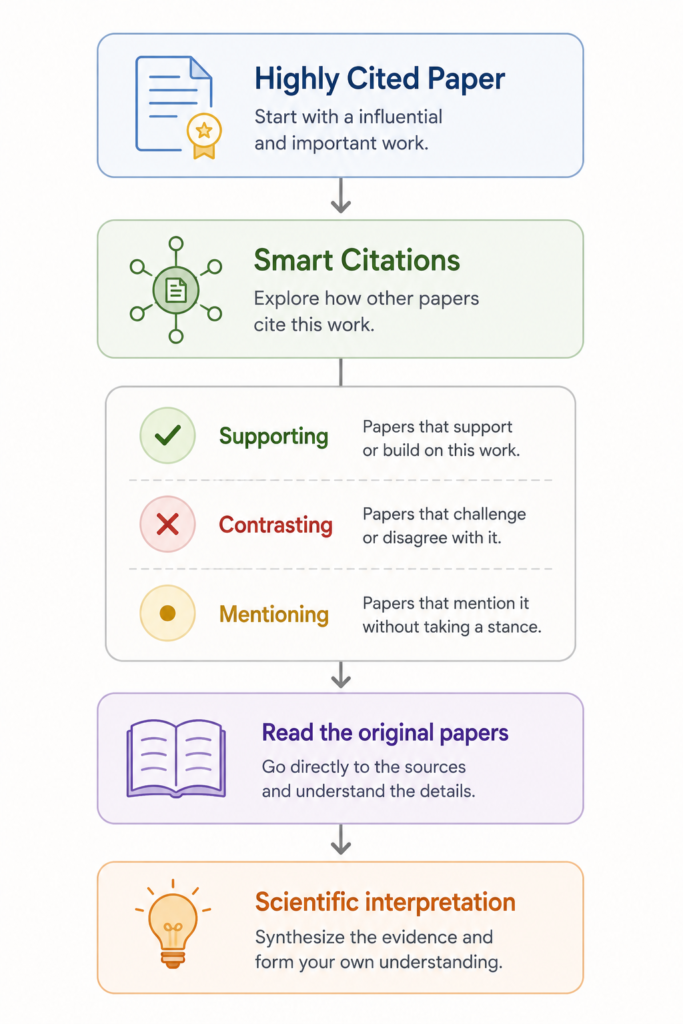
To test whether that distinction actually matters in practice, I also examined a highly cited biology paper and compared its raw citation count with the citation context shown in Scite.
The result was a useful reminder: a large citation number and strong scientific support are not necessarily the same thing.
Should You Read This Review?
This review is designed for researchers who regularly work with scientific literature and want more than a simple citation count.
You’ll find it particularly useful if you are:
- Conducting literature reviews
- Evaluating influential papers before citing them
- Looking for supporting or contrasting evidence
- Working in a field where scientific findings continue to evolve
- Interested in understanding citation context rather than citation numbers
This review may be less relevant if your primary goal is:
- Finding papers through keyword searches
- Writing manuscripts with AI
- Managing references
- Reading full-text papers
Rather than asking whether Scite is “better” than Google Scholar or other AI tools, this review focuses on a more practical question:
Can Scite help researchers move beyond citation counts and better understand how scientific papers are actually cited?
Introduction
A citation count tells you that a paper has been noticed.
It does not tell you why.
Was the paper cited because later studies confirmed its findings? Was it challenged? Was it simply mentioned as background? Traditional citation metrics cannot answer those questions.
For many researchers, that missing context becomes a problem during literature review.
A highly cited paper often appears trustworthy at first glance. But citation counts alone cannot distinguish between broad scientific support, ongoing debate, or routine background references.
This is exactly the gap Scite tries to fill.
Instead of focusing only on how often a paper has been cited, Scite focuses on how it has been cited.
That seemingly small difference changes the way researchers evaluate scientific literature.
In this review, I’ll examine where Scite genuinely improves literature review, where its limitations remain, and how it fits into a modern research workflow alongside Google Scholar, ResearchRabbit, Elicit, NotebookLM, Claude, and Zotero.
But I also wanted to test Scite’s central idea with a real scientific paper.
If a biology paper has been cited hundreds—or thousands—of times, does that actually mean later research strongly supports it?
To find out, I compared the conventional citation count of a highly cited paper with its Supporting, Contrasting, and Mentioning citations in Scite. I then opened several of those citation statements myself to see whether Scite’s labels actually matched the scientific context.
What Is Scite?
Scite is a research tool designed to help researchers understand the context behind scientific citations.
Traditional academic databases tell researchers how many times a paper has been cited.
Scite asks a different question: How has this paper been cited?
Its best-known feature, Smart Citations, attempts to classify citation statements into categories such as supporting, contrasting, and mentioning. Rather than treating every citation equally, Scite provides additional context that helps researchers interpret how later studies have responded to earlier work.
This makes Scite fundamentally different from literature search tools.
Google Scholar helps researchers discover papers.
ResearchRabbit helps them discover related literature.
NotebookLM helps them understand individual papers.
Elicit helps them compare evidence across multiple studies.
Scite sits at a different stage of the workflow.
It helps researchers evaluate how scientific claims have been discussed by later research.
The workflow shifts from counting citations to understanding them.
A paper may receive hundreds or even thousands of citations, but those citations do not necessarily indicate strong scientific support. Some papers are frequently cited because they introduced an important method. Others become highly cited because later researchers questioned or challenged their conclusions.
Citation counts alone cannot distinguish between those situations.
That’s where Scite becomes genuinely useful.
It is important, however, to understand what Scite is not.
It won’t tell you whether a study is correct.
You’ll still need to evaluate the methods yourself.
Think of Scite as additional context—not a replacement for critical reading.
Scite does not simply ask how many times a paper has been cited.
It asks how that paper has been cited.
How Scite Fits Into a Research Workflow
Many researchers first encounter Scite only after they have already identified an important paper.
That is exactly where the platform provides the greatest value.
A practical workflow might look like this:
Research Question → Google Scholar / PubMed → ResearchRabbit → Scite → Elicit → NotebookLM → Claude → ManuscriptEach tool answers a different question.
Google Scholar and PubMed help identify relevant literature.
ResearchRabbit expands that literature through citation networks.
Scite adds another layer by asking how later researchers have cited those papers.
Once the citation context becomes clearer, Elicit can help compare evidence across studies, NotebookLM can support deeper reading, and Claude can help organize ideas into a well-structured manuscript.
Imagine you are investigating a highly cited paper on a cancer signaling pathway.
Google Scholar shows that the paper has been cited hundreds of times.
At first glance, that looks reassuring.
But before treating it as strong evidence, you open Scite.
Instead of seeing only a citation count, you discover that later papers include a mixture of supporting, contrasting, and mentioning citations.
Rather than accepting the original findings at face value, you now know which follow-up studies deserve closer attention.
Once I understand that citation landscape, I would move to NotebookLM to read the key papers in depth and then use Elicit to compare their findings more systematically.
That is where Scite fits naturally into a research workflow.
It does not replace literature search.
It does not replace evidence synthesis.
It helps researchers decide what deserves a closer look before drawing scientific conclusions.
Does a Highly Cited Paper Actually Have Strong Support?
Scite sounds most useful in theory when a paper has already accumulated a large number of citations.
So I wanted to test a simple question:
If a scientific paper is highly cited, how much of that citation activity actually represents support for its findings?
For this test, I chose a well-known paper from cell biology:
Dixon, S. J. et al. (2012). Ferroptosis: An Iron-Dependent Form of Nonapoptotic Cell Death. Cell.
This paper helped establish ferroptosis as a distinct form of regulated cell death and became highly influential across cancer biology, metabolism, oxidative stress, and related fields.
First, I Checked the Citation Count
I started with the conventional metric.
At the time I checked, Google Scholar showed approximately:
Google Scholar citations: 19,743
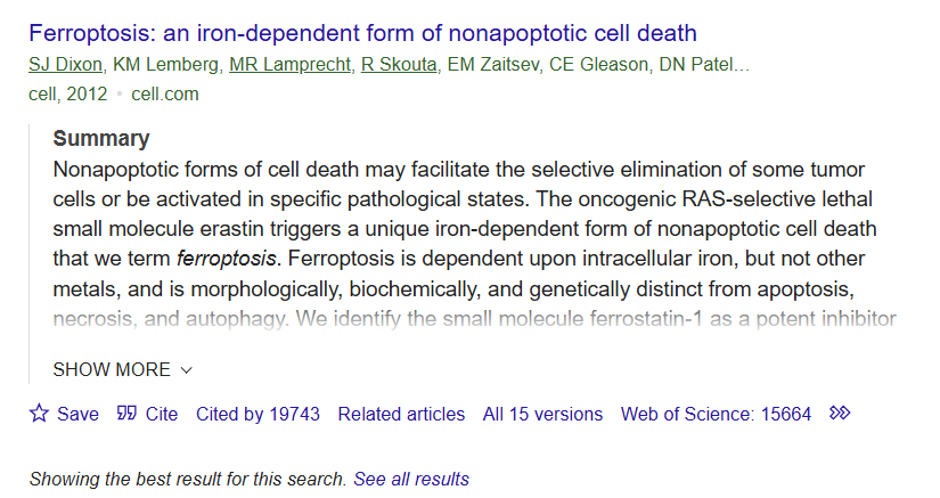
Caption: A conventional citation count immediately makes the paper look highly influential—but it does not explain why later researchers cited it.
There is no question that this number indicates enormous scientific influence.
But it does not answer a more important question:
Were later researchers actually confirming the paper’s findings?
That is where I opened Scite.
What Scite Showed
Scite presented a very different view of the same citation record.
At the time of my test, the Smart Citation breakdown was:
Supporting: 282
Contrasting: 17
Mentioning: 17,365
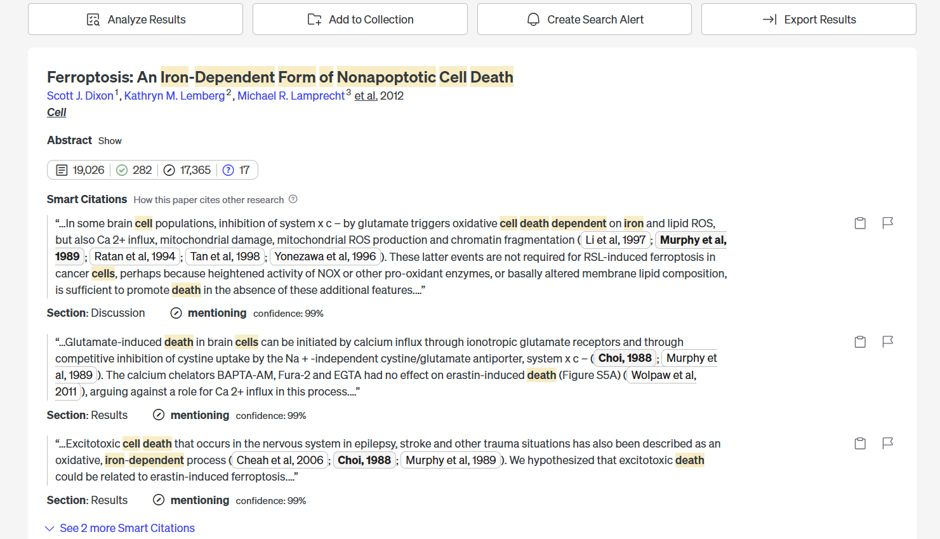
Caption: Scite separates citation activity into Supporting, Contrasting, and Mentioning statements rather than treating every citation as equivalent.
The first thing that stood out was that the total number of citations was not the most informative part of the result.
What mattered was how those citations were distributed.
A large proportion of citations may simply mention the original paper when introducing ferroptosis, describing previous work, or providing historical context.
Those citations demonstrate influence.
They do not necessarily represent independent experimental confirmation.
That distinction is easy to miss when looking only at a citation count.
I Opened One Contrasting Citation Myself
The citation breakdown was useful, but I did not want to stop at the numbers.
For the Dixon et al. ferroptosis paper, Scite showed a large number of citation statements, with most classified as Mentioning, a smaller number as Supporting, and only a small fraction as Contrasting.
That immediately raised a question:
What does a “Contrasting” citation actually look like in practice?
So I opened one of them.
The paper Scite showed was:
Kwon et al. (2020). Systematic identification of a nuclear receptor-enriched predictive signature for erastin-induced ferroptosis. Redox Biology.
Scite classified the citation as Contrasting, with 99% confidence.
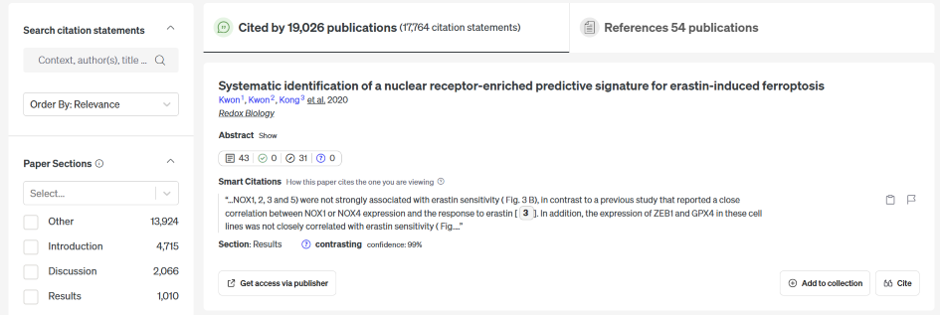
Caption: Scite classified this citation as Contrasting because the later study reported a different relationship between NOX expression and erastin sensitivity.
The citation statement was more nuanced than the label initially suggested.
Kwon et al. reported that NOX1, NOX2, NOX3, and NOX5 were not strongly associated with erastin sensitivity in their dataset. They explicitly contrasted this with earlier work reporting a close correlation between NOX1 or NOX4 expression and the response to erastin.
After reading the citation in context, I thought Scite’s Contrasting classification was reasonable.
But this example also showed why the label should not be interpreted too broadly.
The later paper was not rejecting ferroptosis as a form of cell death, nor was it disproving the central conclusions of Dixon et al.
The disagreement was much narrower.
It concerned a specific mechanistic relationship between NOX expression and erastin sensitivity.
That distinction matters.
If I had only seen the word Contrasting, I might have assumed that the later paper challenged the original ferroptosis study more broadly.
Reading the actual citation statement showed that the scientific disagreement was much more specific.
What the Citation Numbers Actually Told Me
This also changed how I interpreted the citation breakdown itself.
The Dixon paper had accumulated a very large number of citations, but the majority of citation statements in Scite were classified as Mentioning, while only a much smaller number were classified as Supporting or Contrasting.
That does not mean the paper lacks support.
It means that citation count and experimental support are not the same metric.
A paper can become highly cited because it introduced a concept, established terminology, became a standard reference, or influenced an entire research field.
Many later papers may therefore cite it as background without directly testing its original conclusions.
This is exactly the kind of distinction that a traditional citation count cannot show.
Was Scite’s Classification Actually Useful?
In this example, yes.
The most useful part of Scite was not simply seeing that the paper had a Contrasting citation.
It was being able to jump directly to the sentence where the later authors explained what differed from the earlier work.
That made the disagreement much easier to interpret.
At the same time, this small test reinforced an important limitation:
Smart Citation labels should be treated as filters, not scientific verdicts.
A Contrasting citation does not mean that an entire paper has been disproven.
Likewise, a Supporting citation would not prove that every conclusion in the original study is correct.
The scientific meaning depends on which specific claim is being discussed.
For me, the useful workflow became:
See the citation label → open the citation statement → identify the specific claim → decide whether the citing paper deserves closer reading.
That is much more informative than simply counting citations.
What This Test Changed About My View of Scite
Before doing this test, I mainly thought of Scite as a more sophisticated way of displaying citation information.
After opening an actual Contrasting citation, I think its value is more specific.
Google Scholar can tell me:
“This paper has been cited a lot.”
Scite can help me investigate:
“What exactly did later researchers agree or disagree with?”
Those are very different questions.
The Dixon paper is clearly influential.
But influence does not mean that every mechanistic detail proposed in an influential paper remains unchanged as a field develops.
The Kwon et al. example made that especially clear.
The later study did not challenge ferroptosis itself. Instead, it reported a different relationship between NOX expression and erastin sensitivity.
That is precisely the kind of scientific nuance that disappears inside a raw citation count.
For me, that is where Scite adds the most value:
citation count shows how much attention a paper received; citation context shows what happened to its claims afterward.
Practical Strengths
Scite becomes most useful after you have already found an important paper.
At that point, the question is no longer “Where can I find more papers?” It becomes “How should I interpret this one?”
That is where Scite provides something that traditional citation databases often cannot.
Goes beyond citation counts
Citation counts are useful, but they tell only part of the story.
A paper may be cited hundreds of times because it introduced a widely used method. Another may receive the same number of citations because later studies questioned its conclusions.
Without context, those two situations look identical.
Scite helps researchers move beyond citation numbers by showing how later papers have cited the original study.
That extra layer of context makes citation counts much more informative.
Makes scientific debate easier to recognize
Scientific progress rarely follows a straight line.
Researchers often disagree, refine previous findings, or report conflicting results.
Those disagreements are not weaknesses of science—they are part of how scientific knowledge develops.
Scite makes those conversations easier to discover by highlighting supporting, contrasting, and mentioning citations.
For researchers entering a new field, this provides a much clearer picture of where consensus exists and where important questions remain open.
Useful before citing influential papers
One habit I have gradually developed is checking important papers in Scite before citing them.
A highly cited paper can appear authoritative, but citation counts alone cannot reveal whether later researchers largely supported its conclusions or repeatedly challenged them.
Scite provides a useful checkpoint before relying on a paper as evidence.
It does not replace reading the paper itself, but it helps determine which citations deserve closer attention.
Improves literature review decisions
Literature reviews are not simply about collecting papers.
They are about understanding how evidence develops across the scientific literature.
By revealing citation context, Scite helps researchers decide which papers deserve deeper reading and which scientific claims require additional verification.
For that reason, I see Scite as a decision-support tool rather than a literature search engine.
Practical Weaknesses
Like every research tool, Scite has clear limitations.
Understanding those limitations is just as important as understanding its strengths.
Scite cannot determine scientific truth
This is the single most important limitation.
Scite can organize citation context.
It cannot determine whether a scientific claim is correct.
Supporting citations do not automatically validate a conclusion, and contrasting citations do not automatically invalidate it.
Researchers still need to evaluate study design, methodology, statistical analysis, and the broader body of evidence.
Citation context is not the same as study quality
A paper may receive many supporting citations while still containing important methodological limitations.
Likewise, a paper with contrasting citations may simply be part of an active scientific debate rather than being fundamentally flawed.
Citation context should always be interpreted alongside critical appraisal of the original studies.
Smart Citations are useful—but not perfect
Scientific writing is nuanced.
Citation intent can sometimes be difficult to classify, especially when authors discuss previous work in complex or mixed ways.
For that reason, Smart Citation labels should be treated as helpful guides rather than definitive judgments.
Whenever a citation appears particularly important, researchers should read the original citing passage themselves.
Less useful for newly published papers
Citation context develops over time.
Very recent papers may have few citations, making Scite less informative for newly published research.
In these situations, traditional literature searches and careful reading remain more valuable.
Where Scite Fits Into My Workflow
After using Scite alongside my usual workflow, I noticed one change almost immediately.
It works best in the middle of the research workflow—not at the beginning.
I would not start a literature review with Scite.
Instead, I would first identify important papers using Google Scholar, PubMed, or ResearchRabbit.
Only after finding those key papers would I open Scite.
At that point, my question changes.
Instead of asking,
“What papers should I read next?”
I begin asking,
“How has the scientific community responded to this paper?”
That shift completely changes the purpose of the tool.
If I discover several contrasting citations, I know those papers deserve closer reading before I rely on the original findings.
If most citations simply mention the paper without directly supporting its conclusions, I become more cautious about treating citation count as evidence.
Only after understanding that citation landscape would I move to NotebookLM for detailed reading, Elicit for evidence comparison, and Claude for writing.
For me, Scite works best as a citation-context checkpoint rather than a literature search engine.
Scite vs Other AI Tools
| Tool | Best For | Not Designed For |
|---|---|---|
| Scite | Citation context | Judging scientific truth |
| ResearchRabbit | Finding related papers | Citation evaluation |
| Elicit | Comparing evidence | Citation context analysis |
| NotebookLM | Reading individual papers | Literature discovery |
| Claude | Scientific writing | Literature search |
The better question is not which tool is “best.”
The better question is which stage of the research workflow each tool improves.
Key Takeaways
- Citation count does not necessarily reflect scientific support.
- Smart Citations provide context, not conclusions.
- Supporting citations are useful signals—not proof.
- Contrasting citations deserve careful reading rather than immediate dismissal.
- Scite works best after discovering important papers.
- The most effective workflow combines ResearchRabbit, Scite, Elicit, NotebookLM, and Claude.
Frequently Asked Questions
What is Scite?
Scite is a research tool that helps researchers understand how scientific papers have been cited by later studies through Smart Citations.
What are Smart Citations?
Smart Citations classify citation statements as supporting, contrasting, or mentioning, providing context beyond traditional citation counts.
Is Scite free?
Scite offers different access plans.
Can Scite replace Google Scholar?
No. Google Scholar is designed for literature search. Scite is designed to evaluate citation context after important papers have been identified.
Can Scite replace PubMed?
No. PubMed remains one of the primary databases for biomedical literature searching. Scite complements rather than replaces it.
Can Scite tell whether a paper is reliable?
Not directly. Scite helps researchers inspect how later studies have cited a paper, but evaluating reliability still requires critical reading.
What does a contrasting citation mean?
A contrasting citation indicates that a later paper reports findings or interpretations that differ from the cited work. It does not automatically mean the original paper is incorrect.
Do supporting citations prove a claim?
No. Supporting citations are useful evidence, but they should always be interpreted alongside study quality and methodology.
Is Scite useful for literature reviews?
Yes. Scite is particularly useful for evaluating influential papers and understanding scientific debate during literature review.
Is Scite better than Elicit?
Not necessarily. Elicit helps compare evidence across multiple studies. Scite helps researchers understand how those studies have been cited. The two tools complement each other.
When should researchers use Scite?
Scite is most useful after identifying important papers but before relying heavily on them in a literature review or manuscript.
What is Scite’s biggest limitation?
Its biggest limitation is that it cannot determine whether scientific evidence is true or convincing. Researchers must still evaluate the original studies themselves.
Final Verdict
Scite is most valuable when researchers treat it as a citation-context checkpoint—not an authority.
My test with a highly cited biology paper made the distinction especially clear.
A large citation count immediately tells you that a study has influenced a field. But it does not tell you whether those citations represent experimental support, disagreement, methodological use, or simple background references.
Scite makes those differences much easier to investigate.
What I would not do is treat the Supporting, Contrasting, or Mentioning numbers as a score for scientific truth.
The most useful workflow was much simpler:
Find an influential paper → check its citation context → identify important Supporting or Contrasting citations → read those citations yourself.
That is where Scite provides something Google Scholar cannot provide as easily.
Google Scholar tells me:
“This paper matters.”
Scite helps me investigate:
“Why does it matter, and what happened after it was published?”
For researchers conducting serious literature reviews, that is a meaningful difference.
Scite cannot replace critical reading, but it can help researchers decide where critical reading is needed most.
Further Reading
If you’d like to explore Scite in more detail, the following official resources are worth reading:
- Scite Official Website – Learn about Smart Citations, Scite Assistant, and the platform’s core features.
- Scite Help Center – Tutorials, FAQs, and documentation for using Scite effectively.
- Scite Blog – Product updates, research workflows, and articles about evidence evaluation.
Related Articles
• NotebookLM Review (2026) →
After identifying the most important papers with Scite, NotebookLM can help you read, summarize, and explore those papers in greater depth.
• ResearchRabbit Review (2026) →
Need to discover influential papers before checking how they have been cited? ResearchRabbit is a better starting point for literature discovery.
• Elicit Review (2026) →
Once you’ve identified reliable papers and understood their citation context, Elicit can help compare evidence across multiple studies and organize findings for your literature review.