Last updated: July 2026 • 15 min read
Best NotebookLM Prompts for Researchers (2026): 50 Practical Prompts for Literature Reviews, Paper Reading, and Scientific Writing
Quick Answer
If you’re using NotebookLM for literature reviews, the best time to introduce it is after you’ve collected your papers but before you begin writing.
NotebookLM is not designed to replace critical reading or scientific judgment. Instead, it helps researchers understand, compare, and organize information across their own documents. When used with the right prompts, it can turn a collection of papers into a structured knowledge base rather than a folder full of PDFs.
This guide focuses on one goal: helping researchers use NotebookLM more effectively during literature review.
Why Most Researchers Use NotebookLM Ineffectively
The first question many researchers ask NotebookLM is surprisingly simple:
“Summarize this paper.”
There is nothing wrong with that prompt.
The problem is that almost everyone stops there.
A summary tells you what the authors wrote. It rarely helps you evaluate the quality of the evidence, compare multiple studies, or identify unanswered questions.
Those are the tasks that make literature reviews difficult.
NotebookLM becomes much more useful when you stop asking it to summarize information and start asking it to analyze it.
Instead of treating NotebookLM as an AI that gives answers, think of it as a research partner that helps you ask better questions.
That small change in mindset often produces much better results than learning dozens of new features.
This guide focuses on those questions.
Before You Start
NotebookLM works best when you prepare your sources before opening the notebook.
Many disappointing experiences with NotebookLM have very little to do with the AI itself. They usually begin with poorly organized source material.
Before creating a notebook, make sure you have:
- ✅ A clear research question
- ✅ One well-defined research topic
- ✅ A focused collection of related papers
- ✅ PDF versions (or other currently supported source formats) of those papers
For most literature reviews, a notebook containing 5–15 closely related papers is often easier to manage than one containing dozens of loosely connected articles. (Current upload limits and recommendations may change over time and should be verified.)
For example, instead of creating a notebook called:
❌ Cancer
create one with a much narrower focus:
- ✅ Single-cell RNA sequencing in colorectal cancer
The more focused your notebook is, the more focused NotebookLM’s answers become.
Finally, remember one simple principle before moving on:
NotebookLM works with the papers you choose. The quality of its answers depends heavily on the quality of the literature you provide.
1. Understanding Papers
Most researchers begin by asking NotebookLM to explain and summarize a paper.
There’s nothing wrong with starting there.
I did the same when I first began using NotebookLM.
But after a while, I realized that the summaries weren’t the most useful part.
The summaries helped me understand the paper. The questions helped me understand the research.
Prompt 1-1
What is the main research question this paper is trying to answer?
Why it works
Before looking at the results, I like to understand the problem the authors were actually trying to solve.
This prompt immediately identifies the scientific problem the study addresses, making it easier to understand why the paper was conducted in the first place.
Best used for
- Reading unfamiliar papers
- Beginning a literature review
- Understanding the purpose of a study
Avoid using it when
You already understand the paper and need deeper analysis rather than an overview.
Prompt 1-2
Which experiments provide the strongest evidence for the authors’ conclusions?
Why it works
Instead of treating every figure equally, this prompt helps you identify the experiments that carry the greatest weight in the paper’s overall argument.
Best used for
- Critical reading
- Journal clubs
- Preparing presentations
- Exam preparation
Prompt 1-3
Which conclusions are directly supported by evidence, and which are more speculative?
Why it works
Why it works
I’ve found that many papers mix well-supported findings with broader interpretations.
This prompt helps separate the two before they become confused in my notes.
Best used for
- Reading high-impact papers
- Evaluating controversial findings
- Preparing literature reviews
2. Critical Reading Prompts
Understanding a paper is only the beginning.
The more difficult question is whether the evidence actually supports the authors’ conclusions.
The goal is no longer to ask “What did the authors find?”
Instead, ask: “How convincing are those findings?”
Prompt 2-1
What are the major limitations of this study?
Why it works
Every study has limitations.
Sometimes the authors discuss them openly. Sometimes they are easier to recognize only after stepping back and looking at the study as a whole.
Starting with limitations often leads to a much more balanced understanding of the paper.
Best used for
- Literature reviews
- Journal clubs
- Critical appraisal
Prompt 2-2
Which conclusions remain uncertain based on the available evidence?
Why it works
One thing I’ve learned from reading papers is that confidence and evidence are not always proportional.
Some conclusions are strongly supported.
Others remain tentative.
This prompt helps distinguish between the two.
Best used for
- Reading review papers
- Identifying research gaps
Prompt 2-3
What assumptions do the authors make throughout this paper?
Why it works
Important assumptions often remain implicit.
Making them explicit can change how you interpret the entire study.
Best used for
- Critical analysis
- Advanced literature reviews
Prompt 2-4
Which results would require additional evidence before becoming convincing?
Why it works
Rather than accepting conclusions at face value, this prompt encourages NotebookLM to identify areas where stronger evidence may still be needed.
Best used for
- Evaluating influential papers
- Planning future research
3. Comparing Multiple Papers
NotebookLM becomes even more useful once several related papers have been uploaded into the same notebook.
This is where it begins to function less like a summarization tool and more like a literature review assistant.
Many researchers ask: Compare these papers.
The response is often broad and descriptive.
Instead, try asking more focused questions.
Prompt 3-1
Which findings appear consistently across these studies?
Why it works
Instead of focusing on individual papers, this prompt highlights recurring patterns across the literature.
Those patterns are often much more valuable than any single result.
Best used for
- Literature reviews
- Evidence synthesis
- Building evidence tables
Prompt 3-2
Which methodological differences might explain conflicting results?
Why it works
Scientific disagreements are often caused by differences in study design rather than contradictory biology.
This prompt encourages NotebookLM to focus on methodology instead of simply reporting disagreement.
Best used for
- Comparing primary research papers
- Understanding controversial topics
Prompt 3-3
Which paper provides the strongest evidence for this conclusion, and why?
Why it works
Instead of treating every paper equally, NotebookLM evaluates which studies appear to provide the most convincing evidence based on the uploaded literature.
Best used for
- Prioritizing papers
- Preparing literature reviews
- Identifying landmark studies
Avoid using it when
You have uploaded only one or two papers. The prompt becomes much more useful when NotebookLM can compare multiple studies within the same notebook.
4. Finding Research Gaps
One of the most difficult parts of a literature review is figuring out what hasn’t been answered yet.
Reading ten papers will tell you what researchers already know.
Reading those same papers together can reveal something much more valuable: where the evidence is still incomplete.
NotebookLM won’t generate new scientific ideas for you, but it can help organize the unanswered questions that already exist across the literature.
Prompt 4-1
Which important questions remain unanswered across these papers?
Why it works
Most papers end with a short section on future directions.
The problem is that those ideas are scattered across dozens of publications.
This prompt pulls them together, making it much easier to see which research gaps appear repeatedly across the literature.
Best used for
- Literature reviews
- Thesis planning
- Grant proposals
- Choosing future research topics
Avoid using it when
You have uploaded only one paper. This prompt works best when NotebookLM can compare multiple studies.
Prompt 4-2
What future experiments would strengthen the current evidence?
Why it works
Instead of summarizing existing results, this prompt encourages NotebookLM to identify where stronger evidence is still needed.
It shifts your focus from what is known to what should be tested next.
Best used for
- Experimental planning
- Journal clubs
- Research proposal development
Prompt 4-3
Where do these studies disagree, and what might explain those differences?
Why it works
Scientific disagreement often reflects differences in methodology, study populations, or experimental design rather than simple contradictions.
This prompt helps identify those patterns before you read every paper in detail.
Best used for
- Comparing primary research papers
- Understanding controversial topics
- Critical literature reviews
Prompt 4-4
Which biological mechanisms remain unclear based on these papers?
Why it works
Many papers describe what happens without fully explaining why it happens.
This prompt helps identify where mechanistic understanding remains incomplete—a useful starting point for generating new research ideas.
Best used for
- Mechanistic biology
- Molecular biology
- Cell biology
- Translational research
5. Building Literature Notes
After reading several papers, the next challenge is organizing everything you’ve learned into notes you’ll actually use again.
NotebookLM is surprisingly good at this stage.
Instead of keeping one summary per paper, I prefer building notes around research questions or scientific themes.
That makes reviewing the literature much easier a few weeks later.
A prompt I use frequently is:
Organize these papers into:
- Background
- Methods
- Key Findings
- Limitations
- Future Questions
Why I use this prompt
Instead of creating five separate summaries, NotebookLM builds one structured overview of the topic.
That makes it much easier to compare studies and quickly revisit the literature when writing later.
Best for
- Literature reviews
- Research notebooks
- Journal clubs
- Grant preparation
Once those notes are organized, I often continue with prompts like:
Group these studies according to their biological mechanism.
Organize the papers by experimental approach instead of publication date.
Identify recurring themes across all uploaded papers.
These prompts transform individual papers into a connected body of knowledge rather than a collection of isolated summaries.
6. Writing Support
NotebookLM is not a manuscript-writing tool.
However, it is extremely useful for preparing the information that will eventually become a manuscript.
I usually think of the workflow like this:
ResearchRabbit → NotebookLM → ClaudeNotebookLM helps me understand the literature.
Claude helps me communicate it.
Keeping those two jobs separate produces much better results than asking one tool to do everything.
Prompt 6-1
Create an outline for a literature review based on these papers.
Why it works
Instead of generating paragraphs immediately, NotebookLM first helps organize the major themes that should appear in the review.
Best used for
- Literature reviews
- Review articles
- Thesis chapters
Prompt 6-2
Group these papers according to their biological mechanism.
Why it works
Organizing papers by mechanism often produces a more logical structure than organizing them chronologically.
Best used for
- Molecular biology
- Cell biology
- Immunology
- Biomedical research
Prompt 6-3
Identify logical transitions between these research topics.
Why it works
Moving from one section of a literature review to the next is often harder than writing the sections themselves.
This prompt helps identify natural connections before I begin drafting.
Best used for
- Review articles
- Thesis writing
- Grant proposals
Prompt 6-4
Based on these notes, what topics should each section of my literature review cover?
Why it works
Instead of asking AI to write the review, this prompt asks it to organize the structure.
That keeps researchers in control of the interpretation while reducing the time spent planning.
Best used for
- Review writing
- Dissertation chapters
- Manuscript preparation
Real Research Example
One of the first topics I tested in NotebookLM was single-cell RNA sequencing in colorectal cancer.
I started with a small collection of review articles together with several influential primary studies. Rather than uploading everything I could find, I deliberately limited the notebook to papers that addressed the same research question.
My first instinct was to ask for a summary.
I quickly realized that wasn’t the most useful way to use NotebookLM.
Instead, the first question I asked was:
Which findings appear consistently across these studies?
That immediately gave me something more valuable than five separate summaries. Instead of thinking about individual papers, I began thinking about the literature as a whole.
Once I had a broad overview, I wanted to know which studies actually carried the strongest evidence.
So my next question was:
Which experiments provide the strongest evidence for these conclusions?
That changed the way I read the papers.
Rather than treating every figure equally, I knew which experiments deserved my attention first and which results were central to the authors’ conclusions.
After that, I became more interested in the disagreements than the similarities.
I asked:
Where do these studies disagree, and what might explain those differences?
The answers rarely pointed to simple contradictions. More often, they highlighted differences in experimental design, sequencing platforms, study populations, or interpretation.
That was much more useful than simply knowing that the papers disagreed.
Before finishing, I asked NotebookLM to organize everything into a set of structured notes:
Organize these papers into Background, Methods, Key Findings, Limitations, and Future Questions.
By the end of the session, I wasn’t looking at a folder full of PDFs anymore.
I had a structured overview of the literature that I could actually use when planning my review.
For me, the workflow looked something like this:
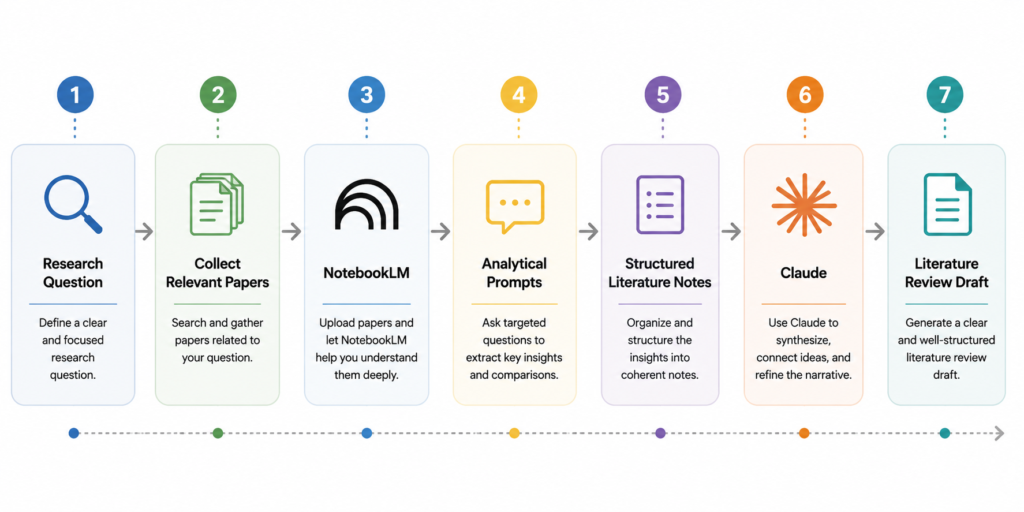
I still read every paper myself.
NotebookLM never replaced that part of the process.
What changed was how quickly I could move from reading papers to actually thinking about them.
Common Prompt Mistakes
Most disappointing NotebookLM experiences are not caused by the AI itself.
They are caused by the questions researchers ask.
Here are some of the most common mistakes.
❌ “Summarize this paper.”
Why it’s limited:
A summary tells you what the paper says.
It rarely tells you why the findings matter or how they compare with other studies.
✅ Try instead:
Which experiments provide the strongest evidence in this paper?
❌ “Explain this paper.”
Why it’s limited:
This usually produces a broad overview that remains fairly descriptive.
✅ Try instead:
Which conclusions are directly supported by evidence, and which remain uncertain?
❌ Uploading dozens of unrelated papers
Why it’s a problem:
NotebookLM performs best when papers address the same scientific question.
Uploading unrelated topics often produces vague or disconnected answers.
✅ A smaller notebook focused on one research question almost always produces better results.
❌ Asking only factual questions
Questions like:
“What happened?”
are useful.
✅ Questions like:
Why do these studies disagree?
or
What assumptions do the authors make?
are usually much more valuable.
The quality of the answer often depends on the quality of the question.
Key Takeaways
- Ask analytical questions instead of requesting simple summaries.
- Organize notebooks around one research question whenever possible.
- Compare evidence across multiple papers rather than reading studies in isolation.
- Build literature notes around themes instead of individual papers.
Frequently Asked Questions
What is the best NotebookLM prompt?
There is no single best prompt.
The most useful prompts depend on your research goal. Questions that encourage comparison, evaluation, and critical thinking generally produce more valuable answers than simple requests for summaries.
How many papers should I upload?
For most literature reviews, a focused collection of related papers is more useful than uploading a very large number of unrelated documents.
Can NotebookLM compare multiple papers?
Yes.
Comparing multiple related papers is one of NotebookLM’s greatest strengths, particularly when the papers address the same scientific question.
Can NotebookLM replace ChatGPT?
Not exactly.
NotebookLM works primarily from the documents you upload, making it particularly useful for source-grounded literature review.
ChatGPT is more suitable for broader reasoning and general-purpose assistance.
The two tools complement each other rather than compete.
Which prompt is best for identifying research gaps?
A good starting point is:
Which important questions remain unanswered across these studies?
This encourages NotebookLM to identify recurring limitations and future directions rather than simply summarizing existing knowledge.
Can PhD students benefit from NotebookLM?
Yes.
NotebookLM is especially useful for PhD students managing large collections of papers, preparing literature reviews, organizing research notes, and comparing evidence across multiple studies.
Final Thoughts
NotebookLM becomes dramatically more useful once you stop asking it to summarize papers and start asking it to help you think about them.
The quality of NotebookLM’s answers depends less on AI itself and more on the quality of the questions you ask.
Used thoughtfully, it becomes a practical research assistant that helps organize literature without replacing scientific judgment.
Further Reading
If you’d like to learn more about NotebookLM, the following official resources are worth exploring:
Note: Features, upload limits, supported file types, and pricing may change over time. Always verify current information through the official resources before relying on them for long-term workflows.
Related Articles
ResearchRabbit Review (2026)
Still collecting papers? Learn how ResearchRabbit helps researchers discover influential papers before building a literature review.
Elicit Review (2026)
Once you’ve understood your papers, Elicit can help compare evidence across multiple studies and identify broader research patterns.
NotebookLM Review (2026)
Want a detailed evaluation of NotebookLM’s strengths, limitations, pricing, and research use cases? Read our complete NotebookLM Review.