Last updated: July 2026
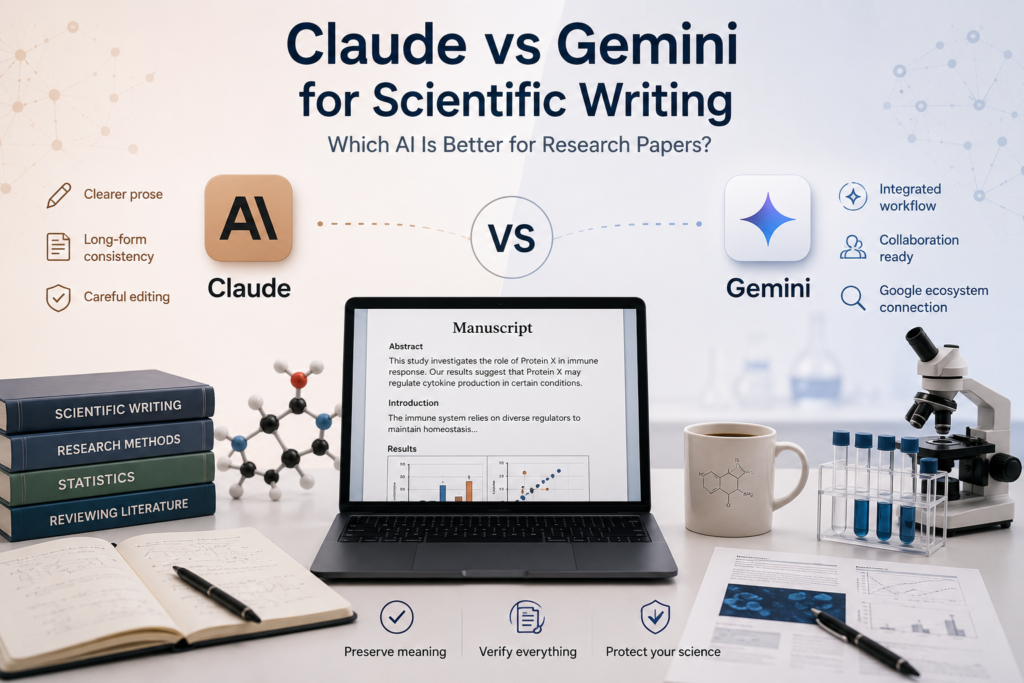
Many AI comparisons focus on which model writes better English.
For researchers, that is rarely the real question.
A sentence can become smoother and still become less accurate. An AI assistant may strengthen a causal claim, remove an important limitation, simplify a method too aggressively, or make an uncertain result sound settled.
The useful question is not: Which AI writes better?
It is: Which assistant improves the writing without changing the science?
Claude and Gemini can both help researchers revise, organize, and clarify scientific text. Neither is the best choice for every stage of writing.
The better starting point depends on the task: revising one paragraph, editing a long manuscript, preparing reviewer responses, polishing a figure legend, or working inside a collaborative document.
This guide compares Claude and Gemini by writing task rather than by model reputation.
Verification note: Model names, document limits, integrations, pricing, plan access, and regional availability may change. Check the official Claude and Gemini documentation before relying on current product capabilities.
The Short Answer
There is no universal winner.
| Writing task | Practical starting point | Main concern |
|---|---|---|
| Revising a long manuscript | Claude may be worth testing first | Consistency across sections |
| Working inside Google-based documents | Gemini may offer a smoother workflow | Current integrations may change |
| Improving paragraph flow | Both assistants | Meaning drift |
| Drafting reviewer responses | Either model with structured prompts | Invented revisions or unsupported claims |
| Revising Methods | Conservative editing with either model | Loss of reproducible detail |
| Editing Results | Either model, followed by manual verification | Numerical and statistical accuracy |
| Improving a Discussion | Either model with claim-strength checks | Stronger causal or mechanistic claims |
| Grant writing | Either model for structural editing | Overstatement of preliminary evidence |
| Figure legends | Either model for language only | Missing technical detail |
| Reference verification | Neither | Check the original source |
Claude may suit researchers who want sustained revision across a long document.
Gemini may be more convenient when writing is closely tied to Google-based collaboration.
Those are workflow differences, not evidence that one model is scientifically more reliable.
Why Scientific Writing Is Different
Scientific writing has a narrow margin for error.
A general editor may be rewarded for making a sentence shorter, stronger, or more confident. In a manuscript, those changes can distort the evidence.
Consider:
Protein X was associated with increased cytokine production.
and:
Protein X increased cytokine production.
The second sentence is cleaner. It also makes a stronger claim.
If the study was observational, the revision may no longer match the design.
Scientific editing must preserve more than grammar:
- technical terminology
- numerical values
- uncertainty
- causal strength
- methodological detail
- limitations
- consistency between sections
A useful AI editor should make the text easier to read without changing what the study supports.
How This Comparison Evaluates Claude and Gemini
This comparison uses five practical criteria.
Scientific meaning
Does the revision preserve the original level of certainty, causality, and scope?
Instruction following
Can the assistant improve flow while preserving numbers, citations, terminology, and limitations?
Long-document consistency
Can it identify repeated claims, inconsistent terminology, and contradictions across sections?
Readability
Does it improve clarity without flattening technical nuance?
Workflow fit
Does the assistant suit the way the researcher stores, shares, and edits the manuscript?
Even a strong model can become frustrating if it does not fit the way a manuscript is written, shared, and revised.
Claude vs Gemini at a Glance
| Criterion | Claude | Gemini |
|---|---|---|
| Paragraph revision | Useful for restructuring and prose editing | Useful for restructuring and prose editing |
| Long-form revision | May suit document-centered editing | May suit large-document or workspace-based workflows |
| Google-based collaboration | May require a separate document workflow | May offer closer Google Workspace integration |
| Scientific meaning | Depends on prompt and human review | Depends on prompt and human review |
| Reviewer responses | Useful with explicit constraints | Useful with explicit constraints |
| Methods editing | Should be used conservatively | Should be used conservatively |
| Citation verification | Not a final authority | Not a final authority |
| Main workflow advantage | Sustained manuscript revision | Google-centered collaboration |
This is not a fixed ranking. Product features change, and performance depends heavily on the document and prompt.
Editing a Scientific Paragraph
A short paragraph is one of the safest places to compare two assistants.
The original remains visible, the output is manageable, and changes in meaning are easier to catch.
Recommended Prompt
Revise this paragraph for clarity, flow, and concision.
Preserve all numerical values, scientific terminology, uncertainty language, causal strength, citations, and limitations.
Do not add new claims, mechanisms, or references.
After revising, identify any sentence whose scientific meaning may have changed.
What to Compare
| Criterion | Question |
|---|---|
| Clarity | Is the revision easier to follow? |
| Meaning | Does the claim remain the same? |
| Terminology | Were technical terms preserved? |
| Uncertainty | Were words such as “may” and “suggests” retained where needed? |
| Scope | Did the model broaden the conclusion? |
| Additions | Did it introduce unsupported information? |
| Rhythm | Does the paragraph sound natural rather than mechanically compressed? |
In practice, a carefully designed prompt often matters more than small differences between models.
A Real Research Scenario: When Better Prose Becomes Worse Science
Imagine that a Discussion section contains this sentence:
These findings suggest that Protein X may contribute to macrophage activation under the conditions tested.
An AI assistant revises it as:
These findings demonstrate that Protein X drives macrophage activation.
The revision is stronger and easier to read.
It may also be scientifically wrong.
Three changes have occurred:
- “suggest” became “demonstrate”
- “may contribute” became “drives”
- “under the conditions tested” disappeared
The new sentence increases certainty, implies causality, and removes the original boundary of the experiment.
A useful follow-up prompt is:
Compare the original and revised sentences. Identify any change in certainty, causal strength, scope, or stated limitation.
That comparison is more valuable than simply asking which version sounds better.
Editing Long Manuscripts
A 300-word paragraph and a 10-page manuscript create different problems.
Across a long document, terminology may drift. Claims may be repeated in slightly different forms. The Discussion may become broader than the Results. A limitation may appear in one section and disappear in another.
Claude may be worth testing when the priority is sustained revision across a large body of prose.
Gemini may be attractive when the manuscript already sits inside a Google-centered collaborative workflow.
Current document limits and integration details require verification.
A Safer Workflow
Do not begin by asking either assistant to rewrite the entire manuscript.
Review the structure
        ↓
Check terminology and claim consistency
        ↓
Revise one section at a time
        ↓
Compare each revision with the original
        ↓
Run a final cross-section check
Start with diagnosis rather than rewriting:
Review the manuscript without rewriting it. Identify repeated arguments, missing transitions, inconsistent terminology, unsupported claims, and conclusions broader than the Results. Return a section-by-section diagnostic table.
Then revise one section at a time.
This workflow is slower, but most researchers would rather spend extra time reviewing edits than discover meaning drift after submission.
Methods, Results, and Discussion Need Different Rules
Each section serves a different scientific purpose. The editing instructions should reflect that.
Methods: Protect Reproducibility
The main risk in Methods editing is not awkward prose. It is the loss of procedural detail.
Removing a concentration, timing step, instrument setting, or software version can make the experiment harder to reproduce.
A safe instruction is:
Revise for clarity, but preserve every procedural detail, number, unit, reagent name, instrument setting, software version, and analysis step. Flag anything ambiguous or incomplete.
The assistant may improve wording. It should not reconstruct missing information.
Results: Protect the Data
A Results section can become misleading through a single altered number, comparison direction, or group label.
A safe instruction is:
Preserve all numerical values, statistical results, group labels, comparison directions, figure references, and uncertainty language. Do not add interpretation that belongs in the Discussion.
Both assistants can improve readability, but neither should be trusted with numerical accuracy without review.
Discussion: Protect the Strength of the Claim
The challenge in Discussion editing is not grammar. It is preserving the boundary between evidence and interpretation.
Watch for changes such as:
- may → does
- suggests → demonstrates
- associated with → caused
- in this model → generally
- under these conditions → omitted
A useful instruction is:
Preserve the distinction between direct findings, interpretation, and speculation. Flag every mechanistic or causal claim.
This is the section where polished prose is most likely to outrun the evidence.
Reviewer Responses
Reviewer responses need to be precise, respectful, and traceable.
The main risk is not tone. It is claiming that a revision, experiment, or analysis has been completed when it has not.
A structured prompt can ask the assistant to organize:
- the reviewer comment
- the requested action
- the manuscript section affected
- the evidence or analysis needed
- the current revision status
- a draft response
Unresolved items should be marked clearly, for example:
Author decision required.
This is useful when comments are long or distributed across several sections.
It should not be used to decide whether the reviewer’s scientific criticism is correct.
Grant Writing
Grant writing rewards clarity, but it also creates pressure to sound more certain than the evidence allows.
The most important distinction is between:
- established evidence
- preliminary findings
- hypotheses
- proposed work
For example:
Preliminary data suggest that Protein X may affect macrophage activation.
should not become:
We have established Protein X as a key regulator of macrophage activation.
The second version may sound more persuasive, but it changes both the maturity and strength of the evidence.
A useful prompt should ask the model to improve logic and concision while preserving those four categories.
Figure Legends and Abstracts
These sections are short, but every word carries technical weight.
Figure Legends
A legend must preserve details such as:
- panel labels
- experimental groups
- sample size
- replicates
- normalization
- statistical tests
- significance notation
Consider this abbreviated legend:
IL-1β expression in WT and KO macrophages. Data are mean ± SEM, n = 5, normalized to GAPDH.
A weak revision might become:
IL-1β levels were compared between control and knockout cells.
The second version is shorter, but it removes:
- the WT and KO terminology
- the sample size
- the summary statistic
- the normalization method
The best prompt is therefore not “make this legend shorter.”
It is:
Improve clarity while preserving every panel label, group name, sample size, unit, statistical test, normalization detail, and significance notation.
The revised legend should still be checked against the figure and Methods.
Abstracts
An abstract compresses the paper into a few sentences, so omissions can alter the overall message.
A useful instruction is:
Preserve the sequence of objective, methods, results, and conclusion. Do not change numerical values or introduce claims not reported in the manuscript.
The final abstract should be checked against the full paper, not only the original abstract.
Google Docs, Overleaf, and Workflow Fit
The surrounding writing environment may matter as much as model quality.
Google-Based Collaboration
Gemini may be convenient for teams already working in Google Docs or Drive.
The practical advantage is fewer transfers between platforms and easier collaboration inside the existing document environment.
Current Google Workspace features may change over time. Check the official documentation if a specific integration is important for your workflow.
Document-Centered Claude Workflows
Claude may suit researchers who prefer uploading a manuscript, comparing sections, and performing focused revisions in a separate workspace.
Current document support and workflow features may change. Verify them if they are important to your writing process.
Overleaf and LaTeX
For LaTeX documents, the main concern is preserving the markup.
A safe instruction is:
Revise only the prose. Do not alter commands, citations, labels, equations, environments, or cross-references. Return the revision in valid LaTeX.
Native LaTeX integrations may change over time. Verify current support before building your workflow around it.
When Claude May Be the Better Starting Point
Claude may be worth trying first when:
- the document is long
- several sections need to be compared
- the task requires sustained prose revision
- the researcher prefers a document-centered workflow
- consistency across the manuscript matters more than in-platform convenience
Claude should not be treated as the final authority for citations, statistics, novelty, or causal interpretation.
When Gemini May Be the Better Starting Point
Gemini may be worth trying first when:
- the manuscript is already in Google Docs or Drive
- several collaborators work inside Google Workspace
- reducing copy-and-paste steps matters
- the document includes text and visual material
- workflow convenience is a major consideration
A smoother workflow can save time, but it does not remove the need to verify every scientific claim.
A Practical Workflow Using Both
Using two assistants does not automatically improve a manuscript.
It can simply create two versions that require review.
A dual-model workflow is useful only when each assistant has a distinct role.
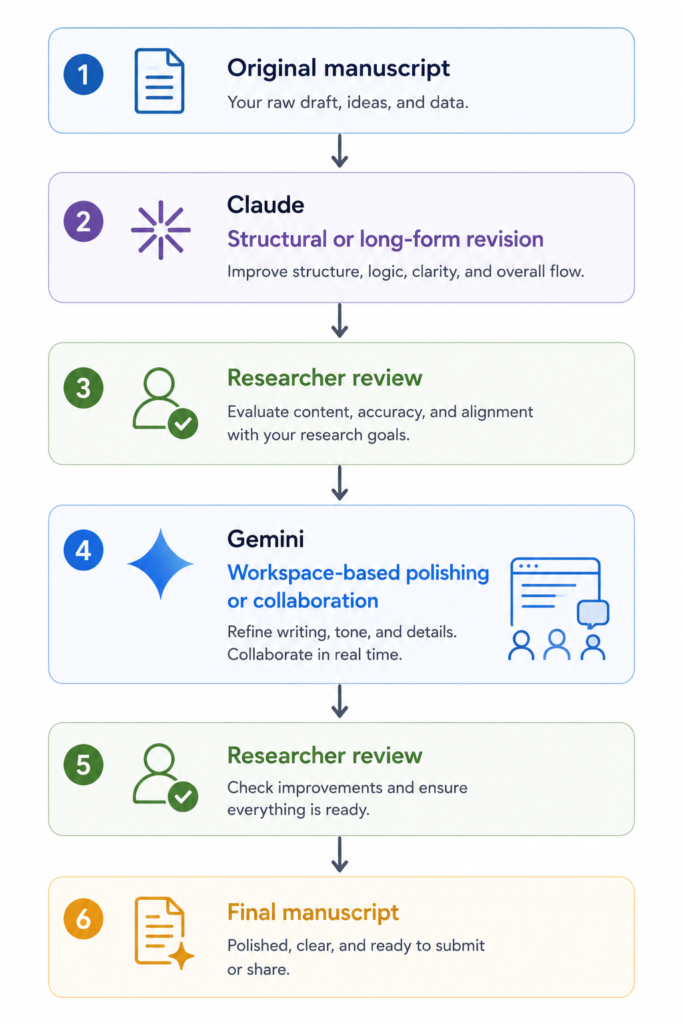
For a short paragraph, a direct comparison may be more useful:
Original paragraph
        ↓
Claude revision
        ↓
Gemini revision
        ↓
Compare both with the original
        ↓
Keep only verified improvements
Agreement between two models is not proof that an edit is correct. They may make the same mistake.
Before Choosing a Model, Ask Yourself
- Is this a paragraph or an entire manuscript?
- Does the section contain critical numerical data?
- Is reproducibility more important than style?
- Is the manuscript already inside Google Workspace?
- Is the document confidential?
- Can every revision be compared with the original?
- Do you need one revision or a side-by-side comparison?
- Will using two tools reduce work, or simply create more versions to review?
Many AI editing problems come from using a larger workflow than the task actually requires.
A single paragraph usually needs a careful revision, not a manuscript-wide review.
Likewise, a Methods section often benefits more from precision checks than from aggressive rewriting.
Common Mistakes
1. Choosing by Reputation
A model’s reputation does not tell you how it will handle your manuscript.
Test the actual task using the same source text and prompt.
2. Letting AI Rewrite Methods Too Freely
Methods should prioritize reproducibility over elegance.
Do not allow technical detail to disappear for the sake of shorter prose.
3. Trusting Generated References
Neither Claude nor Gemini should be treated as a citation-verification system.
Check the original publication and your reference manager.
4. Editing Without Version Control
Preserve:
- the original draft
- the AI-edited version
- the final human-edited version
Without those versions, meaning drift becomes difficult to detect.
Limitations, Privacy, and Reproducibility
| Limitation | Why it matters |
|---|---|
| Meaning drift | Claims may become stronger or broader |
| Hallucinated references | Incorrect citations may enter the manuscript |
| Numerical errors | Values or units may change |
| Loss of nuance | Controls and limitations may disappear |
| Prompt sensitivity | Small wording changes may alter the output |
| Long-document inconsistency | Sections may be edited differently |
| Model updates | Performance may change over time |
| Privacy risk | Unpublished material may be exposed |
Sensitive Material
Take particular care with:
- unpublished manuscripts
- confidential peer reviews
- grant applications
- patient information
- proprietary datasets
- patent-related material
Keep an Editing Log
For important manuscripts, record:
- tool and model
- date
- prompt
- section edited
- original text
- AI revision
- accepted changes
- rejected changes
- final human decision
This makes the editing process easier to review and reproduce.
Frequently Asked Questions
Q1. Can Claude edit a scientific manuscript?
Claude can assist with structure, clarity, and revision. Long manuscripts should be edited in stages, and every meaningful change should be compared with the original.
Q2. Can Gemini revise a research paper in Google Docs?
Gemini may support workflows connected to Google Docs or Google Workspace. Current integration and access details require verification.
Q3. Can I upload an unpublished manuscript to Claude or Gemini?
Do not assume that uploading is permitted or appropriate. Check institutional policy, contracts, confidentiality requirements, and current data-handling terms first.
Q4. Can AI safely rewrite a Methods section?
It can help improve clarity, but every procedural detail must remain intact. The final version should be checked against the original protocol.
Q5. Can Claude or Gemini check scientific references?
Neither should be used as the final authority for reference verification. Check each citation in the original publication or a trusted reference database.
Q6. Which is better for non-native English researchers?
Either may help improve grammar and sentence flow. The better choice depends on the document, prompt, preferred workflow, and how carefully the revisions are reviewed.
Q7. Can AI write reviewer responses?
It can organize reviewer comments and draft professional responses.
It should not invent completed revisions, analyses, or experiments.
Q8. Can AI rewrite the Discussion section?
Yes, but the highest-risk changes involve causality, certainty, scope, and limitations.
Compare every revised claim with the original evidence.
Q9. Should researchers disclose AI-assisted editing?
Requirements vary by journal, institution, funder, and type of use.
Key Takeaways
Claude may be a useful starting point for sustained manuscript revision.
Gemini may be more convenient in a Google-centered writing workflow.
Methods, Results, Discussion, grants, and reviewer responses require different editing rules.
Neither model should be trusted to verify citations, judge novelty, or make final scientific decisions.
Researchers rarely damage a manuscript because of poor grammar.
They damage it when a revision changes what the data actually support.
AI can improve the writing.
The researcher’s job is to make sure it never rewrites the science.
That is the difference between AI-assisted scientific writing and AI-generated science.
Continue Learning
AI and Scientific Writing
Literature Review
- AI Literature Review Workflow
- How to Read Research Papers With AI
- How to Use Claude for Literature Review
- Elicit Review