Last updated: July 2026
When I first started reading scientific papers, I assumed that every sentence mattered.
I would begin with the Introduction, stop whenever I found an unfamiliar term, and keep reading until I reached the References. By the end, I had spent far too long on one paper and still struggled to explain its main figure.
What changed was not my reading speed.
I learned to decide first whether a paper deserved a quick scan, a careful evidence review, or several hours of close analysis.
Most researchers do not read every paper from beginning to end. They change the order and depth of reading according to what they need from it.
You may be checking whether a study belongs in a literature review, trying to understand one figure, comparing conflicting findings, or looking for enough methodological detail to repeat an experiment.
This guide explains how to make that decision—and how to spend the right amount of attention on the right paper.
The Short Answer
Start by deciding why you are reading.
| Reading goal | Start with | Read more deeply when |
|---|---|---|
| Check relevance | Title, abstract, figures | The model and outcome match your question |
| Understand the evidence | Figures, legends, Results | The main comparison matters to your work |
| Evaluate the conclusion | Methods, controls, statistics | The claim may influence a research decision |
| Reproduce an experiment | Methods, supplements, cited protocols | Key procedural details are missing |
| Use the paper in a review | Full-text evidence extraction | The study meets your eligibility criteria |
Do not begin by reading everything.
Begin by deciding what you need from the paper.
The 60-Second Paper Preview
Before reading further, try to answer three questions:
- What is the main research question?
- What model or population was studied?
- What comparison was tested?
You should usually find these answers in the title, abstract, figure titles, or first figure.
If you cannot answer them after a quick scan, do not immediately start reading every paragraph. First determine whether the paper is poorly organized, outside your current background, or simply irrelevant to your question.
A useful one-minute note might look like this:
This paper tests whether Protein X affects IL-1β secretion by comparing stimulated wild-type and knockout macrophages.
That sentence does not explain the entire study. It gives you enough structure to decide what to read next.
Don’t ask: “Do I understand this paper?”
Ask: “Can I explain the question, model, and comparison?”
Why Scientific Papers Feel Difficult
Scientific papers are written for readers who already know much of the field. Authors may use specialized terminology, compress familiar methods into a few sentences, and refer readers to earlier studies for essential background.
The evidence is also scattered across the paper. The abstract gives the headline result, the figures show the experiments, the legends define the comparisons, the Methods explain how the data were produced, and the Discussion tells you what the authors think the findings mean.
This creates two separate tasks:
- understanding what the authors did and observed;
- deciding whether the evidence supports their conclusion.
You can complete the first task without completing the second.
Decide Why You Are Reading
Before opening the paper, ask one question:
What decision will this paper help me make?
Reading for relevance
You are deciding whether the paper deserves more time.
Check:
- the research question
- the model or population
- the intervention or exposure
- the measured outcome
- the type of study
At this stage, a one-sentence note is enough:
Relevant because it tests Protein X in primary macrophages and measures secreted IL-1β.
Reading for evidence
You want to know what was actually observed.
Focus on:
- the experimental comparison
- the endpoint
- the control
- the direction of the effect
- the uncertainty
- the conditions under which the result occurred
Reading for critical evaluation
You want to know whether the conclusion is justified.
Look closely at:
- study design
- controls
- sample size
- unit of analysis
- exclusions
- statistical approach
- alternative explanations
Reading for reproduction
You want to repeat or adapt the experiment.
Your priorities shift toward:
- reagents
- concentrations
- timing
- equipment
- analysis thresholds
- normalization
- procedural details hidden in supplements or cited protocols
The same paper can therefore require four very different reading paths.
The Three-Pass Method
A useful way to avoid getting trapped in detail is to read in passes.
The three-pass method associated with S. Keshav is best treated as a flexible framework, not a rigid rule.
First Pass: Is This Paper Worth More Time?
Scan:
- title
- abstract
- section headings
- figures and tables
- conclusion
- references
Try to answer:
- What problem does the paper address?
- What type of study is it?
- What is the main contribution?
- Is it relevant to my purpose?
Your output should be one sentence explaining whether to continue.
Second Pass: What Did the Authors Actually Find?
Now examine:
- figures
- figure legends
- relevant Results text
- major methods
- key assumptions
- important references
Record:
- research question
- model or population
- main method
- direct finding
- stated limitation
Do not worry about every technical detail yet.
Third Pass: Does the Evidence Support the Conclusion?
Reserve this level for papers that matter.
Examine:
- experimental logic
- controls
- unit of analysis
- statistical assumptions
- alternative explanations
- generalizability
- missing evidence
At the end, separate:
- direct findings
- author interpretation
- unresolved questions
Not every paper deserves a third pass.
How to Read the Abstract
The abstract is useful for orientation.
It can usually tell you:
- what was studied
- how it was studied
- the main result
- the authors’ conclusion
It cannot tell you enough about:
- control quality
- exclusions
- normalization
- subgroup definitions
- methodological weaknesses
- the full statistical analysis
Use the abstract to decide whether to continue.
Do not use it as a substitute for the paper.
How to Read Figures and Tables
In many experimental papers, the figures reveal the structure of the argument faster than the Introduction.
Start with the comparison.
Ask:
- What groups are being compared?
- What variable is being measured?
- What is the unit of analysis?
- What control is present?
- What do the axes show?
- What normalization was used?
- What do the error bars represent?
- What conclusion is directly supported?
Always read the figure together with its legend and the relevant Methods.
A graph may show higher values in one group, but that does not automatically reveal whether the independent unit was a patient, mouse, culture, image, or technical replicate.
That distinction matters.
Separate observation from interpretation
For example:
Direct observation: Secreted IL-1β was higher in knockout macrophages after stimulation.
Interpretation: Protein X may suppress inflammatory signaling under the tested conditions.
The observation comes from the experiment.
The interpretation is an explanation of what the result may mean.
A paper becomes easier to evaluate once those two statements are kept separate.
A Two-Minute Figure Read
Imagine that Figure 2 contains three panels:
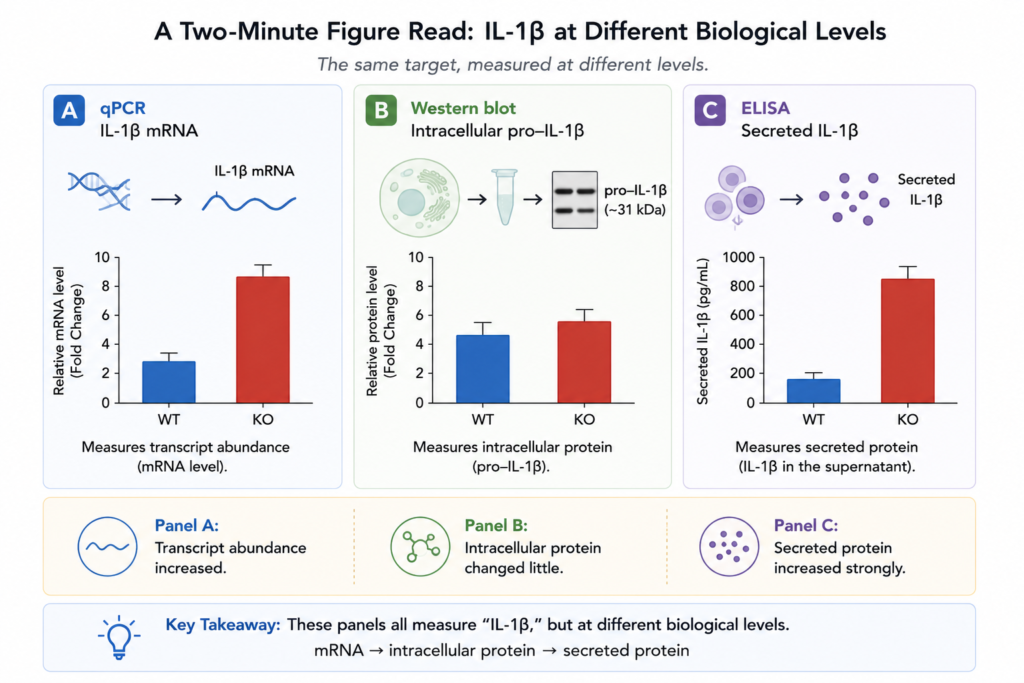
All three panels compare wild-type and Protein X knockout macrophages after stimulation.
At first glance, the figure may appear to test one outcome: “IL-1β production.” In fact, it examines three different biological levels.
The qPCR panel measures transcript abundance. The Western blot examines intracellular protein. The ELISA measures protein released into the culture medium.
These outcomes are related, but they are not interchangeable.
If only secreted IL-1β changes, the result may involve protein processing or secretion rather than transcription. If mRNA changes but secreted protein does not, the downstream steps may limit the final response.
Before accepting the figure title, ask:
- Which panel contains the most direct evidence for the paper’s main claim?
- Are the same biological replicates used across panels?
- Is each assay normalized appropriately?
- Does the proposed mechanism explain all three measurement levels?
This is why reading a figure means more than checking whether one bar is higher than another.
How to Read the Methods
You do not need to read every Methods section with the same intensity.
For relevance screening, identify:
- the model
- the main intervention
- the key assay
For critical evaluation, examine:
- controls
- allocation
- blinding or randomization where relevant
- exclusions
- independent replicates
- statistical analysis
For reproduction, you need much more.
Build a protocol gap list.
| Required detail | Reported? | Where found? | Next step |
|---|---|---|---|
| Cell number | Yes | Methods | — |
| Treatment duration | Yes | Figure legend | — |
| Antibody dilution | No | — | Check cited protocol |
| Analysis threshold | Unclear | Supplement | Verify manually |
A Common Methods Trap
Suppose a Western blot experiment reports:
Three independent experiments were performed, with five images analyzed per condition.
The number of images is not automatically the biological sample size.
If all five images came from the same membrane or the same biological sample, they may provide technical information about measurement variability rather than five independent observations.
The same problem can occur when a study counts:
- multiple fields from one tissue section;
- several wells prepared from one cell culture;
- repeated measurements from one animal;
- many cells collected from a single experimental unit.
Before interpreting the statistics, identify what was independently assigned to the experimental condition.
That unit—not the number of images, cells, or repeated measurements—usually determines the independent sample size.
Pay particular attention to the experimental unit.
Five images from one culture do not necessarily represent five independent biological replicates.
Ten technical measurements from one sample do not create a sample size of ten.
How to Read Results and Discussion
Results: What was observed?
The Results should tell you:
- which groups were compared
- what changed
- how large the change was
- how uncertain the estimate was
- which analysis was used
Do not rely only on whether the result was statistically significant.
Also consider:
- effect size
- confidence intervals
- consistency across experiments
- biological relevance
Discussion: What do the authors think it means?
The Discussion combines evidence with interpretation.
Watch for shifts such as:
- associated with → caused
- suggests → demonstrates
- in this model → generally
- under these conditions → omitted
A result can be valid while the interpretation is too broad.
The Discussion is useful, but it should be read after checking the data that support it.
One Paper, Four Reading Goals
Consider a hypothetical paper titled:
Protein X Regulates IL-1β Secretion in Macrophages
The way you read it should change with your purpose.
Goal 1: Relevance scan
Check:
- macrophage model
- Protein X perturbation
- IL-1β endpoint
- disease or stimulation context
You may stop after the abstract, figures, and conclusion if the paper does not match your question.
Goal 2: Journal club
Read for:
- experimental logic
- strongest figure
- weakest figure
- missing controls
- alternative explanations
- important limitation
Prepare:
- three discussion questions
- one proposed follow-up experiment
Goal 3: Literature review
Extract the same fields you use for every study:
- model
- perturbation
- timing
- endpoint
- assay
- direct finding
- interpretation
- limitation
This allows fair comparison across papers.
Goal 4: Reproduce the experiment
Focus on:
- cell source
- culture conditions
- reagent identity
- concentration
- treatment timing
- controls
- normalization
- analysis steps
- missing procedural details
The same paper can be useful at four different depths.
There is no single correct reading order.
How to Take Notes You Can Reuse
Do not rewrite the entire paper in your notes.
Record only what you may need later.
A practical template is:
| Field | Notes |
|---|---|
| Research question | |
| Model or population | |
| Main method | |
| Direct finding | |
| Author interpretation | |
| Limitation | |
| Relevance to my project |
Also write one sentence in your own words.
For example:
In primary macrophages, Protein X knockout increased secreted IL-1β after stimulation, but the study did not establish the downstream mechanism.
That sentence is more useful than copying the abstract.
How to Compare Multiple Papers
Comparing papers from memory is unreliable.
Use the same variables for every study:
- model
- population
- intervention
- dose
- timing
- control
- endpoint
- assay
- analysis
Do not merge outcomes that were measured at different biological levels.
For example:
- cytokine mRNA
- intracellular cytokine protein
- secreted cytokine protein
are related, but they are not interchangeable.
When studies disagree, list the factual differences first.
Model and population
        ↓
Dose and timing
        ↓
Endpoint and assay
        ↓
Controls and analysis
        ↓
Possible explanation
Do not begin with a mechanistic story before checking whether the experiments were actually comparable.
How to Read Outside Your Field
Do not stop at every unfamiliar term.
First identify the paper’s main question. Then learn only the background needed to understand the model, method, endpoint, and central conclusion.
A review article or textbook-level source can provide orientation before you return to the original paper.
Some sections may still require specialist guidance, particularly when they involve complex statistics, imaging pipelines, sequencing analyses, or mathematical derivations.
A reading framework helps you identify what you do not understand. It does not instantly replace the expertise needed to resolve it.
How AI Can Help—and Where It Fails
AI can be useful for bounded tasks such as:
- explaining unfamiliar terminology
- extracting predefined fields
- organizing notes
- comparing study characteristics
- generating questions
- locating passages that need closer review
It should not be used as a substitute for checking:
- references
- numerical values
- figures
- methods
- controls
- limitations
- causal claims
A safer workflow is:
Read the paper
        ↓
Ask one bounded question
        ↓
Compare the answer with the source
        ↓
Correct errors
        ↓
Save only verified notes
Use AI when it reduces organization or language barriers.
Do not use it when the task depends on exact figures, numerical extraction, citation verification, or confidential material that you are not permitted to upload.
Common Paper-Reading Mistakes
Reading Every Paper From Beginning to End
This gives low-value papers too much time. Start with a relevance scan and continue only when the model, outcome, or evidence matters to your question.
Treating the Abstract as the Evidence
The abstract summarizes the authors’ interpretation, but it rarely contains enough detail to evaluate controls, exclusions, normalization, or methodological limitations.
Highlighting Without a Question
A page full of color is not a reusable note. Mark information according to a specific purpose, such as the main claim, experimental control, limitation, or detail needed for reproduction.
Ignoring the Experimental Unit
Cells, images, technical replicates, and biological samples are not interchangeable. Identify what was independently assigned to the experimental condition before interpreting the sample size or statistics.
Accepting the Discussion Before Checking the Data
The Discussion explains what the authors think the results mean. Check the figures and Results before accepting that interpretation.
Assuming Peer Review Guarantees Correctness
Peer review is an important quality-control process, but it does not guarantee that every method, analysis, or conclusion is correct.
A Practical Scientific Paper Reading Checklist
Before reading
- Why am I reading this paper?
- What information do I need?
- How deeply do I need to read?
First pass
- Identify the research question.
- Check the model or population.
- Scan the figures.
- Decide whether the paper is relevant.
Evidence pass
- Identify the comparison.
- Check the controls.
- Record the endpoint.
- Separate findings from interpretation.
Critical pass
- Check the unit of analysis.
- Review limitations.
- Identify unsupported claims.
- Consider alternative explanations.
After reading
- Write a one-sentence summary.
- Record how the paper relates to your project.
- Save unresolved questions.
- Add the paper to a reference manager.
Frequently Asked Questions
What is the best order for reading a scientific paper?
There is no single best order. Start with the title, abstract, and figures when screening for relevance. Read the Methods and Results more closely when evaluating evidence or reproducing an experiment.
Should I read the abstract or figures first?
The abstract gives orientation. The figures often reveal what was actually tested. For experimental papers, use both before deciding whether to continue.
How long should it take to read one paper?
A relevance scan may take only a few minutes. A deep methodological review may take hours. The appropriate time depends on the paper and the decision it informs.
How should beginners read research papers?
Begin with the main question, model, and key figure. Learn only the background needed to understand those elements before moving into technical detail.
Should I always read the Methods section?
No. Read it briefly for relevance, more carefully for critical evaluation, and in detail when planning to reproduce the work.
How do I know whether a paper is reliable?
Examine the design, controls, unit of analysis, statistical approach, consistency of the results, and whether the conclusion matches the evidence.
What should I write down while reading?
Record the research question, model, method, direct finding, interpretation, limitation, and relevance to your work.
Can AI accurately summarize scientific papers?
It may produce a useful orientation, but it can omit caveats, misread figures, or alter numerical details. Verify important claims in the original paper.
Key Takeaways
Decide why you are reading before choosing where to begin.
Use several passes instead of forcing full comprehension immediately.
Read figures together with their legends, Methods, and Results.
Separate direct evidence from author interpretation.
Spend the most time on papers that affect an important research decision.
Reading a paper well does not mean understanding every line.
It means knowing what the paper shows, what it does not show, and whether it deserves more of your time.
Continue Learning
Literature Review
- How to Find Research Papers Faster
- AI Literature Review Workflow
- How to Organize Research Papers
- How to Use Scite for Literature Review
AI for Research
- Claude Prompts for Scientific Research
- How to Use Claude for Literature Review
- Claude vs ChatGPT for Research
- Best AI Tools for Researchers