Last updated: July 2026
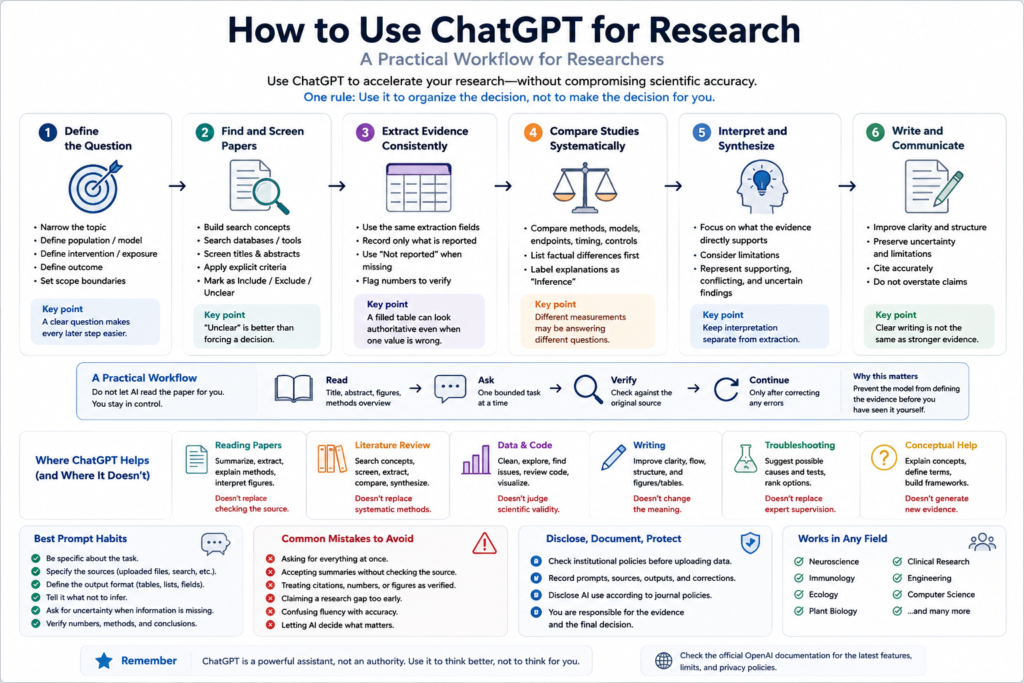
ChatGPT can make research faster.
It can also make mistakes faster.
That tension matters more than any feature list.
Researchers use ChatGPT to refine questions, summarize papers, compare studies, review code, analyze data, and improve scientific writing.
But the important question is not:
Can ChatGPT help with research?
It can.
The better question is:
Which parts of research can ChatGPT accelerate without weakening scientific accuracy?
The safest approach is not to hand over an entire research problem.
Give ChatGPT one bounded task. Define the sources it should use. Ask for an output you can inspect. Then verify anything that could change your conclusion.
Contents
- Start With the Right Task
- Read, Ask, Verify
- Find and Compare Evidence
- Analyze and Write
- Avoid Common Mistakes
The Short Answer
ChatGPT is most useful when the task is clear and the result can be checked.
| Research task | Useful role for ChatGPT | What still requires human review |
|---|---|---|
| Defining a question | Narrowing variables and scope | Novelty and scientific value |
| Finding papers | Building search concepts | Search completeness |
| Screening studies | Applying explicit criteria | Final inclusion decisions |
| Reading papers | Extracting predefined fields | Figures, numbers, and context |
| Comparing studies | Organizing factual differences | Scientific interpretation |
| Data and code | Identifying possible problems | Statistical validity |
| Scientific writing | Improving clarity and structure | Meaning, citations, and claims |
| Troubleshooting | Ranking possible causes | Experimental decisions and safety |
A simple rule helps:
Use ChatGPT to organize the decision, not to make the decision for you.
Start With the Research Task
“Using ChatGPT for research” can mean several different things.
You might be:
- asking a conceptual question;
- searching for recent information;
- reading an uploaded paper;
- comparing several studies;
- analyzing a spreadsheet;
- reviewing code;
- revising a manuscript.
These tasks do not require the same workflow.
A terminology question may work well in ordinary chat. A current factual question needs source-backed search. A literature comparison requires a controlled paper set. A statistical problem needs the data, code, design, and analytical assumptions.
One surprisingly common mistake is to compress all of these into a single request:
Research this topic.
The answer may sound comprehensive, but it becomes difficult to tell:
- where the information came from;
- what was directly reported;
- what was inferred;
- what might be missing;
- what still needs checking.
Key point: A polished answer is not the same as a visible evidence trail.
Before You Ask ChatGPT Anything
Before writing a prompt, ask:
- What decision am I trying to make?
- Which sources should the answer use?
- What must not be inferred?
- What output will be easiest to inspect?
- Which details will I verify myself?
Instead of:
Compare these papers.
try:
Using only the uploaded papers, compare the model, intervention, timing, control, endpoint, direct finding, and stated limitation. Write “Not reported” when information is missing. List factual differences before suggesting explanations.
The second prompt makes the reasoning easier to audit.
A Practical Workflow
Do not ask AI to take over the paper from the first page.
Start by reading the title, abstract, figures, and figure legends yourself.
Then use ChatGPT to organize information, clarify unfamiliar concepts, extract predefined fields, or compare studies.
Return to the paper whenever a result matters.
A useful rhythm is:
Read → Ask → Verify → Continue
For example:
- Read the title and abstract.
- Inspect the main figures.
- Ask ChatGPT to extract specific information.
- Compare its answer with the source.
- Continue after correcting any errors.
This is safer than uploading a paper and asking:
Tell me everything I need to know.
The point is not that researchers must perform every task manually.
The point is to prevent the model from defining the evidence before you have seen it yourself.
Retrieval, Extraction, and Interpretation Are Different Jobs
Many research errors begin when these three stages are merged.
Retrieval asks:
Which sources should I read?
This includes finding search terms, locating relevant papers, and identifying terminology used across a field.
A missed paper is a retrieval problem.
Extraction asks:
What exactly did each source report?
This includes recording the model, sample size, intervention, endpoint, and direct result.
An incorrect dose or sample size is an extraction problem.
Interpretation asks:
What do those findings mean?
This includes explaining disagreements, evaluating significance, and deciding whether the evidence supports a mechanism.
An exaggerated conclusion is an interpretation problem.
Why this matters: When the stages are separated, you can see where an error entered the workflow.
Choosing the Right ChatGPT Workflow
Standard Chat
Use standard chat for:
- refining a research question;
- explaining terminology;
- creating a comparison framework;
- revising a short paragraph;
- discussing a clearly defined source.
Do not rely on it for recent or source-dependent claims unless a search has been performed.
Search
Use search for:
- checking current facts;
- locating a specific article;
- finding recent official information;
- answering focused questions with citations.
Search may help identify useful papers, but it is not a complete scholarly database search.
It may miss:
- alternative terminology;
- subscription-only studies;
- conference papers;
- preprints;
- older foundational work;
- discipline-specific databases.
Use it as a starting point, not proof of completeness.
Deep Research
Deep research may help with broad questions requiring several sources and synthesis.
Examples include:
- mapping a developing field;
- comparing current research tools;
- reviewing recent policies;
- preparing an initial evidence landscape.
It should not be treated as a systematic review or a guarantee of complete database coverage.
Uploaded Files
Can ChatGPT read PDFs and summarize research papers?
Yes. Uploaded files are especially useful when you want the model to work from a controlled source set.
Possible tasks include:
- extracting evidence;
- comparing papers;
- reviewing reports;
- checking manuscript revisions;
- organizing research notes.
Manual checking remains important when the answer depends on:
- figures;
- tables;
- equations;
- supplementary material;
- scanned pages;
- exact numerical values.
Uploading a paper controls the source.
It does not make the interpretation error-proof.
Defining a Research Question
ChatGPT is useful when your topic is still too broad.
Suppose you begin with:
inflammation and macrophages
That is a field, not a research question.
Ask ChatGPT to define:
- the model or population;
- the exposure or intervention;
- the outcome;
- the biological context;
- one scope boundary.
For example:
Does loss of Protein X alter secreted IL-1β in primary macrophages during sterile stimulation?
The same approach works across disciplines.
A neuroscience question might become:
Does chronic sleep restriction alter microglial synapse engulfment in the adolescent hippocampus?
An ecology question might become:
Does repeated drought reduce seedling survival differently in native and invasive grass species?
A machine-learning question might become:
Does class-balanced sampling improve minority-class recall without reducing calibration?
ChatGPT can sharpen the question.
It cannot prove that the question is novel.
Novelty still depends on a sufficiently complete literature search and expert judgment.
Finding and Screening Papers
Build Search Concepts First
ChatGPT can help identify:
- synonyms;
- abbreviations;
- controlled vocabulary;
- broader and narrower terms;
- terminology used in adjacent fields.
This is often more useful than immediately asking for a list of references.
A risky prompt is:
Give me 20 papers proving that Protein X regulates inflammation.
That wording already assumes the conclusion.
A safer prompt is:
Generate search concepts for studies examining Protein X and inflammatory signaling. Separate direct synonyms, related pathways, model-specific terms, and outcome terms. Do not generate references.
Test the terms in the appropriate scholarly databases.
Do not assume a plausible search string is complete.
Screen With Explicit Criteria
Avoid asking:
Is this paper relevant?
Instead, provide inclusion and exclusion criteria and require:
- Include
- Exclude
- Unclear
The “Unclear” category matters because abstracts often omit essential details.
A useful prompt is:
Using only the title and abstract, classify this record as Include, Exclude, or Unclear. Quote the phrase supporting the decision. Choose Unclear when the abstract does not provide enough information.
Many researchers force a decision without realizing how much they are inferring from missing information.
ChatGPT can apply the criteria consistently.
The final decision still belongs to the reviewer.
Extracting Evidence From Papers
Open-ended summaries often become inconsistent.
One paper may be summarized by its methods. Another by its conclusions. A third by whatever detail appeared most distinctive.
Use the same fields for every paper.
| Field | What to record |
|---|---|
| Research question | What was tested? |
| Model or population | Who or what was studied? |
| Sample size | What number was reported? |
| Intervention | What changed between groups? |
| Control | What comparison was used? |
| Endpoint | What was measured? |
| Method | How was it measured? |
| Direct finding | What was observed? |
| Author interpretation | What did the authors conclude? |
| Limitation | What weakens the inference? |
Tell ChatGPT to write:
- Not reported
- Unclear from the source
- Requires manual verification
when information is missing.
A completed table can look authoritative even when one value is wrong.
Check the details most likely to alter the conclusion:
- sample size;
- dose and units;
- confidence intervals;
- exclusions;
- normalization;
- statistical tests;
- biological versus technical replicates.
Common mistake: Treating an empty cell as a problem the model should solve rather than evidence the paper may not have reported the information.
A useful prompt is:
Using only the uploaded paper, extract the research question, model, sample size, intervention, control, endpoint, method, direct finding, author interpretation, and stated limitation. Keep findings separate from interpretation. Write “Not reported” when information is missing.
Comparing Conflicting Studies
Imagine two papers.
Both claim to measure IL-1β production.
One measured IL-1β mRNA.
The other measured secreted mature IL-1β.
Those studies are not actually answering the same question.
Before asking why papers disagree, compare:
- model;
- population;
- intervention;
- dose;
- timing;
- control;
- endpoint;
- assay;
- normalization;
- analysis.
The same problem appears across fields.
Two neuroscience studies may both examine “memory” while testing recognition memory and fear conditioning.
Two ecology studies may both report “drought tolerance” while measuring survival and biomass.
Two machine-learning papers may both claim “better performance” while reporting accuracy and calibration.
A useful prompt is:
First list the factual differences between the studies. Then suggest possible explanations. Label every explanation not directly supported by the papers as “Inference.”
Key point: Differences in measurements should be resolved before differences in mechanisms are discussed.
One Research Question, Seven Tasks
Consider:
Does Protein X regulate IL-1β secretion in macrophages?
The question requires different prompts at different stages.
1. Refine the Question
Define the model, perturbation, stimulation, endpoint, and timing.
2. Build Search Terms
Generate separate concept groups without asking for references yet.
3. Screen Abstracts
Apply explicit criteria and allow “Unclear.”
4. Extract Evidence
Record the model, timing, control, assay, direct result, and limitation.
5. Compare Studies
Keep mRNA, intracellular protein, secreted protein, and cell death separate.
6. Interpret a Figure
Use the figure with its legend, Methods, and relevant Results text.
7. Draft a Synthesis
Use only verified evidence notes. Include supporting, conflicting, and uncertain findings.
Do not introduce new references or mechanisms during the final writing stage.
This staged workflow is less impressive than one enormous prompt.
It is also easier to check and reproduce.
Reading Figures and Tables
ChatGPT can help structure figure analysis, but it needs enough context.
Ask:
- What groups are compared?
- What is measured?
- What is the unit of analysis?
- What control is present?
- What normalization was used?
- What statistical test was reported?
- What conclusion is directly supported?
- What remains uncertain?
Do not upload a cropped panel without its legend and expect a reliable interpretation.
A bar may look twice as high in one group, but that does not tell you whether:
- the experiment was repeated;
- the difference is statistically supported;
- an outlier drove the result;
- normalization was appropriate;
- the comparison matches the claim.
Use ChatGPT to organize the questions.
Use the original figure and Methods to answer them.
Data and Code Analysis
A script can run perfectly while answering the wrong scientific question.
Before analyzing data, define:
- the unit of observation;
- independent and dependent variables;
- repeated measurements;
- missing-data rules;
- exclusion criteria;
- planned statistical tests;
- intended inference.
For example, a dataset may contain ten measurements from each of five animals.
Treating all 50 measurements as independent observations may inflate the sample size.
The code can run without error.
The analysis can still be invalid.
A useful prompt is:
Before analyzing this dataset, identify the unit of observation, possible repeated measures, missing values, grouping variables, and assumptions required by the proposed statistical test.
For code review, ask:
Review this analysis for potential errors and reproducibility risks. Do not rewrite the code yet. Return the affected section, possible problem, why it matters, and what should be verified.
Check for:
- data leakage;
- incorrect indexing;
- unhandled missing values;
- inappropriate assumptions;
- missing random seeds;
- undocumented preprocessing;
- reproducibility problems.
ChatGPT may identify risks.
Scientific validity still depends on the design and intended inference.
Scientific Writing
ChatGPT is useful for:
- clarity;
- flow;
- concision;
- transitions;
- abstract structure;
- reviewer responses;
- figure legends.
The highest-risk edits involve scientific meaning.
A revision may change:
Protein X was associated with increased cytokine secretion.
into:
Protein X increased cytokine secretion.
The second sentence sounds cleaner.
It is also more causal.
Use instructions that preserve:
- values;
- citations;
- uncertainty;
- causal strength;
- limitations;
- technical terminology.
For example:
Improve clarity and flow without changing the scientific meaning. Preserve all values, citations, uncertainty language, causal strength, limitations, and technical terms. Flag any sentence that becomes stronger than the original evidence.
Do not allow ChatGPT to:
- invent references;
- add experiments that were not performed;
- introduce unsupported mechanisms;
- remove inconvenient caveats;
- convert association into causation.
Literature Reviews and Research Gaps
ChatGPT can support a literature review by helping with:
- question refinement;
- search concepts;
- abstract screening;
- evidence extraction;
- study comparison;
- thematic organization;
- writing.
A formal review may also require:
- documented databases;
- reproducible search strings;
- search dates;
- duplicate removal;
- screening records;
- quality assessment;
- transparent study selection.
ChatGPT can assist with these steps.
It should not silently replace them.
The same caution applies to research gaps.
If none of 15 uploaded papers examined primary human cells, you can say:
Within the reviewed source set, evidence remains limited regarding primary human cells.
You cannot automatically conclude:
No studies have examined primary human cells.
An absence in your source set is not necessarily an absence in the field.
Laboratory Troubleshooting
ChatGPT can help organize possible causes when an experiment fails.
Provide:
- the protocol;
- expected result;
- observed result;
- controls;
- deviations;
- relevant images or measurements.
Ask for:
- ranked possible causes;
- evidence supporting each cause;
- one diagnostic check;
- one corrective action.
For example:
I loaded 20 µg protein, confirmed transfer with Ponceau S, used a rabbit primary antibody and anti-rabbit secondary antibody, and detected no target or loading-control bands. Rank the most likely causes and give one diagnostic test for each.
The output remains a hypothesis list.
It does not replace local SOPs, biosafety rules, equipment manuals, reagent documentation, or experienced supervision.
Common Mistakes
Asking for Everything at Once
Combining searching, screening, extraction, interpretation, and writing makes it difficult to locate errors. Split the work into stages.
Trusting a Cited Answer
A citation can be real and still fail to support the sentence beside it. Open the source and check the claim.
Treating Uploaded Papers as Error-Proof
The model may still confuse groups, miss a table, misread a figure, or infer missing information.
Claiming a Research Gap Too Early
An absent comparison within a small source set is not necessarily absent from the field.
Confusing Fluency With Accuracy
Clear writing may still contain incorrect numbers, weak evidence, or exaggerated causality.
Letting AI Define the Paper Before You Read It
An AI summary can influence what you notice later. Read the abstract and figures yourself first.
Skipping Version Control
For important work, keep:
- the prompt;
- the source set;
- the output;
- corrections;
- the final decision.
Privacy, Reproducibility, and Disclosure
Take particular care with:
- unpublished manuscripts;
- confidential peer reviews;
- grant proposals;
- patient information;
- proprietary datasets;
- patent-related material;
- laboratory records.
Check:
- institutional policy;
- collaboration agreements;
- consent requirements;
- current data-handling terms;
- confidentiality obligations.
For research-critical work, record:
- the tool and model;
- date;
- exact prompt;
- uploaded sources;
- output;
- corrections;
- final human decision.
Disclosure rules vary across journals, institutions, funders, and types of AI use.
Frequently Asked Questions
Is ChatGPT accurate for research?
It can assist with structured and checkable tasks. It should not be treated as an independent authority on evidence, methods, statistics, or citations.
Can ChatGPT find research papers?
It may locate useful starting sources, but it does not guarantee complete scholarly coverage.
Can ChatGPT read and summarize PDFs?
Yes, but figures, tables, methods, exact values, and limitations should be checked in the original paper.
Can ChatGPT compare several papers?
Yes, especially when every study is compared using the same fields. Different endpoints and models should not be merged.
Can ChatGPT conduct a literature review or systematic review?
It can support individual steps. A formal review still requires a documented, reproducible methodology and human oversight.
Can ChatGPT identify research gaps?
It can suggest candidate gaps within a supplied source set. A field-wide gap requires broader searching and expert judgment.
Can ChatGPT analyze research data or code?
It may help inspect data, identify errors, and review reproducibility risks. The researcher must confirm the assumptions, analysis, and interpretation.
Can ChatGPT improve scientific writing?
Yes, but every revision should be checked for changes in meaning, causality, uncertainty, and citation support.
Can ChatGPT generate accurate references?
Sometimes. It may also invent or misrepresent references.
Can I upload unpublished research?
Do not assume that it is permitted. Check institutional rules, confidentiality obligations, and current product policies.
Key Takeaways
ChatGPT is most useful when the task is narrow, the source is explicit, and the result can be checked.
Read the title, abstract, and figures yourself before asking AI to interpret the entire paper.
Separate retrieval, extraction, and interpretation.
Use structured outputs to make missing information visible.
Do not treat citations, figures, numbers, or research gaps as verified until you have checked them.
Use ChatGPT to reduce repetitive work.
Do not use it to outsource scientific judgment.
The researcher remains responsible for the evidence, method, interpretation, and final decision.
ChatGPT should make the reasoning easier to inspect.
It should never make the evidence easier to ignore.
Continue Learning
ChatGPT and AI for Research
- Claude vs ChatGPT for Research
- Best AI Tools for Researchers
- AI for Scientific Writing
Literature Review
Scientific Interpretation
- How to Interpret Scientific Figures
- Western Blot Interpretation Guide
- Western Blot Troubleshooting Cheat Sheet