Last updated: August 2026
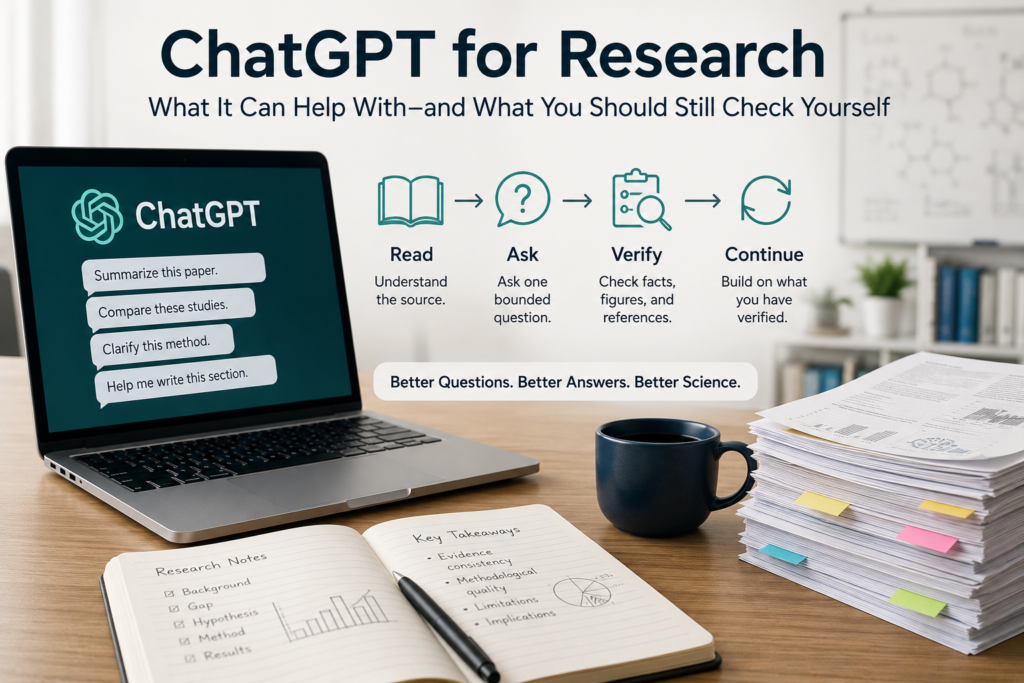
ChatGPT can make research work faster.
It can also make a mistake look finished.
Researchers may use it to organize papers, compare studies, review code, improve scientific writing, or structure troubleshooting. These tasks can save time when the source material is clear and the output can be checked.
The risk begins when a polished response is treated as verified evidence.
A safer workflow is simple:
Read
  ↓
Ask
  ↓
Verify
  ↓
Continue
Read the original source first.
Ask ChatGPT one bounded question.
Check the answer against the paper, data, code, or protocol.
Then continue using only what you have verified.
Quick Rule: ChatGPT should support scientific judgment, not replace it.
The Short Answer
ChatGPT is useful for organizing, comparing, restructuring, and explaining.
It is less reliable when asked to establish novelty, verify references, judge scientific validity, or make final methodological decisions.
| ChatGPT can help with | You should still check |
|---|---|
| Refining a research question | Novelty and scientific importance |
| Building search terminology | Search completeness |
| Extracting fields from papers | Numbers, figures, and context |
| Comparing studies | Whether the explanation is justified |
| Reviewing code risks | Whether the analysis fits the study design |
| Revising scientific writing | Meaning, citations, and claim strength |
| Organizing troubleshooting ideas | Safety and experimental decisions |
The most useful principle is:
Use ChatGPT to make the work easier to inspect, not easier to accept without checking.
How to Use ChatGPT for Research: Read, Ask, Verify, Continue
This four-step pattern works across most research tasks.
Read
Begin with the original material:
- a paper;
- a figure;
- a dataset;
- a script;
- a protocol;
- a reviewer comment;
- a manuscript section.
You do not need to understand every detail before using ChatGPT. You should, however, know what source the answer is supposed to reflect.
Ask
Give ChatGPT one specific task.
Define:
- which sources it may use;
- what it should extract or evaluate;
- what it must not infer;
- what format it should return;
- how missing information should be reported.
For example:
Using only the uploaded papers, compare the model, intervention, timing, control, endpoint, direct finding, and stated limitation. Write “Not reported” when information is missing.
Verify
Check the details most likely to alter the conclusion:
- references;
- numerical values;
- methods;
- figures;
- statistical claims;
- causal language;
- research-gap claims.
Continue
Only verified output should enter the next stage.
A checked evidence table may support a comparison.
A checked comparison may support a synthesis.
An unverified summary should not quietly become part of a manuscript.
Key Point: The safest workflow does not depend on one perfect prompt. It depends on keeping each step small enough to check.
What ChatGPT Does Well
Organizing scattered information
ChatGPT is useful when several sources need to be compared in the same format.
Instead of requesting a general summary of each paper, ask for one row per study using consistent fields:
- model;
- intervention;
- timing;
- control;
- endpoint;
- assay;
- direct finding;
- limitation.
This makes missing information and incompatible outcomes easier to notice.
The table is not evidence by itself. It is a way to inspect evidence more efficiently.
Clarifying unfamiliar concepts
ChatGPT can provide a first explanation of:
- technical terminology;
- laboratory methods;
- statistical concepts;
- abbreviations;
- differences between related measurements.
This can be helpful when reading outside your immediate specialty.
Use it for orientation. Check the original source when the exact definition affects interpretation or reproducibility.
Improving scientific writing
ChatGPT can help revise:
- manuscript paragraphs;
- abstracts;
- reviewer responses;
- figure legends;
- grant sections.
A useful instruction is:
Revise this paragraph for clarity and concision. Preserve all numerical values, citations, uncertainty language, causal strength, and limitations. Do not add new claims or references.
The goal is not stronger writing.
It is clearer writing that preserves the science.
Reviewing code risks
Before asking ChatGPT to rewrite code, ask it to identify possible problems.
Useful checks include:
- data leakage;
- incorrect indexing;
- missing-value handling;
- hard-coded paths;
- undocumented preprocessing;
- missing random seeds;
- reproducibility risks.
A useful request is:
Review this analysis for possible errors and reproducibility risks. Do not rewrite the code yet. Explain what should be checked.
ChatGPT may identify plausible issues. The researcher must confirm whether they are real.
What ChatGPT Often Gets Wrong
References
A reference may be invented, incomplete, irrelevant, or inaccurately described.
A citation does not become reliable because it looks correctly formatted.
Open the source and check whether it supports the claim.
Numbers
Always confirm:
- sample sizes;
- doses;
- units;
- confidence intervals;
- subgroup values;
- statistical output;
- normalization methods.
One incorrect value can change the interpretation of an otherwise accurate summary.
Figures
A figure cannot always be understood from the image alone.
Its interpretation may depend on:
- the legend;
- the experimental unit;
- biological versus technical replicates;
- normalization;
- exclusions;
- axis scaling;
- the Methods.
Do not expect a reliable interpretation from a cropped panel without context.
Causal language
Small wording changes can alter the meaning of a result.
Compare:
Protein X was associated with increased cytokine secretion.
and:
Protein X increased cytokine secretion.
The second statement is stronger.
ChatGPT may quietly change:
- suggests → demonstrates;
- associated with → caused;
- may contribute → drives;
- in this model → generally.
These changes are easy to miss because the revised sentence often sounds better.
Research gaps
ChatGPT may find a comparison missing from the papers you supplied.
That does not prove the comparison is absent from the field.
The apparent gap may reflect:
- an incomplete paper set;
- different terminology;
- work in an adjacent discipline;
- recent studies not included;
- inaccessible literature.
Treat an AI-generated gap as a search lead, not as a conclusion.
The Source Boundary
Before asking ChatGPT to help, decide what it is allowed to use.
Possible boundaries include:
- uploaded papers only;
- a verified reference list;
- current web sources;
- a dataset;
- code and documentation;
- your own checked notes.
Without a source boundary, ChatGPT may combine supplied material with general knowledge or inference.
Instead of asking:
What do these papers show?
ask:
Using only the uploaded papers, identify the direct findings, author interpretations, and stated limitations. Write “Not reported” when information is absent.
A source boundary does not eliminate mistakes.
It makes them easier to trace.
The Verification Boundary
Some details should always be checked directly.
These include:
- citations;
- sample sizes;
- units;
- methodological details;
- figure interpretation;
- statistical claims;
- causal statements;
- field-wide conclusions.
Useful uncertainty labels include:
- Not reported
- Unclear from the source
- Requires manual verification
- Inference, not directly supported
A visible gap is more useful than a confident guess.
Four Real Research Scenarios
1. “I need to compare conflicting papers.”
Read
Identify what each study actually measured.
Ask
Compare:
- model;
- population;
- intervention;
- dose;
- timing;
- control;
- endpoint;
- assay;
- analysis.
Verify
Check that different outcomes were not merged.
For example, studies may all discuss “IL-1β production” while measuring:
- IL-1β mRNA;
- intracellular pro–IL-1β;
- secreted mature IL-1β.
These are related, but they are not interchangeable.
Continue
Only after listing the factual differences should possible explanations be considered.
Quick Rule: Facts first. Mechanisms second.
2. “I need to screen many abstracts.”
Read
Define the inclusion and exclusion criteria.
Ask
Use three outcomes:
- Include
- Exclude
- Unclear
Require a supporting phrase from the title or abstract.
Verify
Review borderline records and those with missing information.
Continue
Only checked decisions should enter the final screening record.
The “Unclear” category prevents missing information from becoming a confident guess.
3. “My manuscript paragraph sounds awkward.”
Read
Identify what the paragraph is claiming.
Ask
Request a revision that preserves:
- numbers;
- citations;
- uncertainty;
- terminology;
- causal strength;
- limitations.
Verify
Compare the original and revised claims line by line.
Continue
Accept only changes that improve readability without changing meaning.
In scientific writing, stronger is not always better.
4. “My experiment failed.”
Read
Collect:
- the expected result;
- the observed result;
- the protocol;
- controls;
- deviations;
- relevant images or measurements.
Ask
Request:
- ranked possible causes;
- evidence supporting each cause;
- one diagnostic check;
- one corrective action.
Verify
Compare the suggestions with local SOPs, equipment documentation, and experienced advice.
Continue
Test one plausible cause at a time.
The output is a hypothesis list, not an experimental decision.
When Not to Use ChatGPT
ChatGPT is a poor choice when:
- the task requires comprehensive literature coverage;
- exact citation verification is the main goal;
- the material is confidential and cannot be uploaded;
- the conclusion depends on subtle figure details;
- specialist statistical or methodological judgment is required;
- an error could cause serious harm and the result cannot be independently checked.
In those situations, use the original source, a scholarly database, validated software, official documentation, or expert review.
A Simple Decision Framework
Before using ChatGPT, ask:
- What is the source?
- What is the exact task?
- What could be inferred incorrectly?
- What must be checked manually?
- What will happen after verification?
If those questions are difficult to answer, the task may still be too broad.
Common Mistake: Asking ChatGPT to search, compare, interpret, and write in one step makes errors harder to locate.
Privacy, Reproducibility, and Disclosure
Take particular care with:
- unpublished manuscripts;
- confidential peer reviews;
- grant proposals;
- patient information;
- proprietary data;
- patent-related material;
- laboratory records.
Do not assume that sensitive material is appropriate to upload because privacy settings are available.
Check:
- institutional policy;
- collaboration agreements;
- consent requirements;
- confidentiality obligations;
- current product terms.
For important research work, record:
- tool and model;
- date;
- exact prompt;
- source set;
- output;
- corrections;
- final human decision.
Disclosure requirements vary across journals, institutions, funders, and types of AI use.
Frequently Asked Questions
Is ChatGPT reliable for academic research?
It can be useful for narrow, checkable tasks. It should not be treated as an independent authority on evidence, statistics, methods, or references.
Can ChatGPT find research papers?
It may locate useful starting sources. It should not be assumed to provide a complete scholarly search.
Can ChatGPT summarize scientific papers?
Yes, but figures, numerical values, methods, and limitations should be checked in the original source.
Can ChatGPT compare multiple papers?
Yes, especially when each study is compared using the same fields. Different endpoints and study designs should remain separate.
Can ChatGPT conduct a literature review?
It can support searching, screening, extraction, comparison, and drafting. A formal review still requires a documented and reproducible method.
Can ChatGPT identify research gaps?
It can suggest candidate gaps within a defined source set. A field-wide gap requires broader searching and expert judgment.
Can ChatGPT generate accurate references?
Sometimes. It may also invent or misrepresent them.
Can I upload unpublished research?
Do not assume that you can. Check institutional policy, confidentiality requirements, contracts, and current product terms.
Key Takeaways
The safest ChatGPT workflow is simple:
Read the source. Ask one bounded question. Verify the answer. Continue only with what you checked.
ChatGPT is useful for organizing information, comparing sources, improving structure, and exposing questions that need closer attention.
It is not the final authority on references, numbers, causality, novelty, or scientific validity.
A clear source boundary shows where the answer came from.
A clear verification boundary shows what still needs human review.
The goal is not to hand over the research problem.
It is to make the next scientific decision easier to see—and harder to get wrong.
Continue Learning
ChatGPT and AI for Research
- Claude vs ChatGPT for Research
- Claude Prompts for Scientific Research
- Claude vs Gemini for Scientific Writing
- Best AI Tools for Researchers
Literature Review
- How to Read Scientific Papers
- AI Literature Review Workflow
- How to Find Research Papers Faster
- How to Organize Research Papers
- How to Use Scite for Literature Review
- Elicit Review
Scientific Writing and Interpretation
- AI for Scientific Writing
- How to Interpret Scientific Figures
- Western Blot Interpretation Guide
- Western Blot Troubleshooting Cheat Sheet