Last updated: August 2026
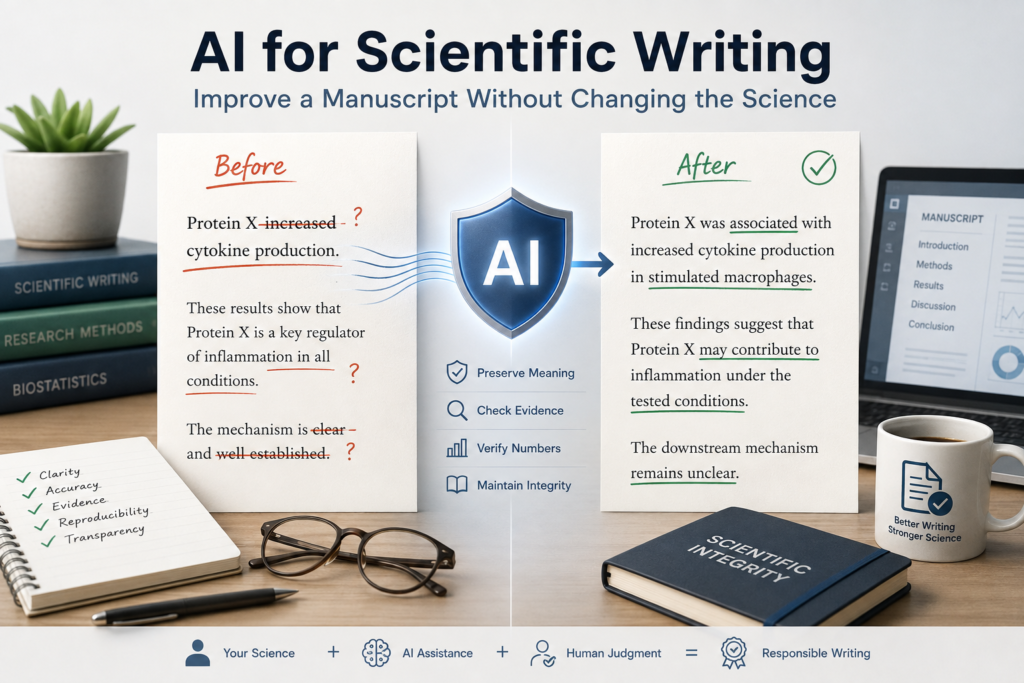
AI can make a scientific manuscript easier to read.
It can also make the science sound stronger than the evidence allows.
That is the central risk.
A sentence may become shorter, smoother, and more confident while quietly losing an important limitation. An association may become a cause. A result observed in one model may be presented as a general biological rule. A Methods section may become more elegant but less reproducible.
The goal is therefore not simply to use AI to improve the writing.
It is to improve the writing without changing what the study actually supports.
The Short Answer
AI writing tasks do not all carry the same risk.
| Writing task | Risk level | Main concern |
|---|---|---|
| Correcting grammar | Lower | Technical terminology may change |
| Removing repetition | Lower | Qualifications may disappear |
| Improving transitions | Lower | Logical relationships may shift |
| Rewriting a paragraph | Moderate | Meaning or certainty may change |
| Drafting an abstract | Moderate | Results may be compressed inaccurately |
| Revising the Discussion | Moderate to high | Causal claims may become stronger |
| Generating references | High | Citations may be false or misleading |
| Writing conclusions from notes | High | Unsupported claims may be introduced |
| Declaring novelty | High | The literature search may be incomplete |
A useful rule is:
The risk rises when AI moves from editing words to deciding what the science means.
Lower-risk tasks mainly improve text that already exists.
Moderate-risk tasks require AI to reorganize, compress, or emphasize information.
Higher-risk tasks depend on scientific judgment, source completeness, or interpretation.
None of these categories is entirely risk-free.
Why Scientific Writing Is Different
Scientific writing is not simply formal writing.
It must preserve:
- evidence strength;
- uncertainty;
- causal boundaries;
- numerical accuracy;
- methodological detail;
- limitations;
- traceability to sources.
General writing often rewards confidence and simplicity.
Scientific writing sometimes requires the opposite.
Consider these two sentences:
Protein X was associated with increased cytokine secretion.
Protein X increased cytokine secretion.
The second sentence is cleaner.
It is also stronger.
If the study was observational, the revision may no longer match the design.
Small expressions such as may, suggests, associated with, in this model, and under these conditions are not filler. They define how far the evidence can travel.
Key point: Clearer writing should make the evidence easier to understand—not make the claim broader than the evidence.
Where Scientific Meaning Changes
The dangerous revision is rarely obviously wrong.
It usually sounds slightly better than the original.
Most meaning changes happen through one stronger verb, one removed limitation, or one broader noun.
Association Becomes Causation
Original:
Protein X was associated with increased IL-1β secretion.
Unsafe revision:
Protein X drove IL-1β production.
The revision changes an observed relationship into a causal mechanism.
Scope Becomes Broader
Original:
In stimulated macrophages, Protein X was associated with higher IL-1β secretion.
Unsafe revision:
Protein X regulates inflammation.
The model, condition, and measured endpoint have disappeared.
Uncertainty Disappears
Original:
These findings suggest that Protein X may contribute to macrophage activation.
Unsafe revision:
These findings demonstrate that Protein X activates macrophages.
The second version is more confident than the evidence.
The Endpoint Changes
Original:
Secreted IL-1β increased.
Unsafe revision:
IL-1β expression increased.
Secretion, intracellular protein abundance, and gene expression are related but distinct biological measurements.
Replacing one with another changes the claim.
Before accepting a revision, ask:
- Did certainty increase?
- Did association become causation?
- Did the model or condition disappear?
- Did the measured endpoint change?
- Was a limitation removed?
- Was new scientific content added?
The same distinction matters when reading published results. For a broader workflow, see How to Interpret Scientific Figures.
Lower-Risk Ways to Use AI
AI manuscript editing is most useful when the scientific content is already written and verified.
Clarifying Existing Text
AI can help improve:
- grammar;
- sentence flow;
- concision;
- paragraph structure;
- transitions.
A useful instruction is:
Revise this paragraph for clarity and concision. Preserve all numerical values, citations, uncertainty language, causal strength, technical terminology, and limitations. Do not add new claims or references.
The editing goal should remain narrow.
“Make this stronger” is usually a poor instruction for scientific writing.
Organizing Supplied Material
AI can help arrange information the researcher has already provided.
Useful tasks include:
- reorganizing an Introduction;
- identifying repeated claims;
- comparing manuscript versions;
- grouping reviewer comments;
- converting notes into an outline;
- building a revision checklist.
This works best when the source boundary is explicit.
For example:
Use only the supplied manuscript and reviewer comments. Do not add references, experiments, or interpretations.
Flagging Sentences That Need Review
AI can also act as a first-pass reviewer.
It may flag:
- causal language;
- broad generalizations;
- inconsistent terminology;
- unsupported mechanisms;
- repeated conclusions;
- revisions that may have changed meaning.
In many cases, asking AI to identify risky sentences is safer than asking it to rewrite the entire manuscript immediately.
Supporting Non-Native English Researchers
AI can reduce language friction by suggesting:
- clearer sentence structures;
- alternative phrasing;
- smoother transitions;
- more natural academic tone;
- corrections to grammar and article use.
The aim should be clearer expression, not standardized expression.
Scientific writing does not need to sound as though every author has the same voice. It needs to be precise, readable, and faithful to the intended meaning.
A revision is not helpful if the author no longer recognizes the intended scientific claim.
How to Edit Each Manuscript Section
Different manuscript sections require different constraints.
A prompt that is appropriate for the Introduction may be unsafe for the Methods or Discussion.
Introduction
AI can help with:
- paragraph order;
- repeated background;
- transitions;
- narrowing the stated problem;
- distinguishing established evidence from open questions.
Check manually:
- references;
- descriptions of previous work;
- claims of consensus;
- field-wide generalizations;
- statements about novelty.
AI should not invent a research gap simply because one is rhetorically useful.
When the problem is finding or organizing sources rather than editing prose, a separate AI Literature Review Workflow is more appropriate.
Methods
The main goal of Methods editing is reproducibility.
AI may improve wording, but it should preserve:
- concentrations;
- units;
- timing;
- reagent identities;
- equipment;
- software versions;
- thresholds;
- exclusion criteria;
- analysis steps.
A shorter Methods section is not better if another researcher can no longer repeat the work.
A useful instruction is:
Improve clarity without removing or changing any procedural detail. Flag anything that appears incomplete or ambiguous.
Results
Results editing requires numerical discipline.
Preserve:
- sample sizes;
- group labels;
- comparison directions;
- effect estimates;
- confidence intervals;
- p-values;
- figure references;
- uncertainty language.
After revision, ask AI to produce a separate list of all numerical statements.
Then compare that list with the original statistical output and figures.
Discussion
The Discussion carries the greatest risk of meaning drift.
AI may unintentionally:
- strengthen causality;
- add a mechanism;
- remove a limitation;
- broaden generalizability;
- merge findings with interpretation.
A safe instruction is:
Improve clarity and flow while preserving the distinction between direct findings, interpretation, and speculation. Flag every causal or mechanistic claim.
Abstract
AI can help compress a manuscript into:
- objective;
- methods;
- results;
- conclusion.
The final abstract should be checked against the full paper, not only against the original abstract.
Compression can remove exactly the qualification that keeps the conclusion accurate.
Figure Legends
Figure legends must retain:
- panel labels;
- group names;
- sample size;
- biological or technical replicates;
- normalization;
- units;
- statistical tests;
- significance notation.
A shorter legend is not better if technical information disappears.
A Before-and-After Example
Consider this original passage:
Protein X was associated with increased IL-1β secretion in stimulated macrophages. However, this effect was observed only under the tested condition, and the downstream mechanism remains unclear.
An over-edited version might read:
Protein X drives inflammatory cytokine production in macrophages.
The sentence is shorter.
It is also scientifically different.
Several changes have occurred:
- association became causation;
- IL-1β became a broad cytokine category;
- the stimulation condition disappeared;
- the experimental boundary was removed;
- an unclear mechanism became an implied mechanism.
A safer revision would be:
Protein X expression was associated with higher IL-1β secretion in stimulated macrophages, although the downstream mechanism remains unclear.
The sentence is smoother without becoming stronger.
Before accepting any AI revision, compare:
- numbers;
- terminology;
- certainty;
- causality;
- scope;
- limitations;
- added scientific content.
A Safe AI-Assisted Writing Workflow
A reliable workflow is simple:
Original draft
      ↓
Define the editing goal
      ↓
AI revision
      ↓
Compare meaning and evidence
      ↓
Check numbers and citations
      ↓
Accept selected changes
      ↓
Save the human-approved version
Define the Editing Goal
Use a specific request.
Examples:
- improve clarity;
- remove repetition;
- shorten the abstract;
- reorganize the Discussion;
- improve the tone of a reviewer response.
Avoid:
Make this better.
Set the Source Boundary
Tell the AI what it may use:
- the supplied paragraph only;
- the full manuscript;
- verified references;
- reviewer comments;
- figure legends;
- statistical output.
The broader the source boundary, the harder the revision becomes to audit.
Preserve the Original
Keep:
- the original version;
- the AI-edited version;
- the final author-approved version.
Do not overwrite the source file immediately.
Check Before Accepting
Ask seven questions:
- Did any number change?
- Did certainty increase?
- Did association become causation?
- Was the scope broadened?
- Was a limitation removed?
- Was new content added?
- Can every citation and claim be verified?
The goal is not to accept every improvement.
It is to keep only the changes that remain scientifically accurate.
This is the writing equivalent of the Read → Ask → Verify → Continue workflow described in ChatGPT for Research.
Related Scientific Writing Tasks
The same principles apply beyond direct manuscript editing.
Reviewer Responses
AI may help:
- organize reviewer comments;
- identify requested actions;
- draft respectful wording;
- connect comments to manuscript sections;
- track unresolved issues.
It must not claim that an experiment, analysis, or revision was completed unless the supplied material confirms it.
A useful status label is:
Author decision required.
Grant Proposals
Grant writing is broader than manuscript editing, but it involves many of the same risks.
AI may improve structure, transitions, concision, and alignment between aims and methods.
It must preserve the difference between:
- established evidence;
- preliminary data;
- hypotheses;
- proposed work.
For example:
Preliminary data suggest that Protein X may affect macrophage activation.
should not become:
We have established Protein X as a key regulator of macrophage activation.
Persuasive writing is not permission to upgrade the evidence.
What AI Should Never Decide
AI should not make the final decision about:
- scientific validity;
- novelty;
- statistical appropriateness;
- causal interpretation;
- authorship;
- ethical compliance;
- readiness for submission;
- whether confidential material may be uploaded.
It can help expose the questions.
It cannot take responsibility for the answers.
Disclosure, Confidentiality, and Authorship
Policies vary across journals, publishers, institutions, and funders.
Some distinguish basic proofreading from substantive generation or analysis. Requirements may also depend on what the tool did, what material was uploaded, and how the output was used.
Before using AI with unpublished work, consider:
- journal and publisher policies;
- institutional rules;
- collaborator expectations;
- confidentiality agreements;
- patient or participant information;
- proprietary or patent-related material;
- current product data-handling terms.
The existence of a privacy setting does not automatically mean the material is appropriate to upload.
AI tools also cannot approve a manuscript, answer for its accuracy, or accept responsibility for the work. They should not be presented as authors.
Common Mistakes
Asking AI to Make the Writing Stronger
Stronger language may exceed the evidence. Ask for clearer writing instead.
Using the Same Prompt for Every Section
Methods and Discussion require different constraints. One protects procedural detail. The other protects interpretation.
Accepting a Revision Without Comparison
A fluent sentence may still have changed meaning. Always compare it with the original.
Trusting Generated References
A correctly formatted reference may still be false, irrelevant, or unable to support the claim. Check every citation.
Uploading Confidential Material Without Checking Policy
Technical availability does not equal permission.
Frequently Asked Questions
Can AI write or improve a scientific paper?
AI can assist with outlining, drafting, revising, organizing, and improving clarity. Human authors remain responsible for the scientific content, evidence, interpretation, citations, and final manuscript.
Is it ethical to use AI for scientific writing?
It can be, depending on how it is used and disclosed. The relevant journal, publisher, institutional, and funder policies should be checked before submission.
Can AI help non-native English researchers?
Yes. It may reduce language barriers and suggest clearer phrasing. Authors should still verify terminology, uncertainty, disciplinary meaning, and scientific voice.
Can AI edit Methods, abstracts, and figure legends?
Yes, but each section requires different constraints. Methods must preserve reproducibility. Abstracts must preserve the balance of the full manuscript. Figure legends must retain technical and statistical details.
Can AI draft reviewer responses?
Yes. It can organize comments and draft professional wording. It must not invent completed experiments, analyses, or revisions.
Can AI generate scientific references?
It can produce references, but they may be inaccurate, irrelevant, or fabricated.
Does AI-assisted writing need to be disclosed?
Requirements vary by journal, publisher, institution, funder, and type of AI use.
Can I upload an unpublished manuscript?
Do not assume that uploading is permitted. Check confidentiality agreements, institutional policy, collaborator expectations, consent requirements, and current data-handling terms.
Is AI better than a professional scientific editor?
AI may be faster for routine language revision. A professional editor may provide deeper scientific, structural, disciplinary, and journal-specific judgment. The better choice depends on the manuscript and the level of review required.
Key Takeaways
AI is most useful when editing verified scientific content.
Different manuscript sections require different constraints.
Clearer writing should not increase certainty, causal strength, or scope.
Numbers, references, methods, and conclusions still require direct checking.
The human author remains responsible for every accepted revision.
Good scientific writing makes the evidence clearer. AI-assisted writing is useful only when it does the same.
Continue Learning
AI and Scientific Writing
- Claude vs Gemini for Scientific Writing
- ChatGPT for Research
- Claude Prompts for Scientific Research
- Best AI Tools for Researchers