Last updated: August 2026
Controls are one of the first things I look at when deciding whether I trust an experiment.
A result can look impressive.
The graph may be clean.
The p-value may be small.
The phenotype may be dramatic.
But without the right controls, it can still be difficult to know what actually caused the result.
As a PhD student in the life sciences, I often ask one simple question when reading a paper:
“What would I need to see to believe this experiment?”
Very often, the answer is a control.
But simply having a control is not enough.
The more useful question is:
“Does this control actually address the alternative explanation that matters?”
That is the idea behind this guide.
Part 1 — How to Think About Controls
1. Start With the Claim
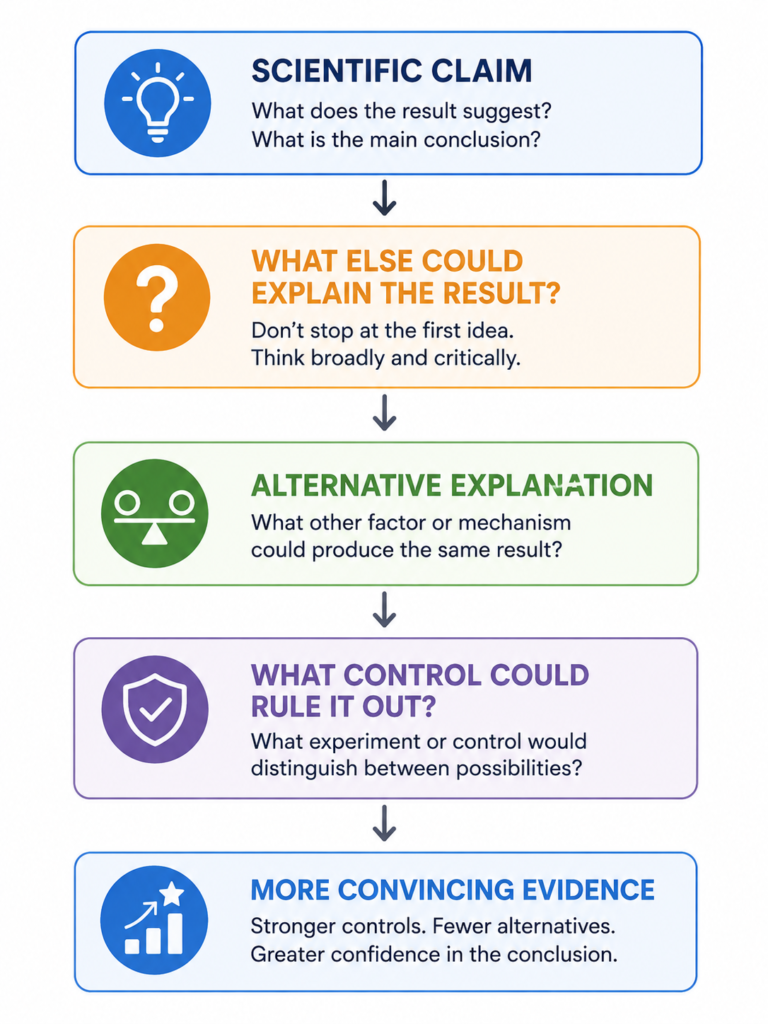
Before evaluating the control, I first identify what the experiment is trying to prove.
For example:
Claim: Gene A is required for ferroptosis.
Then I ask:
What else could explain the same result?
If Gene A knockdown reduces cell death, possible explanations include:
- Gene A is truly required for ferroptosis.
- The siRNA has off-target effects.
- The cells were damaged by transfection.
- The knockdown altered general cell health.
- The assay itself was affected.
- Another pathway compensated for the loss of Gene A.
A strong control strategy should help eliminate these alternative explanations.
This is why I do not think of controls as a technical formality.
They are part of the logic of the experiment.
Claim → Alternative explanation → Control
That is usually the sequence I have in mind when reading a figure.
2. Identify the Baseline
Every experiment needs a meaningful comparison.
Common baseline controls include:
- untreated cells,
- vehicle-treated cells,
- wild-type animals,
- mock-transfected cells,
- empty-vector controls,
- non-targeting siRNA,
- unstimulated samples.
The correct baseline depends on the experiment.
For example, if Drug X is dissolved in DMSO, comparing Drug X only with untreated cells is not ideal.
I would also expect a group treated with the same amount of DMSO but without the drug.
Otherwise, I cannot cleanly separate:
effect of Drug X
from
effect of the solvent.
A good baseline control keeps everything as similar as possible except for the variable being tested.
Part 2 — What Different Controls Tell You
3. Negative Controls
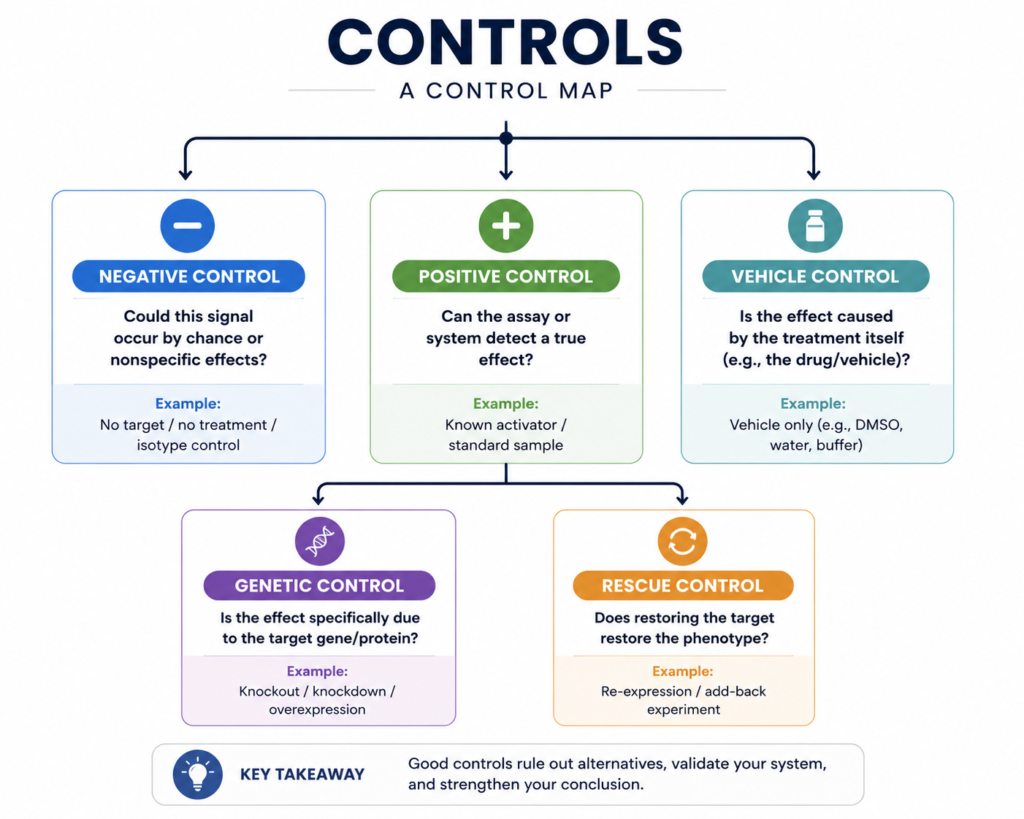
Negative controls show what the experiment looks like when the expected effect should not occur.
Examples include:
- vehicle-only treatment,
- non-targeting siRNA,
- empty vector,
- no-template PCR control,
- secondary-antibody-only staining.
A negative control helps answer:
Could this signal appear even when the biological phenomenon I care about is absent?
For example, if an immunofluorescence experiment shows strong fluorescence, I want to know whether some of that signal could come from background, nonspecific binding, or autofluorescence.
The negative control helps define that background.
4. Positive Controls
Positive controls ask the opposite question:
If the effect were truly present, could this experiment detect it?
Examples include:
- a known pathway activator,
- a known inhibitor,
- a known positive sample,
- a cell line known to express the target protein,
- a treatment known to induce the phenotype.
Positive controls become especially important when the experiment produces a negative result.
Suppose the authors conclude:
Compound X does not induce apoptosis.
That conclusion is stronger if a known apoptosis inducer produces the expected signal in the same assay.
Otherwise, another explanation remains:
Maybe the assay simply failed.
5. Vehicle Controls
Vehicle controls are easy to overlook but often essential.
If the experimental group receives:
10 μM Drug X in 0.1% DMSO
the vehicle control should usually receive:
0.1% DMSO without Drug X.
The goal is to isolate the effect of the drug itself.
This applies not only to DMSO, but also to:
- ethanol,
- buffer,
- saline,
- transfection reagents,
- delivery vehicles.
The control should match the treatment condition as closely as possible.
6. Genetic Controls
Genetic experiments usually need more than one layer of control.
Suppose a paper reports:
siRNA against Gene A reduces cell proliferation.
I may ask:
- Was a non-targeting siRNA included?
- Was knockdown confirmed?
- Were multiple siRNA sequences tested?
- Was the phenotype rescued by re-expressing Gene A?
Each one addresses a different problem.
A non-targeting siRNA controls for transfection-related effects.
Knockdown validation confirms that the target was actually reduced.
Multiple siRNAs reduce concern about sequence-specific off-target effects.
A rescue experiment provides stronger evidence that the phenotype is really caused by loss of Gene A.
7. Rescue Experiments
Rescue experiments are among the strongest controls in mechanistic biology.
Suppose the authors show:
Gene A knockout → phenotype B
That suggests Gene A may be involved.
But if they also show:
Gene A knockout + Gene A re-expression → phenotype moves back toward normal
the causal argument becomes much stronger.
The rescue asks:
If I restore the thing I removed, does the phenotype also recover?
That helps separate target-specific effects from unintended consequences of the manipulation.
Not every experiment requires a rescue.
But when a paper makes a strong causal claim from knockout or knockdown data, I pay close attention to whether one is present.
8. Matched Controls
A control can exist and still be poor.
The experimental and control groups should ideally differ only in the variable being tested.
I look for differences in:
- treatment duration,
- solvent concentration,
- cell density,
- genetic background,
- age,
- sex,
- culture conditions,
- imaging settings,
- sample processing.
For example, comparing drug-treated cells at 24 hours with untreated cells at 6 hours introduces time as another variable.
Likewise, comparing microscopy images acquired with different exposure settings can make a weak difference look dramatic.
The label “control” does not automatically make a comparison valid.
Part 3 — Controls in Common Experiments
9. Western Blot Controls
For Western blots, I commonly check:
- loading controls or total-protein normalization,
- untreated or vehicle controls,
- positive controls when antibody specificity is uncertain,
- expected molecular weight,
- replicate experiments,
- full blot context when available.
If the authors claim that Protein A increases after treatment, I want to know whether the difference could be caused by unequal loading.
A loading control helps address that.
But even loading controls need scrutiny.
Housekeeping proteins such as GAPDH, β-actin, or tubulin are only useful if they remain reasonably stable under the experimental condition.
A loading control that changes with treatment can make normalization misleading.
For a deeper guide, see How to Read and Interpret Western Blot Figures Correctly.
10. Microscopy and Immunofluorescence Controls
For microscopy-based experiments, I may look for:
- no-primary-antibody controls,
- secondary-antibody-only controls,
- isotype controls,
- known positive samples,
- consistent exposure settings,
- blinded quantification,
- appropriate segmentation.
One common problem is showing representative images without enough quantitative analysis.
Another is comparing images captured using different acquisition settings.
A brighter image does not automatically mean more protein.
The imaging conditions also need to be controlled.
11. Flow Cytometry Controls
Flow cytometry often requires several kinds of control.
Depending on the experiment, I may expect:
- unstained controls,
- single-stained controls,
- compensation controls,
- fluorescence-minus-one controls,
- viability dyes,
- biological positive and negative controls.
I also pay close attention to the gating strategy.
A clean-looking plot is not meaningful if the gate is poorly defined.
The control should help establish where the true negative population begins and how much signal should be considered real.
12. qPCR Controls
For qPCR, I may look for:
- no-template controls,
- reverse-transcription-negative controls,
- validated primers,
- appropriate reference genes,
- biological replicates.
Reference genes deserve particular attention.
A housekeeping gene is only useful if its expression remains stable under the condition being tested.
A gene should not be accepted as a valid reference simply because it is commonly used.
13. Cell-Viability and Cell-Death Controls
Cell-death experiments often need multiple controls because the same phenotype can arise through different mechanisms.
If a paper claims a treatment induces ferroptosis, I may expect:
- untreated control,
- vehicle control,
- ferroptosis inhibitor rescue,
- comparison with apoptosis or necroptosis inhibitors,
- lipid peroxidation measurements,
- viability assays,
- genetic validation when appropriate.
Simply observing cell death does not identify the mechanism.
The control strategy should help distinguish the proposed mechanism from plausible alternatives.
Part 4 — How to Judge Whether the Controls Are Enough
14. Look for Missing Controls
One of the most useful questions I ask when reading a figure is:
“What control would I add if I were doing this experiment?”
Examples:
Drug causes phenotype → Was there a vehicle control?
siRNA causes phenotype → Was there a non-targeting siRNA?
Knockout causes phenotype → Was there a rescue experiment?
No signal observed → Was there a positive control?
Fluorescence increased → Were imaging settings identical?
The absence of a control does not automatically invalidate the entire paper.
The more important question is:
How much uncertainty does the missing control introduce?
15. Not Every Experiment Needs Every Possible Control
More controls are not automatically better.
A paper does not need every imaginable control for every experiment.
The relevant question is:
Which alternative explanations are plausible enough that they need to be ruled out?
A strong mechanistic claim usually requires stronger control logic than a simple descriptive observation.
For example, a rescue experiment may be very valuable when claiming that a specific gene causes a phenotype.
It may be unnecessary for a purely descriptive experiment.
Controls should match the strength of the claim.
16. Good Controls Cannot Rescue Bad Experimental Design
Controls are essential, but they are not everything.
An experiment can include reasonable controls and still be weak because of:
- inadequate sample size,
- pseudoreplication,
- poor randomization,
- inappropriate statistics,
- biased quantification,
- unreliable reagents,
- poor model choice.
This is why I do not use a simple rule like:
Controls present = trustworthy
or
Controls absent = useless
Controls are one part of experimental design.
They need to be interpreted together with methods, statistics, replication, and biological relevance.
🧠 My Control Checklist
When I read a figure, I usually ask:
- What is the main claim?
- What alternative explanation could produce the same result?
- What is the baseline control?
- Is there an appropriate negative control?
- Is a positive control necessary?
- Are the experimental and control groups properly matched?
- Could the treatment or delivery method itself cause the effect?
- Was a genetic manipulation validated?
- Would a rescue experiment strengthen the claim?
- What control is missing?
- Does that missing control materially weaken the conclusion?
This is much more useful to me than memorizing a list of control types.
The central question remains:
Does this control actually address the alternative explanation that matters?
🤖 Where AI Fits Into Control Evaluation
AI tools can help explain unfamiliar experimental terminology.
They can also help summarize what a control is supposed to do.
But I would not rely on an AI system alone to decide:
“Are the controls in this paper sufficient?”
That judgment depends on:
- the claim,
- the biological system,
- the experimental design,
- the methods,
- the alternative explanations,
- and sometimes supplementary data.
If an AI summary says:
“The authors used appropriate controls.”
I still want to know:
Which controls?
What did each one rule out?
What alternative explanation remains?
AI can help me navigate the paper.
It should not replace experimental reasoning.
🔍 How This Fits Into My Paper-Reading Workflow
When I read a biology paper, controls are not a separate checklist I complete at the end.
They are part of how I interpret every major figure.
My general process is:
Identify the claim → identify alternative explanations → inspect the controls → ask what each control rules out → look for missing alternatives → decide how far the conclusion can go
That is why I often spend more time thinking about figure design than simply reading the paragraph describing it.
For the broader process, see How I Read a Biology Paper: From Abstract to Figures.
You may also find these useful:
- How to Interpret Scientific Figures
- How to Read and Interpret Western Blot Figures Correctly
- How to Read Research Papers With AI
Final Thoughts
Controls are not there just to make an experiment look complete.
They are there to make alternative explanations less likely.
That is why I do not simply ask:
“Does this experiment have a control?”
I ask:
“Does this control actually address the alternative explanation that matters?”
That small change in perspective makes experimental figures much easier to evaluate.
A strong control does not automatically prove a scientific claim.
But without the right controls, even a striking result can remain difficult to interpret.
For me, that is the main purpose of controls:
They help turn an observation into evidence.