Last updated: July 2026 • 12 min read
Quick Answer
Reading scientific papers efficiently is not about reading faster.
It’s about reading with a clear purpose.
Experienced researchers rarely read every paper from the first page to the last in a single pass. Instead, they decide what they need to learn, identify the sections that answer those questions, and adjust their reading strategy accordingly.
The goal isn’t to finish more papers. It’s to understand the evidence well enough to make better research decisions.
Why Reading Scientific Papers Feels So Difficult
Most researchers don’t struggle because scientific papers are too difficult.
They struggle because there are simply too many of them.
Finding relevant papers is only the beginning. The real challenge is deciding which ones deserve careful attention, understanding how they relate to one another, and turning dozens of individual studies into a coherent understanding of a research topic.
More importantly, it requires making hundreds of small decisions along the way.
Which paper should I read first?
Which figures actually matter?
Can I skip the methods?
Should I trust the authors’ conclusions?
Experienced researchers answer those questions almost instinctively.
They don’t read every paper the same way because every paper serves a different purpose.
Some papers introduce new ideas. Others are valuable because of their methods. A few deserve careful reading because the evidence could change how you think about the field.
The key is knowing what you’re looking for before you begin reading.
This guide explains the workflow I use when reading scientific papers, from choosing the right paper to organizing notes after I’ve finished reading.
Before You Read the First Paper
Before opening any paper, I try to answer three simple questions.
- ✅ What research question am I trying to answer?
- ✅ Why am I reading this paper?
- ✅ What information am I hoping to find?
Those questions determine almost everything that follows.
If I’m trying to understand a new field, I read very differently than when I’m evaluating a paper for a literature review or looking for a specific experimental method.
Without a clear purpose, it’s surprisingly easy to spend an hour reading a paper and finish without remembering what mattered most.
Reading becomes much more efficient once the objective is clear.
The purpose of reading determines how you should read.
The Scientific Paper Reading Workflow
One of the biggest misconceptions about reading scientific papers is that every paper should be read from beginning to end in exactly the same order.
In my experience, that’s rarely the most efficient approach.
Experienced researchers usually adapt their reading strategy depending on what they’re trying to learn.
A typical workflow looks like this:
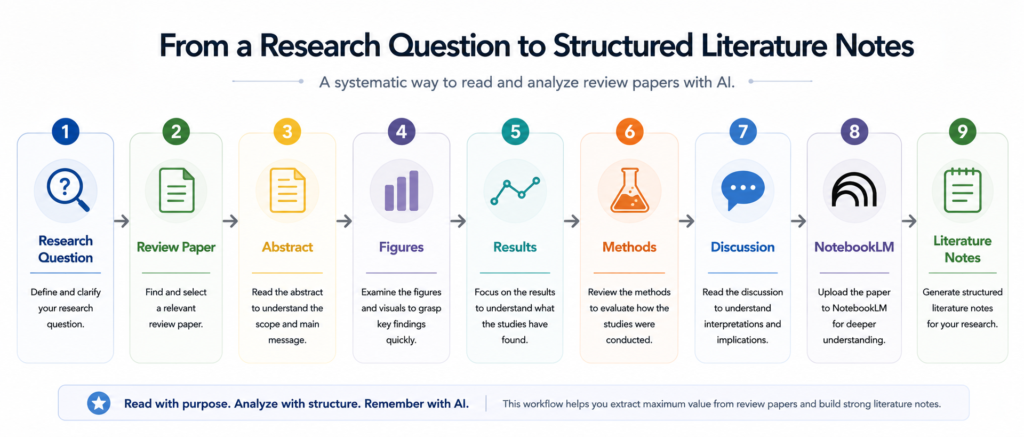
Each step answers a different question. Once I started thinking about those questions instead of simply reading from start to finish, the process became much more efficient.
| Section | Question |
|---|---|
| Review paper | What is already known? |
| Abstract | Is this relevant? |
| Figures | What is the evidence? |
| Methods | Can I trust it? |
| Discussion | What do the authors think it means? |
| NotebookLM | How does this paper connect with everything else I’ve read? |
| Literature notes | What do I want to remember after closing the paper? |
Notice what this workflow does.
It doesn’t encourage reading everything in order.
It encourages reading with a purpose.
Once I’ve answered the question I’m looking for, I either continue reading more deeply or move on to the next paper.
Experienced researchers don’t read papers in order. They read them with a purpose.
Step 1: Build Context with a Review Paper
When I’m learning a new topic, I almost never begin with a primary research paper.
I start with a review.
A good review paper helps me understand the questions researchers are trying to answer before I spend time reading individual studies.
More importantly, it introduces the terminology that appears repeatedly throughout the literature.
Without that background, even a well-written paper can feel unnecessarily difficult.
The goal at this stage isn’t to learn every detail.
It’s to understand the landscape.
A simple workflow looks like this:
Research Question
        ↓
Key Terminology
        ↓
Review Paper
        ↓
Background Understanding
When NOT to start with a primary paper
Primary research papers assume that readers already understand the field.
If you’re completely new to a topic, beginning with one can make the learning process much slower than it needs to be.
Step 2: Use the Abstract as a Filter
The abstract is usually the first section I read.
It’s also the section I trust the least.
An abstract is designed to answer two important questions:
- What question did the researchers investigate?
- What conclusion did they reach?
Those answers help me decide whether the paper is relevant.
They do not tell me whether the evidence is convincing.
Important details—experimental design, limitations, unexpected results, and methodological weaknesses—rarely fit into a few hundred words.
That’s why I treat the abstract as a screening tool rather than a final summary.
An abstract tells you what the authors claim—not whether the claim is convincing.
If the paper looks relevant, I keep reading.
If not, I move on without feeling guilty.
Step 3: Let the Figures Guide You
One habit that changed the way I read scientific papers was spending more time with the figures before reading the Results section.
Figures are where the evidence lives.
The text explains the experiments.
The figures show what actually happened.
My workflow is usually very simple.
Figure
      ↓
Main Finding
      ↓
Worth Reading Further?
If the figures answer an important research question or show particularly strong evidence, I continue reading.
If they don’t, I often move on to another paper.
This approach saves a surprising amount of time during literature reviews because it quickly separates papers that deserve close attention from those that are less relevant.
Step 4: Connect Results with Methods
Many people read the Results section first and leave the Methods until the end.
I rarely do that.
Results are only meaningful if you understand how they were produced.
Whenever I encounter an interesting finding, I immediately look at the corresponding methods.
That usually answers questions like:
- How large was the study?
- Which experimental model was used?
- Were the controls appropriate?
- Can the experiment actually support the conclusion?
Reading the Results without the Methods makes it much easier to overestimate the strength of the evidence.
A result is only as convincing as the experiment behind it.
Methods tell you whether the results deserve your confidence.
Step 5: Question the Discussion
The Discussion is often where the paper becomes most interesting.
It’s also where I become most cautious.
Rather than asking:
What do the authors conclude?
I usually ask a different question:
Does the evidence actually support those conclusions?
Those are not always the same thing.
Some Discussion sections remain closely tied to the experimental data.
Others extend into broader interpretations or future possibilities.
Both are valuable, but they shouldn’t be confused.
By the time I reach the Discussion, I already know what the figures showed and how the experiments were performed.
That makes it much easier to separate evidence from interpretation.
The Discussion is not where I learn what the paper says. It’s where I decide whether the evidence supports the authors’ interpretation.
Real Reading Example
To show how these ideas fit together, here’s how I typically approach a paper on single-cell RNA sequencing.
I don’t begin by reading the paper itself.
I begin by understanding the field.
The workflow usually looks like this:
Review
   ↓
Abstract
   ↓
Figures
   ↓
Methods
   ↓
Understanding
   ↓
NotebookLM
   ↓
Literature Notes
The review paper gives me the background.
The abstract helps me decide whether the paper is worth reading.
The figures tell me where the evidence is.
Only then do I move into the methods. The methods help me judge whether that evidence is reliable.
Only after I’ve worked through those steps do I upload the paper to NotebookLM to organize my notes and connect it with the rest of the literature.
Reading comes first.
Organization comes second.
For me, NotebookLM is simply the bridge between the two.
Common Reading Mistakes
The biggest mistake isn’t reading papers too slowly.
It’s reading them without a clear strategy.
❌ Reading every paper from beginning to end
Why it’s a problem
Not every paper deserves the same amount of attention.
Some papers only require a quick screening.
Others deserve careful study.
Reading every paper the same way often wastes time.
Better approach
Read with a purpose.
Decide what you’re trying to learn before deciding how deeply to read.
❌ Trusting the abstract
Why it’s a problem
Abstracts summarize the authors’ conclusions.
They rarely show the evidence behind those conclusions.
Better approach
If a paper looks important, move to the figures before deciding whether to continue reading.
❌ Ignoring the methods
Why it’s a problem
Interesting results are only meaningful if the experiments were designed well.
Without understanding the methods, it’s difficult to judge how much confidence the findings deserve.
Better approach
Whenever an important result catches your attention, read the corresponding methods before accepting the conclusion.
❌ Reading without a research question
Why it’s a problem
Reading becomes much less efficient when you don’t know what you’re looking for.
It’s easy to finish a paper without remembering why you read it in the first place.
Better approach
Define your research question before opening the paper.
That question should guide every decision that follows.
Which Part of a Paper Should You Read First?
The answer depends on what you’re trying to accomplish.
| Goal | Read First |
|---|---|
| Learn a new topic | Review paper |
| Decide whether a paper is relevant | Abstract |
| Evaluate the evidence | Figures |
| Assess the reliability of the study | Methods |
| Understand the authors’ interpretation | Discussion |
Experienced researchers don’t always read papers in the same order.
They change their reading strategy depending on the question they’re trying to answer.
How AI Can Support Your Reading Process
Careful reading should always come first.
Only after I’ve finished reading do I start thinking about how to organize what I’ve learned.
That’s where AI becomes genuinely useful.
For me, that usually means NotebookLM.
By the time I upload a paper, I already understand the research question, I’ve examined the figures, and I’ve decided the study is worth keeping in my literature review.
At that point, NotebookLM isn’t helping me read the paper.
It’s helping me connect that paper with everything else I’ve already read.
One question I often come back to is: Which findings appear consistently across these papers?
That question shifts my attention away from individual studies and toward the evidence as a whole.
When NOT to use NotebookLM
NotebookLM should not be your first step.
If you haven’t read the paper yourself, you won’t know whether its summaries accurately reflect the evidence or whether important methodological details have been overlooked.
For me, NotebookLM begins where careful reading ends.
Key Takeaways
- Read every paper with a clear purpose.
- Don’t rely on abstracts alone.
- Figures often provide the fastest path to understanding the evidence.
- Methods determine how much confidence you should place in the results.
- NotebookLM helps organize your understanding—it should never replace careful reading.
Frequently Asked Questions
What is the best way to read scientific papers?
Start with a clear research question. Once you know what you’re looking for, you can decide which parts of the paper deserve the most attention.
Should I read the abstract first?
Usually, yes. The abstract is useful for deciding whether a paper is relevant. It should not be treated as sufficient evidence.
Should I read the methods section?
Yes, particularly when the results will influence your own research. The methods determine how reliable the findings are.
How do experienced researchers read papers?
Most researchers adapt their reading strategy depending on the purpose. They rarely read every paper from beginning to end without first deciding whether it’s relevant.
Can NotebookLM help me read papers?
Yes, but it works best after you’ve already read the paper yourself. Its greatest strength is organizing and connecting information across multiple papers.
How long should reading a paper take?
There is no universal answer. Reading time depends on your familiarity with the topic, the complexity of the study, and the purpose of your reading. Avoid rigid time targets.
Do I need to read every paper completely?
No.
Many papers don’t need a full read. The abstract and figures are often enough to decide whether they’re worth your time. Reserve careful, detailed reading for the studies that are most relevant to your research question.
What should I highlight while reading?
Focus on the research question, key findings, important figures, methodological limitations, and any conclusions that directly influence your own work.
Final Thoughts
Reading scientific papers efficiently isn’t about reading less.
It’s about knowing what deserves your attention.
Further Reading
If you’d like to improve your literature review workflow, these official resources are worth exploring:
- Google Scholar – Academic literature search
- PubMed – Biomedical literature database
- NotebookLM – Official Google product page and Help Center