Last updated: July 2026
Quick Answer
AI can help you read research papers faster by explaining methods, summarizing key ideas, and organizing notes.
However, researchers should always read the figures, methods, and supporting evidence themselves before accepting an AI-generated interpretation.
The most effective workflow combines AI-assisted explanation with critical reading.
Reading research papers has never been easier—or more overwhelming.
Modern AI tools can summarize papers in seconds, explain unfamiliar methods, compare studies, and organize notes automatically. Used well, they can significantly reduce the time spent navigating scientific literature.
But speed comes with a trade-off.
AI can overlook important experimental details, misinterpret figures, or present speculative conclusions with unwarranted confidence. That means the question is no longer whether researchers should use AI—it’s how to use it without compromising scientific judgment.
Experienced researchers don’t let AI read papers for them. They use it to explain difficult concepts, organize information, and generate better questions while evaluating the evidence themselves.
This guide introduces a practical workflow for combining AI with critical reading—helping you understand papers faster without giving up scientific rigor.
💡 Key Takeaway
Use AI as a reading partner—not a replacement for critical thinking.
When Should AI Read for You—and When Should You Read Yourself?
One of the biggest mistakes researchers make is expecting AI to do everything equally well.
In reality, some tasks are well suited to AI, while others still require careful human evaluation.
| Task | AI | You |
|---|---|---|
| Summarize the abstract | ✅ | |
| Explain unfamiliar methods | ✅ | |
| Organize notes | ✅ | |
| Compare multiple papers | ✅ | |
| Read figures carefully | ✅ | |
| Evaluate experimental evidence | ✅ | |
| Judge whether conclusions are supported | ✅ | |
| Decide whether to cite the paper | ✅ |
A useful rule is simple: Let AI reduce the workload—not make the scientific decisions.
This division of labor reflects the strengths of both AI and human researchers.
AI is excellent at explaining unfamiliar concepts, organizing information, and identifying patterns across multiple papers.
Researchers, however, remain responsible for interpreting figures, evaluating experimental evidence, and deciding whether the conclusions are supported by the data.
A useful way to think about AI is this:
Let AI explain the paper. Let yourself evaluate it.
A Simple AI Workflow for Reading Research Papers
Many articles focus on recommending specific AI tools. The tools will continue to evolve, but a good reading workflow remains useful regardless of which AI system you use.
The workflow below shows where AI adds the most value—and where careful reading should remain your responsibility.
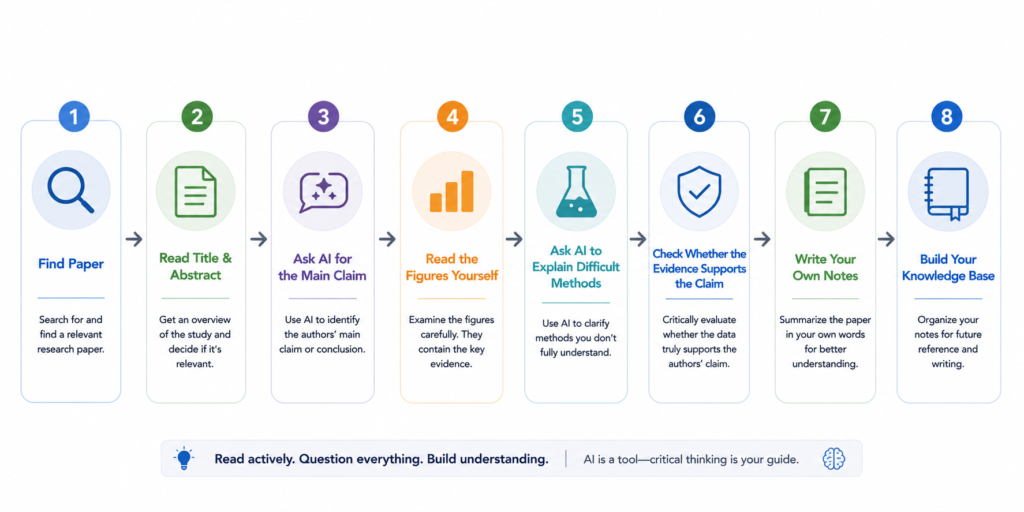
The key idea is simple: alternate between your own reading and AI assistance instead of handing the entire paper to AI from the beginning.
Read the title, abstract, and figures yourself. Then use AI to explain difficult methods, organize information, and identify questions worth investigating further.
The following sections walk through each step of this workflow in detail.
Step 1 — Read the Title and Abstract Yourself
Before asking AI anything, read the title and abstract yourself.
This helps you understand the research question before AI influences your interpretation.
Ask yourself:
- What question are the authors trying to answer?
- Why does this study matter?
- What do I expect the results to show?
Only then ask AI to clarify or summarize the paper.
Useful AI prompts
- Summarize the research question in one sentence.
- What problem is this paper trying to solve?
- What hypothesis are the authors testing?
AI can simplify technical language, but your first impression of the paper should always be your own.
Step 2 — Ask AI to Identify the Main Claim
Once you understand the research question, ask AI to summarize the paper’s central claim.
AI is particularly useful for identifying the study’s main hypothesis, conclusion, and objective in clear language.
However, remember one principle:
A claim is not evidence.
A useful follow-up prompt is:
Which figure provides the strongest evidence for this claim?
This shifts your focus from what the paper says to why the authors believe it.
Step 3 — Read the Figures Yourself
This is the step AI should not replace.
Figures contain the primary evidence supporting the paper’s conclusions, and subtle details are often difficult for AI to interpret accurately.
Pay particular attention to:
- 🧪 Western blots
- 🔬 Microscopy images
- 🧫 Flow cytometry plots
- Kaplan–Meier survival curves
- 📊 Statistical graphs
Before asking AI what a figure means, ask yourself:
- Which figure supports the main claim?
- Are the controls convincing?
- Does the evidence match the authors’ conclusion?
Only then use AI to clarify details that remain unclear.
Step 4 — Use AI to Explain Methods, Not Replace Them
Methods sections are often where AI provides the greatest value.
Use AI to explain unfamiliar techniques such as CRISPR, RNA sequencing, ELISA, Western blotting, or statistical analyses.
Tools like ChatGPT, Claude, or NotebookLM can explain unfamiliar experimental methods in simpler language, while literature-focused tools such as Elicit help compare findings across multiple studies.
The goal is to understand how a method works so that you can judge whether it was appropriate for the study.
AI should explain the method—not evaluate the experiment for you.
Step 5 — Ask AI What the Paper Doesn’t Say
One of the best ways to use AI is to challenge the paper rather than summarize it.
Ask questions such as:
- What are the major limitations?
- Which controls are missing?
- Which conclusions are strongly supported?
- Which conclusions are speculative?
- What experiments would strengthen this study?
These questions encourage the same critical thinking used during journal clubs and peer review.
Step 6 — Write Your Own Summary
Never stop with the AI summary.
Instead, write your own notes.
A simple template includes:
- Research question
- Experimental approach
- Key findings
- Major limitations
- Relevance to your research
AI can organize these notes, but the interpretation should always be yours.
AI helps you understand the paper. Writing your own summary proves that you understood it.
Common Mistakes When Using AI to Read Research Papers
AI can dramatically speed up paper reading, but it cannot replace scientific judgment.
Most mistakes occur not because AI gives incorrect answers, but because researchers stop checking the original paper.
Letting AI Replace the Paper
AI should help you understand a paper—not replace reading it.
Summaries are useful for orientation, but they inevitably simplify details that may be critical for interpreting the study.
Always read the original paper before citing or discussing its findings.
Trusting AI Summaries Without Checking the Figures
Figures contain the primary evidence supporting a paper’s conclusions.
An AI summary may describe the conclusion correctly while missing important details in the figures.
Always examine the figures yourself before accepting the interpretation.
Ignoring the Methods
Two papers may reach similar conclusions while using very different experimental approaches.
Use AI to understand unfamiliar methods—but never skip reading them yourself.
Assuming Citations Guarantee Accuracy
Source-linked citations are helpful, but they do not guarantee that the AI interpreted the paper correctly.
Whenever a claim is important for your work, verify it in the original paper.
Accepting Conclusions Without Checking the Evidence
AI summarizes conclusions well.
What it cannot reliably determine is whether those conclusions are fully supported by the evidence.
Before accepting any conclusion, ask yourself:
Does the evidence actually support this claim?
Asking AI Only for Summaries
Many researchers ask AI to summarize every paper.
Instead, ask questions that improve your understanding, such as identifying limitations, explaining unfamiliar methods, or comparing multiple studies.
Practical AI Prompts for Reading Research Papers
The quality of AI-assisted reading depends as much on the questions you ask as on the AI tool itself.
Instead of asking for a generic summary, ask targeted questions that improve your understanding of the paper.
| Goal | Example Prompt |
|---|---|
| Understand the main claim | What is the central claim of this paper? |
| Explain a method | Explain this RNA-seq workflow for a graduate student. |
| Evaluate the evidence | Which figure provides the strongest evidence for the main conclusion? |
| Identify limitations | What important limitations should I know? |
| Compare studies | Compare this paper with Paper B. What are the major differences? |
As a general rule, ask AI to explain, compare, or clarify rather than simply summarize.
Frequently Asked Questions
Can AI replace reading research papers?
No.
AI can accelerate reading by explaining methods, organizing information, and summarizing key ideas, but researchers should still evaluate the original figures, methods, and evidence themselves.
Which AI tool is best for reading research papers?
There is no single best tool.
Source-grounded tools are generally better for summarizing uploaded papers, while literature-focused tools are useful for comparing studies. General-purpose AI is often most helpful for explaining concepts and generating questions.
Should I upload the full PDF?
Whenever copyright, publisher policies, and institutional guidelines allow it, providing the complete paper generally gives AI more context than pasting isolated sections.
Always confirm that uploading research papers complies with your institution’s policies.
Can AI explain figures?
Yes—but it should not replace your own interpretation. Always examine the figures yourself before relying on an AI-generated explanation.
Can AI summarize methods accurately?
Usually.
AI is often effective at explaining unfamiliar techniques, but you should still decide whether the method was appropriate for the research question.
How do I avoid AI hallucinations?
The simplest strategy is:
- Read the title and abstract yourself.
- Examine the figures yourself.
- Ask AI specific questions.
- Verify important claims in the original paper.
The more grounded your questions are, the more reliable the answers are likely to be.
Should I trust AI-generated citations?
Treat AI-generated citations as a starting point, not proof. Always verify important references in the original paper.
What should I always read myself?
Never skip:
- The figures
- The methods
- The limitations
- The primary evidence supporting the main claim
Final Thought
If you’re ever unsure whether to trust AI, remember this:
The closer something is to the paper’s evidence, the more you should read it yourself.
Read the figures, methods, and supporting data directly.
Use AI to explain concepts, organize information, and speed up your understanding—not to replace your scientific judgment.
AI helps you read papers faster. Critical thinking helps you read them correctly. The best researchers use both.
Key Takeaways
If you use AI to read research papers, remember these principles:
- Read the title, abstract, and figures yourself.
- Let AI explain the paper—not decide what it means.
- Connect every major claim to its supporting evidence.
- Use AI to understand methods and organize notes.
- Write your own interpretation before moving on to the next paper.
The best researchers don’t let AI think for them—they use AI to think more efficiently.
Continue Learning
📖 New to Reading Research Papers?
Follow this learning path:
- How to Read Research Papers with AI (You’re here)
- How to Find Research Papers Faster
- How to Organize Research Papers
- AI Literature Review Workflow
🤖 AI Tools for Researchers