Last updated: July 2026
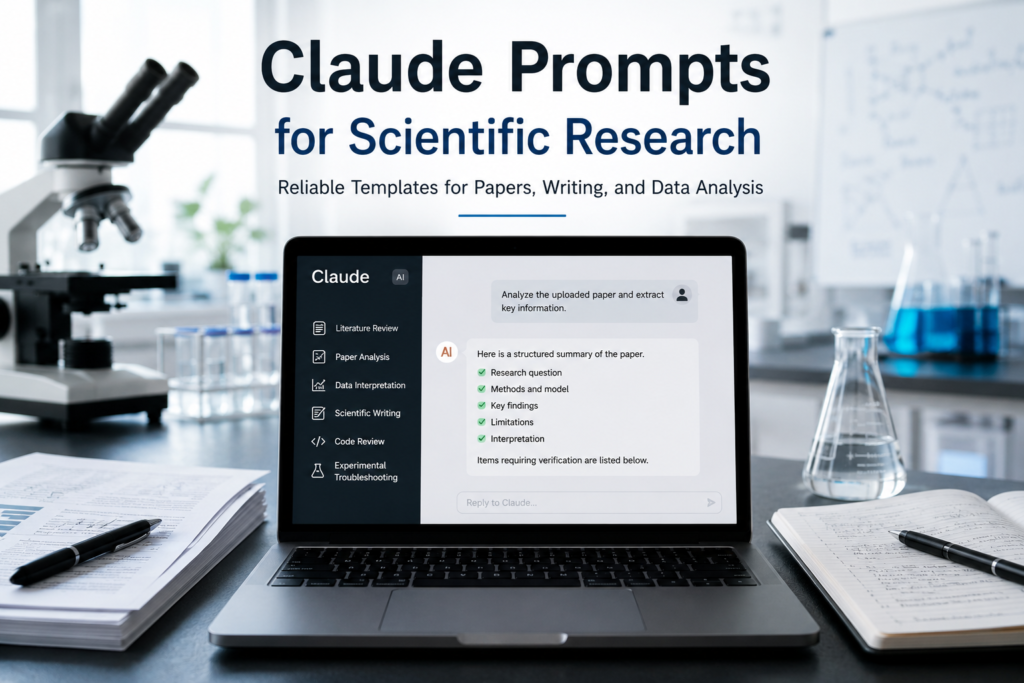
Most researchers do not need a more complicated prompt.
They need a clearer one.
Claude becomes more useful when it knows which sources to use, what task to perform, what information not to infer, and how the answer will be checked.
Without those boundaries, even a polished response can hide missing evidence, merge incompatible outcomes, or make a cautious result sound more certain than it is.
By the end of this guide, you will have reusable prompts for narrowing a research question, screening papers, extracting evidence, comparing conflicting studies, interpreting figures, revising scientific writing, reviewing code, and troubleshooting experiments.
The templates are meant to be adapted to the task in front of you—not copied without thought.
A good prompt does not remove the researcher from the process. It makes the researcher’s decisions easier to inspect.
The Short Answer
A strong research prompt usually answers six questions:
| Prompt element | Question to answer |
|---|---|
| Source | What material should Claude use? |
| Task | What exactly should it do? |
| Fields | What information should it extract or evaluate? |
| Boundaries | What should it avoid inferring, adding, merging, or changing? |
| Output | What format should it return? |
| Verification | What should the researcher check afterward? |
Using only [SOURCE], perform [TASK].

Extract or evaluate:
[FIELDS]

Do not:
[BOUNDARIES]

Return the result as:
[OUTPUT FORMAT]

If information is missing, write:
[UNCERTAINTY RULE]

At the end, list:
[ITEMS REQUIRING MANUAL VERIFICATION]
The structure is simple for a reason.
It makes the task clearer, the omissions easier to see, and the final output easier to verify.
Quick Navigation
New to Claude? Start with How to Build a Reliable Claude Research Prompt, then jump to the section that matches your current task. You do not need to use every prompt in this guide.
- Build a Reliable Research Prompt
- Define a Research Question
- Find and Screen Papers
- Extract and Compare Evidence
- Interpret Figures and Tables
- Improve Scientific Writing
- Review Code and Data Analysis
- Troubleshoot Laboratory Experiments
How to Build a Reliable Claude Research Prompt
Evidence Rules Used Throughout This Guide
Every prompt in this guide follows three principles:
- Separate direct findings from interpretation.
- Allow missing information instead of guessing.
- Verify important references, numbers, methods, and conclusions manually.
These rules appear inside the prompts where they are needed, so each template can still be copied and used on its own.
Start With the Evidence
“Analyze this paper” leaves too much open.
Should Claude use outside knowledge? Should it focus on the figures, the methods, or the discussion? Is the goal explanation, critique, or data extraction?
A better version begins with the source:
Using only the uploaded paper, identify the research question, experimental model, main methods, direct findings, author interpretation, and stated limitations.
The same principle applies to figures, manuscripts, datasets, code, and collections of abstracts.
Defining the source does not guarantee accuracy. It makes mistakes easier to locate.
Name the Actual Task
Words such as analyze, review, and improve are too broad on their own.
Use operations that can be checked:
- extract
- compare
- classify
- flag
- rank
- rewrite
- test
- separate
Instead of: Review these papers.
Try: Compare these papers by model, population, dose, timing, endpoint, control, assay, statistical method, and stated limitation.
The second prompt gives every paper the same basis for comparison.
Separate Evidence From Interpretation
Scientific conclusions often become distorted when three different things are blended together:
- what the study directly observed
- what the authors concluded
- what Claude inferred
A useful instruction is:
Separate the direct findings, the authors’ interpretation, and any additional inference you make.
This is especially important when studies disagree. Possible explanations may be useful, but they should be labelled as inference unless the papers support them directly.
Choose a Checkable Output
Tables, matrices, checklists, and risk logs are easier to inspect than long paragraphs.
For example: Return one row per study with separate columns for model, sample size, endpoint, main finding, interpretation, and limitation.
The format does not make the answer more accurate.
It makes gaps and inconsistencies easier to notice.
Allow Missing Information
Do not force Claude to fill every field.
Tell it what to write when the source does not contain the answer:
- Not reported
- Unclear from the supplied source
- Requires manual verification
- Inference, not directly supported
This is particularly important for sample size, dose, subgroup definitions, statistical methods, and research gaps.
End With Verification
A research prompt should end with a check, not with the answer.
At the end, list the references, numerical values, methodological details, and interpretations that require manual verification.
That final step turns verification into part of the workflow rather than an afterthought.
Prompts for Defining a Research Question
A broad topic is not the same as a research question.
Terms such as inflammation, AI in medicine, or macrophage activation describe research areas, but they do not specify the evidence that should be included.
A well-defined research question usually identifies:
- a population or model
- an exposure or intervention
- an outcome
- a biological or clinical context
- a clear boundary on scope
Narrowing a Broad Topic
Help me narrow the following topic into three answerable research questions.
For each question, specify:
- the model or population
- the exposure or intervention
- the outcome
- the biological or clinical context
- one explicit scope boundary
Do not introduce a new field or broaden the topic.
This prompt is useful when a research question is still too broad for a focused literature search.
However, it should not be used to establish novelty.
Claude can help refine the wording of a research question, but it cannot determine whether that question has already been answered in the literature.
Turning a Question Into a Review Framework
Convert the following research question into a PICO, PECO, or concept-based framework.
Explain which framework fits best and why.
Do not create eligibility criteria that are not implied by the question.
A structured framework helps organize later search and screening decisions.
The final eligibility criteria, however, still require domain expertise and human judgment.
Prompts for Finding Research Papers
Claude is useful at the beginning of a search, when the main problem is often vocabulary rather than retrieval.
A biological process may have one name in immunology, another in cell biology, and a broader label in clinical research. Claude can help map those terms before you open a database.
It should not be treated as the database itself.
Build the Search Concepts
Generate search terms for the following concepts:
- macrophage activation
- sterile inflammation
- IL-1β secretion
For each concept, separate:
- controlled vocabulary
- common synonyms
- abbreviations
- terminology used in adjacent fields
Distinguish true synonyms from broader related terms.
Do not generate citations or claim that the search is complete.
This gives you a vocabulary map rather than a finished search.
Terms from adjacent fields can improve recall, but broader terms may also introduce irrelevant results. Review each group before combining it into a search string.
Draft the Search Structure
Using the concept groups below, draft a Boolean search structure.
Keep each concept group separate. Explain where AND and OR should be used.
Identify any syntax that may need to be changed for the target database.
The result should be tested in PubMed, Scopus, Web of Science, or the relevant discipline-specific database.
A draft search string is a starting point—not a validated search strategy.
Avoid requests such as:
Find every important paper on this topic.
No open-ended AI request can guarantee comprehensive retrieval. When coverage matters, search scholarly databases and record the databases, dates, filters, and final search strings.
Prompts for Screening Papers
Screening requires consistent rules.
A model should not be asked whether a paper “looks relevant” without explicit criteria.
Title and Abstract Screening
Using only the title and abstract, classify this record as:
- Include
- Exclude
- Unclear
Apply the inclusion and exclusion criteria below exactly.
Quote the phrase that supports your decision.
If the abstract does not contain enough information, choose “Unclear” rather than inferring.
The “Unclear” category matters.
Without it, Claude may treat missing information as evidence.
Full-Text Screening
Apply the eligibility criteria to the full text.
For each criterion, report:
- Met
- Not met
- Unclear
Identify the section or passage supporting the decision.
If excluding the study, provide one primary exclusion reason.
This can support pilot screening and consistency checks.
It should not become the sole decision-maker in a formal review.
Prompts for Extracting Evidence
Evidence extraction works best when every paper is evaluated using the same fields.
Paper-Level Evidence Table
| Field | What to capture |
| Citation | Verified reference |
| Research question | What was tested? |
| Model or population | Who or what was studied? |
| Sample size | Reported number |
| Method | Main experimental or analytical approach |
| Endpoint | What was measured? |
| Direct finding | What was observed? |
| Author interpretation | What did the authors conclude? |
| Limitation | What weakens the inference? |
| Relevance | Why does it matter? |
Recommended Prompt
Complete the evidence table using only the uploaded paper. Write “Not reported” for missing fields. Preserve the authors’ terminology for the endpoint. Separate direct findings from author interpretation. Do not convert association into causation.
High-Risk Fields
Some fields deserve extra attention:
- sample size
- dose
- units
- confidence intervals
- subgroup values
- exclusions
- statistical tests
- normalization methods
A well-formatted table can still contain a wrong number.
Check the values that could change the conclusion.
Prompts for Comparing Multiple Papers
If you have ever tried to compare ten papers from memory, you already know the problem.
The details that matter most—dose, timing, model, endpoint, and control—are often the first ones to disappear.
A fixed comparison structure keeps those variables visible and helps reveal whether the studies are genuinely comparable.
Comparing the Same Variables
Compare the supplied papers using the same variables:
- model
- population
- intervention
- dose
- timing
- control
- endpoint
- assay
- statistical method
- limitation
Return one row per study.
Do not merge studies that measured different outcomes.
Preventing False Equivalence
In biology, similar labels may refer to different measurement levels.
Cytokine mRNA, intracellular protein, and secreted protein are related, but they are not interchangeable endpoints.
A useful instruction is:
Keep mRNA, intracellular protein, and secreted protein as separate outcomes. Do not combine them into one category.
Comparing Conflicting Findings
First list the factual differences in model, population, dose, timing, control, endpoint, assay, and statistical analysis.
Then suggest possible explanations for the conflicting findings.
Mark every explanation not directly supported by the papers as “Inference.”
The order matters. Facts come first. Interpretation comes later.
Prompts for Interpreting Figures and Tables
A figure can look convincing long before you understand what was actually measured.
The image is only one part of the evidence. Its meaning also depends on the legend, axis labels, controls, methods, normalization, and statistical analysis.
Figure Analysis Prompt
Analyze Figure 3 using:
- the figure
- the figure legend
- the relevant Results text
Identify:
- the experimental comparison
- the measured variable
- the controls
- the statistical test
- the direct result
- the conclusion supported by the figure
List any conclusion that requires evidence outside this figure.
Questions Worth Asking
- What is being compared?
- What is the unit of analysis?
- What control is present?
- What normalization was used?
- Are the groups independent or paired?
- Is the endpoint direct or indirect?
- Does the figure support the stated conclusion?
- What information is missing?
Common Interpretation Risks
- cropped figures
- missing controls
- unclear normalization
- overexposed images
- inappropriate comparisons
- misleading axes
- indirect measurements presented as direct evidence
Visual inspection alone is not enough.
The figure legend and methods are part of the evidence.
Prompts for Identifying Research Gaps
Research gaps are easy to generate and surprisingly difficult to prove.
When Claude notices a missing comparison in a small paper set, that may point to an interesting question. It may also mean that the relevant literature was never included.
For that reason, it is safer to treat AI-generated gaps as leads for further searching rather than conclusions about the field.
Separate Three Types of Gaps
- explicitly documented gaps
- inconsistent findings
- candidate inferred gaps
Recommended Prompt
Using only the supplied papers, list:
- questions explicitly described by the authors as unresolved;
- inconsistent findings across studies;
- variables that have not been compared within this paper set.
Label the third category “Candidate inferred gaps.”
Do not claim that any gap is field-wide.
Verification Workflow
Candidate gap
     ↓
Search broader terminology
     ↓
Check adjacent fields
     ↓
Review recent papers
     ↓
Confirm whether the gap remains
A missing comparison in five uploaded papers may reflect an incomplete source set, not a genuine absence in the literature.
Prompts for Scientific Writing
Scientific writing should become clearer without becoming stronger than the evidence.
Revising for Clarity
Revise this section for clarity, flow, and concision.
Preserve:
- all numerical values
- uncertainty language
- causal wording
- citations
- limitations
Do not add new claims or references.
After revising, list any sentence whose scientific meaning may have changed.
Checking Claim Strength
Classify each claim as:
- descriptive
- associative
- predictive
- mechanistic
- causal
Flag any sentence that is stronger than the supplied evidence.
Suggest a more accurate alternative where needed.
This is useful for detecting phrases such as:
- drives
- causes
- proves
- establishes
when the evidence supports only association.
Responding to Reviewer Comments
For each reviewer comment, identify:
- the requested action
- the manuscript section affected
- the evidence needed
- the revision status
- a draft response
Do not claim that an experiment, analysis, or revision has been completed unless it appears in the supplied materials.
What Should Never Be Delegated
Do not allow Claude to:
- invent references
- fabricate completed experiments
- strengthen causal claims
- remove inconvenient limitations
- create conclusions unsupported by the data
A smoother sentence is not automatically a better scientific sentence.
Prompts for Coding and Data Analysis
Code that runs is not necessarily code that answers the right question.
An analysis may execute without errors while mishandling missing values, leaking information between datasets, applying the wrong statistical model, or producing a figure that cannot be reproduced later.
Claude can help inspect those risks, but asking it to rewrite the code immediately is usually the wrong place to start.
The more useful question is:
Can I reproduce and verify what the code did?
Review the Risks Before Rewriting
Review this analysis code for:
- data leakage
- incorrect indexing
- unhandled missing values
- inappropriate statistical assumptions
- hard-coded paths
- reproducibility problems
Do not rewrite the code yet.
First return a risk table with the affected line or section, the potential problem, why it matters, and what needs to be verified.
| Line or section | Potential issue | Why it matters | Verification needed |
|---|
Once the risks have been checked, use a second prompt:
Revise only the confirmed problems. Preserve the original analysis goal and explain each change.
Interpret the Statistical Output
Explain what this output supports and what it does not support.
Distinguish:
- statistical significance
- effect size
- uncertainty
- model assumptions
- practical relevance
Do not infer causality unless the study design supports it.
Check Reproducibility
Review this analysis for reproducibility. Check the data input, preprocessing, package versions, random seeds, missing-value handling, output files, and figure-generation steps.
Return a checklist of missing or undocumented information.
Prompts for Laboratory Troubleshooting
When an experiment fails, a long list of possible causes is rarely helpful.
What you need is a shorter list of explanations that fit the evidence and can actually be tested.
Rank the Most Plausible Causes
Given the protocol and observed failure, rank the possible causes by consistency with the available evidence.
For each cause, provide:
- the evidence supporting it
- one diagnostic check
- one corrective action
Separate causes supported by the current protocol from general possibilities.
| Possible cause | Supported by current evidence? | Diagnostic check | Corrective action |
|---|
This structure can help organize problems such as absent Western blot bands, high background, inconsistent qPCR results, cell contamination, or unexpected assay variability.
The output is a troubleshooting hypothesis list. It does not replace local SOPs, biosafety procedures, equipment manuals, or advice from an experienced colleague.
One Research Question, Five Better Prompts
A prompt that works well at one stage of research may be completely wrong for the next.
Consider the question:
Does Protein X regulate IL-1β production in macrophages?
Prompt 1: Narrow the Question
Rewrite this question into three focused alternatives.
For each, specify:
- macrophage model
- experimental context
- Protein X perturbation
- IL-1β endpoint
- timing
Do not broaden the topic beyond macrophage biology.
Prompt 2: Generate Search Concepts
Generate controlled vocabulary, synonyms, abbreviations, and related terms for:
- Protein X
- macrophages
- IL-1β
- sterile inflammation
Group terms by concept.
Do not generate citations or claim that the search is complete.
Prompt 3: Extract Evidence
Using only the uploaded paper, extract:
- model
- Protein X manipulation
- dose
- timing
- control
- IL-1β measurement level
- assay
- direct finding
- author interpretation
- limitation
Write “Not reported” for missing information.
Prompt 4: Compare Conflicting Findings
Compare the supplied studies by model, perturbation, dose, timing, control, endpoint, assay, and analysis.
Keep IL-1β mRNA, intracellular protein, and secreted protein separate.
First list the factual differences.
Then suggest possible explanations and label unsupported explanations as “Inference.”
Prompt 5: Draft a Synthesis
Using only the verified evidence notes below, write a short synthesis of whether Protein X regulates IL-1β production in macrophages.
Represent supporting and conflicting findings.
Do not introduce new papers, mechanisms, or references.
Preserve uncertainty where the evidence is mixed.
The prompt changes because the research task changes.
A search prompt should not behave like a writing prompt.
An extraction prompt should not behave like a hypothesis-generation prompt.
A Practical Claude Prompt Workflow
Complex research tasks are easier to check when each stage produces a visible result.
Define the task
        ↓
Choose the source set
        ↓
Set the evidence boundary
        ↓
Request a structured output
        ↓
Verify missing or high-risk details
        ↓
Use the checked result in the next prompt
This sequence separates retrieval from extraction, extraction from comparison, and comparison from interpretation.
A single prompt is usually enough for a bounded task such as revising a paragraph, checking a small piece of code, or creating a limited table.
Split the work when the task involves literature retrieval, screening, conflicting evidence, data analysis, or manuscript-wide revision.
The aim is not to use more prompts. It is to make each research decision easier to trace.
Common Prompt Mistakes
1. Asking for Too Much at Once
A prompt that asks Claude to search, screen, compare, cite, interpret, and draft in one step hides where mistakes occur.
Split the work at natural methodological boundaries.
2. Using Vague Verbs
Words such as analyze, review, and improve need operational definitions.
Say what should be extracted, compared, preserved, or flagged.
3. Saying Only “Do Not Hallucinate”
That instruction does not create a reliable evidence boundary.
Restrict the source, define how missing information should be handled, require evidence locations where possible, and allow Claude to answer “Unclear.”
4. Forcing Every Field to Be Filled
When the source does not contain an answer, an empty field is more useful than a plausible guess.
Use labels such as “Not reported,” “Unclear,” and “Requires manual verification.”
5. Claiming Field-Wide Gaps From a Small Paper Set
A missing comparison within the uploaded papers is not automatically a gap in the field.
Treat it as a lead for further searching until the broader literature has been checked.
Limitations, Privacy, and Reproducibility
| Limitation | Why it matters |
| Hallucinated references | False citations may enter a manuscript |
| Incomplete source set | Missing literature can distort the synthesis |
| Numerical errors | Values and units may be misread |
| Loss of nuance | Controls and limitations may disappear |
| Prompt sensitivity | Small wording changes may alter the result |
| Model drift | The same prompt may behave differently later |
| Privacy risk | Sensitive research may be exposed |
| Poor documentation | Results become difficult to reproduce |
Keep a Prompt Log
For serious research work, record:
- the exact prompt
- model or product used
- date
- uploaded files
- source set
- output format
- corrections
- final decisions
A prompt without its source context is difficult to interpret later.
Sensitive Material
Take particular care with:
- unpublished manuscripts
- patient information
- confidential peer review
- proprietary data
- laboratory records
- patent-related material
Prompt Injection
Documents and webpages may contain hidden or adversarial instructions intended to influence an AI system.
This becomes relevant when Claude reads external content, connected sources, or uploaded documents.
Do not assume that every instruction embedded in a source is benign.
Frequently Asked Questions
What are the best Claude prompts for researchers?
The best prompts are task-specific. They define the source, task, evidence boundary, output format, uncertainty rule, and verification step.
How do I stop Claude from inventing citations?
There is no prompt that can guarantee perfect citation accuracy. Restrict the answer to verified sources, allow “Not reported,” and check every citation manually.
How do I make Claude use only uploaded papers?
State the boundary directly:
Use only the uploaded papers. If the answer is not present, write “Not reported.”
Then confirm that the response is actually supported by those papers.
What is the best Claude prompt for literature review?
Ask Claude to extract the same fields from every paper, compare methods and findings, preserve conflicting evidence, and mark unsupported explanations as inference.
Can Claude compare multiple research papers?
Yes, especially when the comparison variables are defined in advance. Numerical values, endpoints, and methodological details still require manual checking.
Can Claude identify research gaps?
Claude can suggest candidate gaps within a supplied paper set. A field-wide gap requires broader searching and domain expertise.
What is the best Claude prompt for scientific writing?
Ask Claude to improve clarity while preserving numerical values, causal language, uncertainty, citations, and limitations. Do not allow it to add references or new claims.
Should I use one long prompt or several shorter prompts?
Use one prompt for small, bounded tasks. Split complex work when retrieval, extraction, comparison, interpretation, and writing need to remain separate.
Can I upload unpublished research to Claude?
Do not assume that it is safe or permitted. Check institutional policy, contracts, consent requirements, and current data-handling terms.
Should researchers disclose Claude use?
Requirements vary by journal, institution, funder, and type of use.
Key Takeaways
A strong Claude research prompt defines the source, task, boundaries, output, and verification step.
Structured outputs make missing information easier to detect.
Direct findings, author interpretation, and Claude’s inference should remain separate.
Complex research tasks are easier to audit when divided into stages.
“Do not hallucinate” is less useful than clear source limits and uncertainty rules.
Research gaps suggested by Claude remain candidate gaps until they are verified.
Most importantly:
A good prompt does not remove the researcher from the process. It makes the researcher’s decisions easier to inspect.
Continue Learning
Claude and General AI
- How to Use Claude for Literature Review
- Claude vs ChatGPT for Research
- Claude Science Explained
- Best AI Tools for Researchers
Literature Review
- AI Literature Review Workflow
- How to Use Scite for Literature Review
- How to Read Research Papers with AI
- Elicit Review