Last updated: July 2026
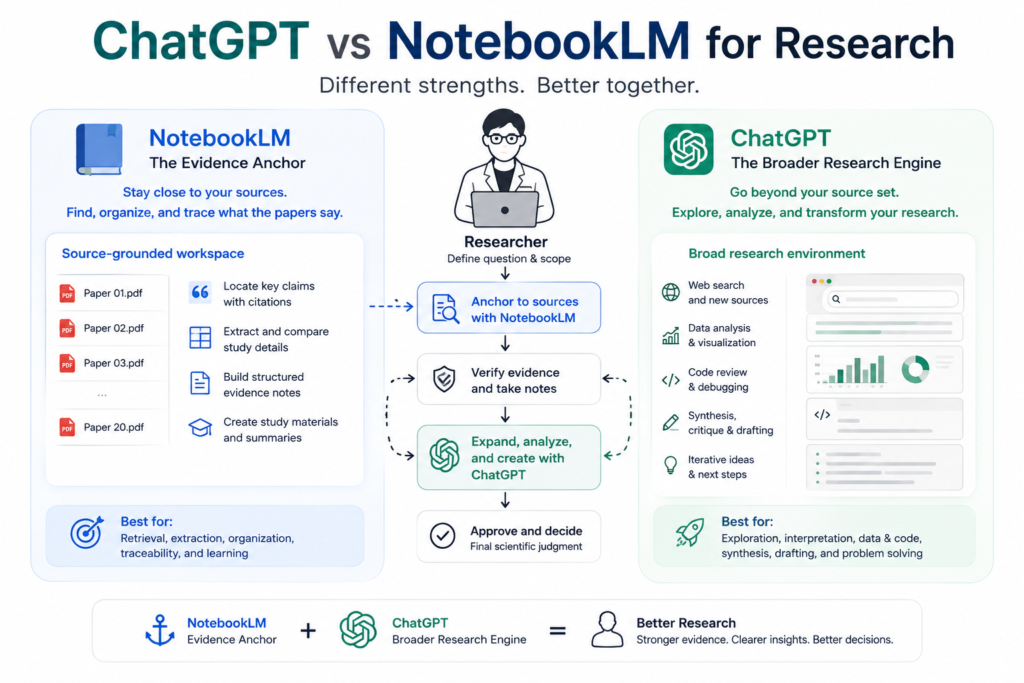
ChatGPT and NotebookLM can both help researchers work with papers.
They do not solve the same problem.
NotebookLM is strongest when the source set is already defined. It helps you locate evidence, compare selected documents, and keep answers connected to the materials in your notebook.
ChatGPT is more useful when the project needs to move beyond that source set—through current web research, broader exploration, data analysis, coding, critique, synthesis, or drafting.
The practical distinction is:
NotebookLM is the evidence anchor. ChatGPT is the broader research engine.
NotebookLM keeps the project connected to selected evidence.
ChatGPT helps explore, analyze, and transform the work around that evidence.
The researcher remains the verifier and decision-maker.
Contents
- The Best Combined Workflow
- The Real Difference: A Defined Notebook or a Broader Research Environment
- Grounding, Retrieval, Interpretation, and Creation
- Finding Current and Broader Research
- Reading One Research Paper / Comparing Multiple Papers
- Literature Reviews and Research Gaps
- Scientific Writing
- Data Analysis and Code
- Studying and Journal Club
- Where Each Tool Can Fail
- Privacy, Citations, and Verification
- Which One Should You Choose?
The Short Answer
| Research task | Better starting tool | Why |
|---|---|---|
| Locate a claim in selected sources | NotebookLM | Source-linked retrieval |
| Study a fixed paper collection | NotebookLM | Notebook-centered organization |
| Build preliminary evidence notes | NotebookLM | Easier passage-level traceability |
| Create source-based study materials | NotebookLM | Grounded review formats |
| Explore a broad or current topic | ChatGPT | Wider research workflow |
| Find additional search terms or sources | ChatGPT | Broader exploration |
| Analyze spreadsheets or structured data | ChatGPT | More flexible analysis tools |
| Review code | ChatGPT | Coding and reasoning support |
| Explain conflicting studies | ChatGPT | Open-ended synthesis |
| Draft from verified notes | ChatGPT | Stronger transformation workflow |
| Establish a field-wide research gap | Neither alone | Requires broader, reproducible searching |
| Make the final scientific conclusion | Neither alone | Requires researcher judgment |
The simplest summary is:
NotebookLM is the evidence anchor. ChatGPT is the broader research engine. The researcher remains the verifier and decision-maker.
That does not make one tool universally better.
It means the right choice depends on the stage of the project.
The Best Combined Workflow
You do not need to choose one tool for the entire project.
A stronger workflow separates grounding, expansion, and judgment:
NotebookLM
Anchor the project to selected evidence
          ↓
Researcher
Verify the sources and extracted claims
          ↓
ChatGPT
Explore, analyze, critique, code, or draft
          ↓
Researcher
Approve the final scientific conclusion
This sequence matters.
If ChatGPT begins interpreting before the evidence has been checked, it may build a polished explanation around an incorrect extraction.
If NotebookLM is treated as a complete representation of the field, an incomplete notebook may be mistaken for a complete literature review.
Facts first. Interpretation second.
A 30-Second Example
Imagine that you have 20 papers on whether autophagy promotes or suppresses tumour growth.
The literature appears contradictory.
Some papers report that autophagy supports tumour-cell survival.
Others suggest that it limits tumour development.
NotebookLM can act as the evidence anchor by helping you extract:
- cancer type;
- disease stage;
- experimental model;
- autophagy manipulation;
- measured marker;
- endpoint;
- direct result;
- limitation;
- supporting passage.
After you verify that table, ChatGPT can act as the broader research engine by helping you ask:
Are these findings truly contradictory, or do they reflect differences in disease stage, model, intervention, and endpoint?
You may discover that some studies measured LC3 abundance, others measured autophagic flux, and others measured tumour growth or cell survival.
Those measurements are related.
They are not equivalent.
This is the core division of labour:
NotebookLM anchors the project to what the papers reported. ChatGPT helps analyze how those verified findings relate to one another.
The Real Difference: A Defined Notebook or a Broader Research Environment
NotebookLM as the Evidence Anchor
NotebookLM is organized around materials selected by the user.
These may include:
- research papers;
- reports;
- notes;
- websites;
- transcripts;
- other supported documents.
This makes it useful when the main question is:
What do these sources say?
Its strongest use cases include:
- locating a passage;
- reviewing a fixed reading list;
- comparing predefined variables;
- creating source-linked notes;
- preparing learning materials.
Its main advantage is traceability.
Its main limitation is equally important:
A well-organized notebook can still contain an incomplete source set.
NotebookLM can anchor a project to the sources you selected.
It cannot guarantee that those sources represent the entire field.
ChatGPT as the Broader Research Engine
ChatGPT can also work with supplied files, but it supports a wider range of research tasks.
It may help with:
- current web research;
- terminology expansion;
- document comparison;
- spreadsheet analysis;
- coding;
- visualization;
- critique;
- synthesis;
- drafting;
- iterative troubleshooting.
This makes it useful when the question changes from:
What do these documents say?
to:
What other evidence matters, how should these findings be analyzed, and what should I do next?
Its flexibility is the advantage.
It is also the risk.
The farther the task moves beyond a defined source set, the easier it becomes to mix sources, introduce unsupported explanations, or make the answer sound more settled than the evidence allows.
Grounding, Retrieval, Interpretation, and Creation
Research tasks become safer when these stages remain separate.
| Stage | Core question | Better starting point |
|---|---|---|
| Grounding | Which sources define the project? | NotebookLM |
| Retrieval | Where does a source say this? | NotebookLM |
| Extraction | What did each study report? | NotebookLM |
| Verification | Does the output match the source? | Researcher |
| Expansion | What other sources or context matter? | ChatGPT |
| Interpretation | Why might the findings differ? | ChatGPT |
| Creation | How can verified evidence become a draft or analysis? | ChatGPT |
| Final judgment | What does the evidence justify? | Researcher |
Suppose one prompt asks an AI tool to:
- search for papers;
- summarize them;
- explain disagreement;
- identify a research gap;
- draft a Discussion section.
If the final result is wrong, it becomes difficult to locate the error.
Was the search incomplete?
Was the extraction incorrect?
Was the explanation unsupported?
Did the writing stage strengthen the conclusion?
A safer sequence is:
Ground
  ↓
Extract
  ↓
Verify
  ↓
Expand
  ↓
Interpret
  ↓
Create
Do not interpret evidence that has not yet been verified.
Facts first. Interpretation second.
Finding Current and Broader Research
This is where ChatGPT differs most clearly from a closed, source-centered workspace.
Use ChatGPT When the Source Set Does Not Yet Exist
ChatGPT may be a useful starting point when you need to explore:
- recent studies;
- current policies or guidelines;
- unfamiliar terminology;
- adjacent fields;
- broader search concepts;
- possible databases or source types;
- new developments outside your existing collection.
For example, a research question about tumour metabolism may also require terminology related to:
- nutrient stress;
- metabolic plasticity;
- oxidative phosphorylation;
- glycolytic adaptation;
- tumour microenvironment;
- metabolic competition.
ChatGPT can help reveal that vocabulary before you begin a formal database search.
A useful request is:
Generate search concepts for this topic. Separate direct synonyms, broader terms, model-specific terminology, outcome terms, and adjacent concepts. Do not generate references yet.
Use Scholarly Databases for the Reproducible Search
After expanding the terminology, use the appropriate scholarly databases to run and document the search.
Depending on the field, these may include:
- PubMed;
- Web of Science;
- Scopus;
- discipline-specific databases.
Preserve:
- database names;
- search dates;
- exact search strings;
- filters;
- screening decisions;
- inclusion criteria.
Use NotebookLM After Selecting the Sources
Once the relevant papers have been chosen, NotebookLM becomes the evidence anchor for:
- organizing the collection;
- locating passages;
- comparing predefined fields;
- revisiting the same materials;
- maintaining source-linked notes.
The workflow becomes:
ChatGPT
Expand the topic and terminology
          ↓
Scholarly databases
Run and document the search
          ↓
NotebookLM
Anchor the selected source set
ChatGPT can assist exploration.
NotebookLM can organize the selected evidence.
Neither replaces a reproducible scholarly search.
Search convenience is not search completeness.
Reading One Research Paper
Use NotebookLM When Navigation Is the Problem
NotebookLM is a strong starting point when:
- the paper is long;
- exact passages matter;
- citation traceability is important;
- you want structured notes;
- the document will be revisited repeatedly.
A useful request is:
Using only this paper, identify the research question, model, intervention, control, primary endpoint, direct findings, and stated limitations. Cite the relevant passage for each item. Write “Not reported” when information is missing.
This creates a map of the paper.
It does not replace the paper itself.
Use ChatGPT When the Logic Is the Problem
Once the factual structure is clear, ChatGPT can help examine:
- why each experiment was performed;
- which result most directly supports the conclusion;
- which result is indirect;
- what alternative explanation remains;
- whether the Discussion goes beyond the Results.
A useful request is:
Explain how each experiment contributes to the main conclusion. Separate direct evidence, author interpretation, and mechanisms that remain unproven.
Neither tool should replace:
- reading the figure legend;
- checking exact values;
- examining the Methods;
- evaluating the controls;
- reading the limitations directly.
A summary helps you navigate a paper.
It is not the paper.
Comparing Multiple Papers
The first goal is not to explain why papers disagree.
It is to determine whether they tested comparable questions.
Anchor the Comparison to Consistent Fields
Use the same fields for every paper:
- population or model;
- intervention;
- dose;
- timing;
- control;
- endpoint;
- assay;
- direct result;
- stated interpretation;
- limitation.
NotebookLM can help create a preliminary comparison table from a selected paper set.
Every important row should still be checked in the original source.
Interpret Only After Verification
Once the table is reliable, ChatGPT can help examine whether the apparent disagreement reflects:
- different species;
- different cell types;
- different disease stages;
- different doses;
- different time points;
- different assays;
- different analytical methods;
- different biological measurement levels.
A useful request is:
Using only the verified table, list the factual design and measurement differences first. Then suggest possible explanations. Label every explanation not directly supported by the sources as “Hypothesis.”
The correct sequence is:
Define comparison fields
          ↓
Extract consistently
          ↓
Verify every row
          ↓
Compare designs and endpoints
          ↓
Interpret disagreement
Facts first. Mechanisms second.
Literature Reviews and Research Gaps
Both tools can support a literature review.
Neither can replace the methodology required for one.
NotebookLM Anchors the Selected Collection
It may assist with:
- organizing included papers;
- finding relevant passages;
- producing preliminary evidence notes;
- comparing predefined variables;
- reviewing a bounded source set.
ChatGPT Expands and Transforms the Project
It may assist with:
- expanding search terminology;
- identifying adjacent concepts;
- exploring additional sources;
- grouping verified findings;
- testing the logic of a synthesis;
- drafting from an evidence table.
What Neither Tool Can Do Alone
A formal review may still require:
- appropriate database selection;
- reproducible search strings;
- inclusion and exclusion criteria;
- deduplication;
- documented screening;
- quality assessment;
- transparent synthesis.
Uploading a folder of papers does not create a complete review of the field.
Be Careful With Research Gaps
If no paper in the notebook addresses a particular mechanism, you may say:
This mechanism was not examined in the reviewed source set.
You cannot automatically say:
No studies have examined this mechanism.
NotebookLM may reveal a gap in the selected collection.
ChatGPT may help convert that observation into a candidate research question.
Neither establishes novelty without broader searching and expert judgment.
Scientific Writing
Scientific writing is safer when evidence collection and prose generation remain separate.
Anchor the Draft to Verified Evidence
NotebookLM can help collect:
- source-linked findings;
- supporting passages;
- paper-specific limitations;
- citation notes;
- structured comparisons.
The purpose is to keep claims connected to evidence before drafting begins.
Use ChatGPT as the Research Engine for Transformation
ChatGPT is more naturally suited to:
- outlining;
- drafting from verified notes;
- restructuring paragraphs;
- improving transitions;
- revising tone;
- preparing reviewer responses.
A safer workflow is:
NotebookLM
Anchor the draft to selected evidence
          ↓
Researcher
Verify every claim and citation
          ↓
ChatGPT
Transform verified evidence into prose
          ↓
Researcher
Check meaning, certainty, and references
After drafting, ask:
- Did certainty increase?
- Did association become causation?
- Was a limitation removed?
- Was a mechanism added?
- Does each citation support the full sentence?
- Did a narrow result become a broad conclusion?
Good scientific writing makes evidence clearer.
It should not make evidence sound stronger.
Data Analysis and Code
This is one of ChatGPT’s clearest advantages in a research workflow.
ChatGPT may help with:
- spreadsheet inspection;
- data cleaning;
- exploratory analysis;
- visualization;
- code review;
- preprocessing checks;
- reproducibility audits;
- analysis documentation.
A useful first request is:
Review this analysis for possible errors, hidden assumptions, and reproducibility risks. Do not rewrite it yet. Explain what should be checked manually.
The important phrase is:
Do not rewrite it yet.
Finding the problem should come before changing the code.
NotebookLM is more useful when the task remains documentation-centered, such as organizing:
- software manuals;
- protocols;
- standard operating procedures;
- analysis plans;
- code documentation.
Use NotebookLM when the question is:
What do these documents say I should do?
Use ChatGPT when the question is:
What might be wrong with this analysis, and how can I test it?
Neither tool should independently establish statistical validity.
The design, assumptions, and final analysis still require expert review.
Studying and Journal Club
NotebookLM may help create:
- summaries;
- glossaries;
- review questions;
- flashcards;
- topic maps;
- audio or presentation-style materials.
These formats are useful for orientation and revision.
They are less reliable for checking:
- exact values;
- Methods;
- figure details;
- statistical assumptions;
- subtle uncertainty.
The more compressed the output, the more important it is to return to the source.
ChatGPT is more useful for critical discussion:
- Which control is missing?
- Which experiment is most decisive?
- What alternative interpretation remains?
- Does the paper demonstrate mechanism or association?
- Is the Discussion broader than the Results?
A practical division is:
Ask NotebookLM:
What did the authors report, and where is the evidence?
Ask ChatGPT:
What does the evidence not establish?
The researcher remains the verifier and decision-maker.
Where Each Tool Can Fail
NotebookLM Can Fail Even When Citations Are Present
It may:
- omit context;
- misread a passage;
- combine findings;
- overstate a citation;
- misunderstand a figure or table.
A citation makes an answer easier to inspect.
It does not make the answer automatically correct.
The notebook itself may also be:
- selective;
- outdated;
- incomplete;
- duplicated;
- biased toward one subfield.
A well-organized collection is not necessarily a representative collection.
The evidence anchor is only as strong as the sources attached to it.
ChatGPT Can Let Reasoning Outrun the Evidence
It may generate:
- unsupported mechanisms;
- overly broad conclusions;
- plausible but unverified explanations;
- confident synthesis from incomplete sources;
- polished language that hides merging errors.
State the source boundary explicitly.
Useful labels include:
- Directly supported
- Author interpretation
- Model-generated hypothesis
- Not reported
- Requires verification
The danger is not only that an answer may be wrong.
It may sound finished before the question has been resolved.
A broader research engine still needs clear boundaries.
Privacy, Citations, and Verification
Verify Important Citations
For each major claim:
- Open the source.
- Locate the supporting passage.
- Check the conditions and context.
- Verify numbers and terminology.
- Confirm that the citation supports the entire statement.
A citation may support one clause without supporting the conclusion of the sentence.
Protect Confidential Material
Take particular care with:
- unpublished manuscripts;
- peer-review documents;
- patient information;
- grant applications;
- proprietary datasets;
- patent-related work.
The ability to upload a file does not mean you have permission to upload it.
Recheck Current Product Claims
Features that may change include:
- product names;
- model access;
- file limits;
- search modes;
- research tools;
- connected apps;
- study outputs;
- data-analysis functions;
- pricing.
Which One Should You Choose?
Choose NotebookLM When:
- your source set is already defined;
- exact traceability matters;
- you need to locate passages;
- you are studying a fixed collection;
- you want source-based notes or learning materials.
Choose ChatGPT When:
- the task requires broader or current research;
- you need data or code analysis;
- verified notes need to become a draft;
- you want critique or synthesis;
- the project requires frequent task switching.
Use Both When:
- a project begins with a defined paper set;
- source-linked evidence must become a report or manuscript;
- retrieval and reasoning need separate checkpoints;
- you want to reduce source mixing.
Use Neither Alone When:
- literature coverage must be exhaustive;
- exact statistical validation is required;
- sensitive material cannot be uploaded;
- the decision is clinically or scientifically high stakes;
- specialist judgment is essential.
The most useful summary is:
NotebookLM is the evidence anchor. ChatGPT is the broader research engine. The researcher remains the verifier and decision-maker.
Frequently Asked Questions
Is ChatGPT or NotebookLM Better for Research?
NotebookLM is usually better for organizing and locating information within a defined source set. ChatGPT is usually better for broader research, interpretation, coding, data analysis, and drafting.
Is NotebookLM More Accurate Than ChatGPT?
There is no universal answer. NotebookLM may offer stronger traceability for source-based questions, while ChatGPT may be more useful for open-ended analysis. Both can make errors.
Which Is Better for Reading and Comparing Papers?
NotebookLM is useful for locating passages and creating consistent extraction tables. ChatGPT is useful after the evidence has been verified and requires interpretation.
Which Is Better for Literature Reviews?
Both can support parts of the process. Neither replaces a reproducible search strategy, screening process, quality assessment, and manual synthesis.
Which Is Better for Current Research Topics?
ChatGPT is generally the more natural starting point for broader or time-sensitive exploration. Important searches should still be reproduced in appropriate scholarly databases.
Which Is Better for Scientific Writing?
NotebookLM can help anchor the draft to source-supported notes. ChatGPT is generally better suited to outlining, drafting, and restructuring verified material.
Which Is Better for Code and Data Analysis?
ChatGPT is generally more suitable for active analysis and code review. NotebookLM is more useful for organizing documentation, protocols, and manuals.
Can Either Tool Identify a Research Gap?
They may identify gaps within a supplied source set. Neither can establish a field-wide gap without broader searching and expert judgment.
Can NotebookLM Hallucinate?
Yes. It may omit, merge, misread, or overstate source content. Citations improve traceability but do not guarantee accuracy.
Can ChatGPT Use Only Uploaded Files?
It can be instructed to do so. The source boundary should be explicit, and important claims still require verification.
Should I Use Both Tools Together?
Yes, when their roles are separated clearly:
- NotebookLM as the evidence anchor;
- ChatGPT as the broader research engine;
- the researcher as the verifier and decision-maker.
Can I Upload Unpublished Research?
Do not assume that uploading is permitted. Check institutional policies, collaborator agreements, consent requirements, confidentiality obligations, and current product terms.
Key Takeaways
NotebookLM is strongest when a project must remain close to a defined source set.
ChatGPT is strongest when verified evidence needs to be expanded, analyzed, critiqued, coded, or transformed.
Citations improve traceability but do not guarantee accuracy.
Broader reasoning is useful only when facts, interpretations, and hypotheses remain separate.
Neither tool replaces comprehensive searching, direct source checking, or scientific judgment.
Facts first. Interpretation second.
And remember:
NotebookLM is the evidence anchor. ChatGPT is the broader research engine. The researcher remains the verifier and decision-maker.
Continue Learning
AI Tool Comparisons
- Claude vs NotebookLM for Research
- Claude vs ChatGPT for Research
- Claude vs Gemini for Scientific Writing
- Best AI Tools for Researchers